Gold’s record run and reversal: central banks, sanctions and a 30% fall
Gold more than doubled in two years, peaking near $5,600 an ounce in January 2026 as central banks bought at a pace not seen in decades. Since then it has lost about 30%. What drove the rally, who was buying, and what has changed.
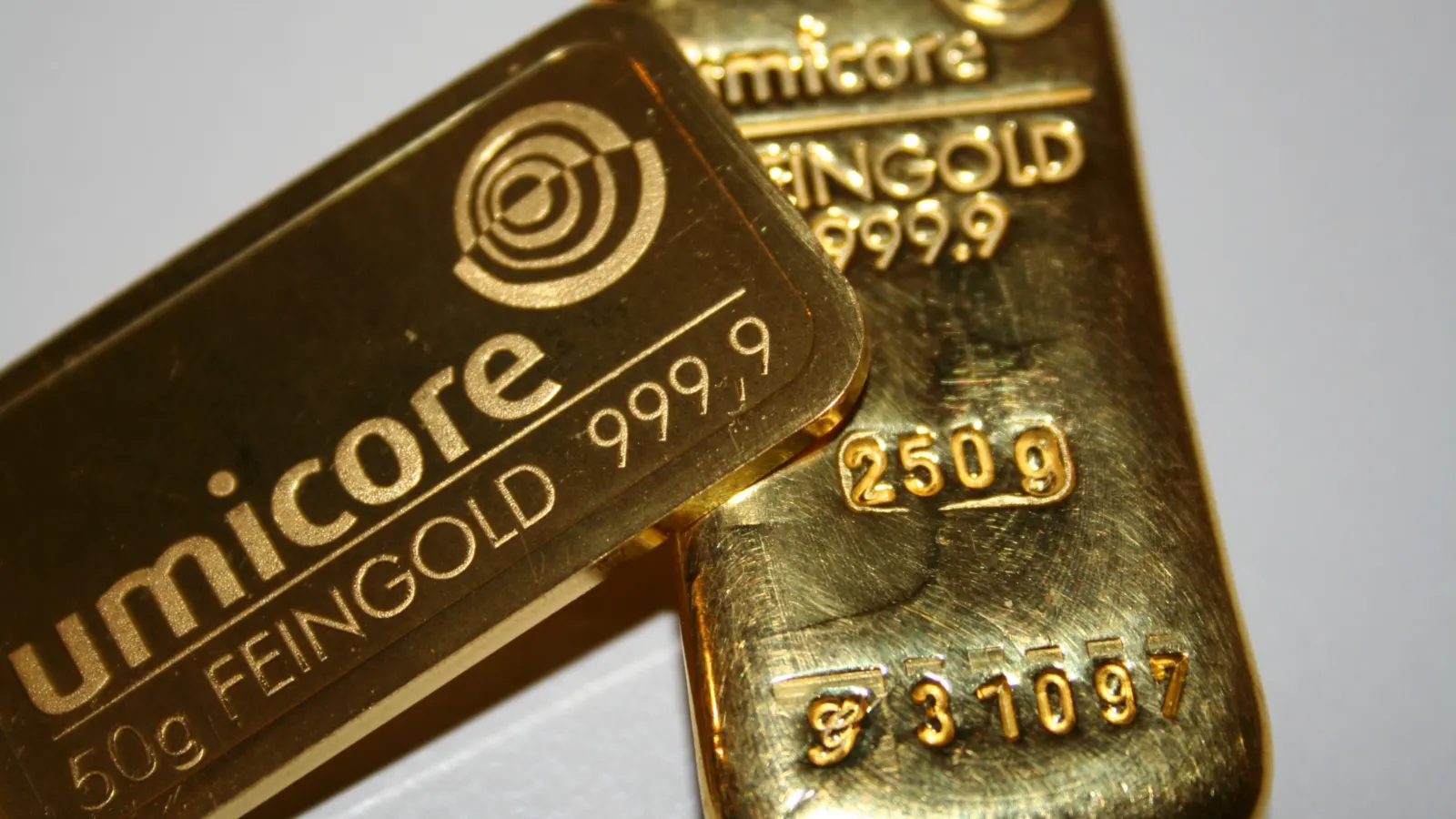
LONDON On 29 January 2026 spot gold touched $5,594.82 an ounce, an all-time high. It had hit new highs in nine straight sessions and was up 28% for the month 1. Fifteen months earlier, on the eve of the 2024 US presidential election, it had set what was then a record of $2,790.15 2.
By 12 November 2026 it had fallen to $3,852.14 at one point, its lowest since October 2025 and about 31% below the January peak 3.
The climb
Gold rose about 27% in 2024 4. It crossed $3,000 for the first time on 14 March 2025, as Reuters cited President Trump’s tariff war, a stock-market selloff and central banks diversifying away from the dollar 5. It passed $4,000 on 8 October 2025, up about 54% for the year 4, and then hit $4,381.52 on 20 October before falling as much as 6.3% the next day, its steepest one-day drop in 12 years, according to Bloomberg 6. “Corrections reveal a market’s genuine strength,” said Ole Hansen of Saxo Bank 6.
It topped $5,000 for the first time on 26 January 2026, according to AFP 7. “Gold’s perfect storm continues with U.S.-Iran geopolitical tensions, a weak dollar and market expectations of more Fed rate cuts,” Jamie Dutta of Nemo.money told Reuters on the day of the record 1.
The buyers
Behind the rally sat the world’s central banks. According to the World Gold Council (WGC), the industry body that tracks gold demand, central banks bought more than 1,000 tonnes a year in 2022, 2023 and 2024, against an average of 473 tonnes a year in 2010–2021 89. Purchases eased to 863 tonnes in 2025 9. Poland’s central bank was the largest buyer in both 2024 and 2025, adding 90 and then 102 tonnes; Turkey, India and China were also among the biggest buyers in 2024, and Kazakhstan, Brazil and Azerbaijan’s state oil fund in 2025 89.
Buying picked up again in 2026. Central banks added a net 321 tonnes in the third quarter, the most since the end of 2024, taking the year’s total to 675 tonnes, 6% ahead of 2025; China (63 tonnes) and Poland (40 tonnes) led reported purchases, while Russia’s 19-tonne fall was the only sizeable sale 10. The WGC notes that about 63% of the quarter’s buying was not reported at country level 10.
Why are they buying? The European Central Bank (ECB) has found that “imposing financial sanctions is associated with increases in the share of central bank reserves held in gold”: countries sanctioned in the same or the previous year account for five of the ten largest annual increases in gold’s share of reserves since 1999, and central-bank demand jumped after Russia’s full-scale invasion of Ukraine in 2022 11. In the WGC’s 2025 survey of central banks, 73% expected the US dollar’s share of global reserves to be moderately or significantly lower within five years 12. By the end of 2025, at market prices, gold made up 27% of official reserves worldwide, more than the euro’s 15% and US Treasuries’ 22%, the ECB said, largely because of the price rise 13.
Investors followed. Gold exchange-traded funds took in a net 801 tonnes in 2025, helping push total gold demand to a record 5,002 tonnes 14.
Milestones
-
Record of $2,790.15 ahead of the US election.
-
Key moment. Gold tops $3,000 for the first time.
-
Gold passes $4,000.
-
Biggest one-day fall in 12 years after a record $4,381.52.
-
Gold tops $5,000.
-
Key moment. All-time high of $5,594.82.
-
Spot falls about 9% after Kevin Warsh is confirmed as Fed chair nominee.
-
Biggest quarterly fall in a decade.
-
Key moment. Session low of $3,852.14, lowest since October 2025.
The reversal
The fall began within hours of the record. On 30 January spot gold dropped about 9%, to just under $4,900, after Trump confirmed Kevin Warsh as his nominee to chair the Federal Reserve, which eased concerns about political pressure on the central bank; the dollar rose and speculators took profits 15. “We’re seeing aggressive selling after gold hit new all-time highs,” said David Meger of High Ridge Futures 16.
The second quarter of 2026 brought gold’s biggest quarterly decline in a decade. The WGC linked it to the war in Iran: an energy shock and inflation fears pushed central banks towards tighter policy and lifted US interest-rate expectations and bond yields 17. By November, traders were pricing an 87% chance that the Federal Reserve would raise rates in December, after a stronger-than-expected inflation reading and higher oil prices 3. “Higher energy prices continue to warrant a hawkish Fed,” Meger said, “and a hawkish Fed is an environment of higher interest rates and hence a headwind for the yellow metal” 3.
Who pays
High prices hit the jewellery trade hardest. Jewellery demand fell 18% by volume in 2025 14, and in the third quarter of 2026 it fell another 17%, to 313 tonnes, the weakest third quarter in the WGC’s data back to 2000; India and China each fell by about a fifth 18. Miners, by contrast, raised output to a record 3,672 tonnes in 2025, though their all-in sustaining costs also reached a record $1,930 an ounce in the second quarter of 2026 19. Several producing countries, including Kazakhstan, Uzbekistan and Ghana, were themselves central-bank buyers, which the WGC links to domestic gold markets and local purchasing programmes 10.
Why it matters
The rally was driven less by jewellery buyers than by states and investors. Central banks have spent four years adding gold to their reserves at roughly twice the pace of the previous decade, and the ECB’s research links part of that shift to the risk of sanctions. The 2026 reversal shows the limits of that support: when US interest-rate expectations turned, prices fell by almost a third even as central banks kept buying. For reserve managers, gold’s appeal is that no other government controls it; for investors, its price still moves with the Federal Reserve.
Sources and references
- ArticleReuters (via Kitco), “Gold nears $5,600 as safe-haven rush intensifies; silver blazes past $120”, 29 January 2026. Link
- ArticleReuters (via Kitco), “US election anxieties push gold towards its best month in seven”, 31 October 2024. Link
- ArticleThe Nation (Thailand), “Global gold drops 3% to over one-year low on November 12”, 13 November 2026. Link
- ArticleReuters (via Kitco), “Gold zooms past $4,000 for first time in historic flight to safety”, 8 October 2025. Link
- ArticleReuters (via Kitco), “Gold pops above $3,000/oz for first time in historic safe-haven rally”, 14 March 2025. Link
- ArticleMiningMX (Bloomberg), “Gold falls most in 12 years after record run”, 21 October 2025. Link
- ArticleAFP (via Naharnet), “Gold tops $5,000 for first time on Trump policy unrest”, 26 January 2026. Link
- ReportWorld Gold Council, “Gold Demand Trends Full Year 2024: Central banks”, 5 February 2025. Link
- ReportWorld Gold Council, “Gold Demand Trends Full Year 2025: Central banks”, 29 January 2026. Link
- ReportWorld Gold Council, “Gold Demand Trends Q3 2026: Central banks”, 3 November 2026. Link
- Official documentEuropean Central Bank, “Gold demand: the role of the official sector and geopolitics”, June 2025. Link
- ReportWorld Gold Council, “Central Bank Gold Reserves Survey 2025”, 17 June 2025. Link
- Official documentEuropean Central Bank, “The international role of the euro, June 2026”, June 2026. Link
- ReportWorld Gold Council, “Gold investment rockets in 2025, setting a new high as uncertainty bites”, 29 January 2026. Link
- ArticleCoinWeek, “CoinWeek Bullion Report: Gold and silver suffer historic selloff as dollar surges”, 31 January 2026. Link
- ArticleThe Nation (Thailand), “Global gold prices drop as investors cash in after surge”, 30 January 2026. Link
- ArticleKitco News, “Gold demand proves resilient despite Q2 selloff as central banks return”, 30 July 2026. Link
- ReportWorld Gold Council, “Gold Demand Trends Q3 2026: Jewellery”, 3 November 2026. Link
- ReportWorld Gold Council, “Gold Demand Trends Q3 2026: Supply”, 3 November 2026. Link
Sources and references are provided for transparency and further reading. Allegations and claims are attributed to their respective sources. Triple Frontiers distinguishes reported allegations from independently established facts.
The Frontier Brief
The week’s essential international reporting and new investigations, every Friday.