From ‘Liberation Day’ to the Supreme Court: how Trump’s tariffs reshaped world trade
On 2 April 2025 the US put a tariff on almost every country on earth. Ten months later the Supreme Court ruled the legal basis unlawful, and refunds of around $166 billion began. Replacement tariffs are now in force, and trade has been rerouted rather than stopped.
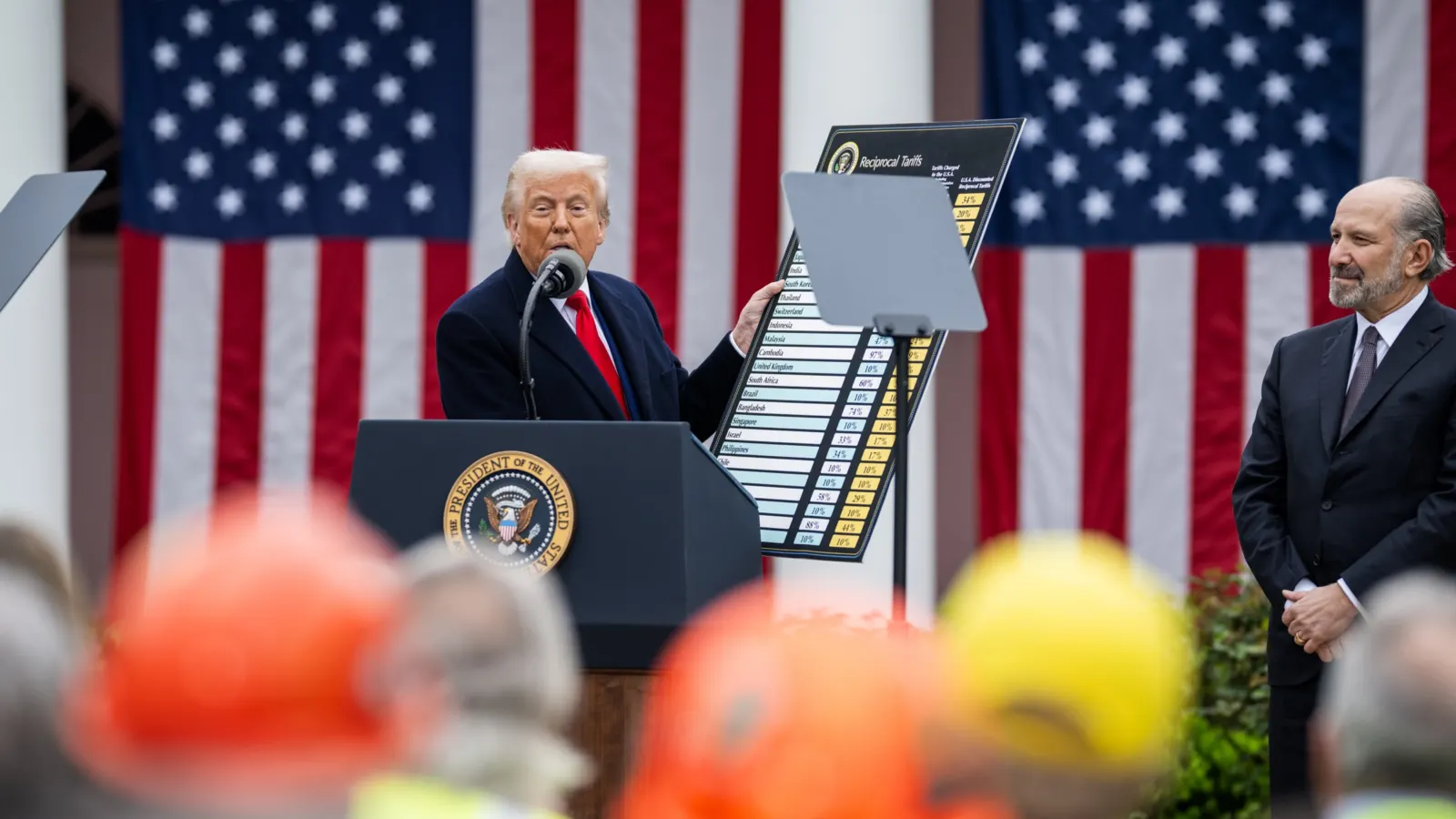
WASHINGTON On 2 April 2025, in the White House Rose Garden, President Donald Trump held up a chart of tariff rates and declared a national emergency. Under the International Emergency Economic Powers Act (IEEPA), he imposed a 10% tariff on imports from nearly every country from 5 April, with higher “reciprocal” rates from 9 April on the countries with which the US ran the largest trade deficits 118. “Access to the American market is a privilege, not a right,” the White House said 1.
The announced rates included 34% on China, 20% on the European Union, 46% on Vietnam, 26% on India, 24% on Japan and 49% on Cambodia 31. The highest, 50%, fell on Lesotho, a small southern African kingdom whose textile industry employed about 40,000 people; its officials said they could not explain the 99% tariff the US claimed Lesotho charged 3135.
Shock, pause and deals
Markets fell hard. The Dow Jones dropped nearly 1,700 points, about 4%, on 3 April, and US stocks lost more than 12% over four sessions, the steepest four-day fall since the pandemic 33. China retaliated with a 34% tariff on all US goods 33.
On 9 April the administration suspended the higher country rates for 90 days for every partner except China, whose rate rose to 125% 2. The S&P 500 rose 9.5% that day, its biggest one-day gain since October 2008 34. A month later, in Geneva, Washington and Beijing agreed to cut their additional tariffs for 90 days 3.
A series of bilateral deals followed. The UK kept a 10% rate and a quota of 100,000 cars a year at 10% 4. On 31 July a new order re-set rates from 7 August: 39% for Switzerland, 25% for India, 20% for Vietnam and Taiwan, 19% for much of South-East Asia, 15% for Japan and South Korea, and a 15% all-in formula for the EU, with a 40% penalty on goods judged to have been transshipped to dodge duties 56. The EU agreed a framework under which it said it intended to remove tariffs on US industrial goods and buy about $750 billion of US energy 10; Japan agreed to a 15% baseline and $550 billion of investment in US projects 11.
Some partners were singled out on other grounds. Brazil faced an extra 40%, a total of 50%, under a separate emergency order citing the prosecution of former president Jair Bolsonaro 7. India’s rate was doubled to 50% in August over its purchases of Russian oil, which New Delhi called “unfair, unjustified, and unreasonable” 936. In February 2026 Trump announced the rate on India would fall to 18% after India agreed to stop buying Russian oil 37. A November 2025 deal with China cut fentanyl-related tariffs, kept the higher reciprocal rate suspended until 10 November 2026, and secured Chinese commitments on rare-earth exports and soybean purchases 12.
How it unfolded
-
Key moment. Trump declares an emergency and announces a 10% baseline tariff and higher ‘reciprocal’ rates.
-
Higher rates paused for 90 days for all but China, raised to 125%.
-
US and China agree a 90-day reduction in Geneva.
-
Court of International Trade rules the tariffs unlawful.
-
Re-set reciprocal rates take effect.
-
Federal Circuit affirms 7–4; tariffs stay in place pending appeal.
-
Key moment. Supreme Court rules 6–3 that IEEPA does not authorise tariffs.
-
IEEPA collection ends; a 10% Section 122 surcharge begins.
-
Key moment. Section 122 surcharge expires; Section 301 ‘forced labour’ tariffs on 60 economies take effect.
The courts
Importers and states challenged the tariffs from the start. On 28 May 2025 the US Court of International Trade ruled that IEEPA did not authorise them 16. On 29 August the Federal Circuit, sitting en banc, agreed by 7 votes to 4, calling the tariffs “unbounded in scope, amount, and duration”, but left them in force while the government appealed 1724.
On 20 February 2026 the Supreme Court ruled 6–3 in Learning Resources, Inc. v. Trump that IEEPA does not authorise the president to impose tariffs. “We claim no special competence in matters of economics or foreign affairs,” Chief Justice John Roberts wrote. “We claim only, as we must, the limited role assigned to us by Article III of the Constitution” 18. Justice Brett Kavanaugh, joined by Justices Clarence Thomas and Samuel Alito, dissented: “In essence, the Court today concludes that the President checked the wrong statutory box by relying on IEEPA rather than another statute to impose these tariffs” 18.
Collection of the IEEPA tariffs stopped on 24 February 28. According to a customs declaration cited in court, about $166 billion had been collected on more than 53 million entries from over 330,000 importers 25. Refunds have been flowing since spring through a customs portal and court orders, though the government has appealed parts of the refund rulings 2527.
The replacements
The administration moved immediately to rebuild the wall on a different legal footing. On the day of the ruling Trump imposed a 10% import surcharge for 150 days under Section 122 of the Trade Act of 1974, effective from 24 February 13. In May the Court of International Trade held that surcharge unlawful too, but limited its order to the plaintiffs; the surcharge expired on 24 July 2629.
The day before it lapsed, the US Trade Representative imposed tariffs under Section 301 on 60 economies for failing to ban imports made with forced labour: 10% on 17 of them, including India, Mexico, Canada and the UK, and 12.5% on others including China, Vietnam, Brazil and Thailand 1430. “President Trump recognizes that decades of moral suasion have not eradicated forced labor from global supply chains,” said Trade Representative Jamieson Greer 14. Those tariffs remain in force.
What it did to trade
The tariffs raised a lot of money, for a while. Net US customs receipts were $194.9 billion in the 2025 fiscal year, against $77.0 billion the year before. In fiscal 2026 gross receipts reached $317.8 billion, but $144.6 billion was refunded, leaving $173.2 billion 15.
World trade did not collapse. The WTO estimates the volume of merchandise trade grew 4.2% in 2025, and in October 2026 it raised its forecast for 2026 to 3.9%, driven mainly by AI-related goods, which made up 47% of trade growth by value in the first half of the year 1920. North American imports fell 3.2% in that half-year, largely because buyers had stocked up ahead of the 2025 tariffs 19. The IMF, which put the US effective tariff rate at about 19% in October 2025, said the hit to global growth had been at the modest end of its range 21; it now projects global growth of 3.1% in 2026 22. Economists at the Minneapolis Fed say the effective US tariff rate remains more than double its pre-2025 level, and attribute the economy’s resilience largely to AI-related investment 23.
Trade was redirected rather than reduced. China’s exports to the US fell 20% in 2025, yet it posted a record trade surplus of about $1.19 trillion as exports to Africa rose 25.8% and to South-East Asia 13.4% 3839. Vietnam’s exports to the US rose 28% to $126 billion in the first ten months of 2025, according to Vietnamese customs 40, and Bangladesh’s garment exports to the US rose 11.75% 41. At the other end, Lesotho declared a national state of disaster in July 2025 over youth unemployment and job losses linked to tariff uncertainty 35.
Why it matters
The 2025 tariffs were, in the Minneapolis Fed’s words, the largest increase in US tariffs since the Great Depression 23. They were imposed by emergency decree and struck down by the country’s highest court. The ruling settled who can levy tariffs under that law, but not whether the US will keep them: replacement duties under other statutes are in force, the deals struck under the old ones are of uncertain standing, and the truce that kept higher rates on China suspended ran only to 10 November 2026 12. For exporters from Hanoi to Maseru, the lesson of the past 19 months is that access to the American market can change overnight, and that trade finds other routes when it does.
Sources and references
- Official documentThe White House, “Fact Sheet: President Donald J. Trump Declares National Emergency to Increase our Competitive Edge, Protect our Sovereignty, and Strengthen our National and Economic Security”, 2 April 2025. Link
- Official documentThe White House, “Modifying Reciprocal Tariff Rates to Reflect Trading Partner Retaliation and Alignment” (Executive Order 14266), 9 April 2025. Link
- Official documentThe White House, “Joint Statement on U.S.-China Economic and Trade Meeting in Geneva”, 12 May 2025. Link
- Official documentThe White House, “Fact Sheet: U.S.-UK Reach Historic Trade Deal”, 8 May 2025. Link
- Official documentThe White House, “Further Modifying the Reciprocal Tariff Rates”, 31 July 2025. Link
- Official documentThe White House, “Fact Sheet: President Donald J. Trump Further Modifies the Reciprocal Tariff Rates”, 31 July 2025. Link
- Official documentThe White House, “Fact Sheet: President Donald J. Trump Addresses Threats to the United States from the Government of Brazil”, 30 July 2025. Link
- Official documentThe White House, “Modifying the Scope of Tariffs on the Government of Brazil”, 20 November 2025. Link
- Official documentThe White House, “Fact Sheet: President Donald J. Trump Addresses Threats to the United States by the Government of the Russian Federation”, 6 August 2025. Link
- Official documentThe American Presidency Project, “Joint Statement on a United States–European Union Framework Agreement on Reciprocal, Fair, and Balanced Trade”, 21 August 2025. Link
- Official documentThe White House, “Fact Sheet: President Donald J. Trump Implements a Historic U.S.-Japan Framework Agreement”, 4 September 2025. Link
- Official documentThe White House, “Fact Sheet: President Donald J. Trump Strikes Deal on Economic and Trade Relations with China”, 1 November 2025. Link
- Official documentThe White House, “Imposing a Temporary Import Surcharge to Address Fundamental International Payments Problems”, 20 February 2026. Link
- Official documentOffice of the US Trade Representative, “USTR Takes Action in Forced Labor Section 301 Investigations”, 23 July 2026. Link
- DataUS Treasury, Bureau of the Fiscal Service, Monthly Treasury Statement, Table 4: customs duties (Fiscal Data API), accessed November 2026. Link
- Court rulingUS Court of International Trade, V.O.S. Selections, Inc. v. United States, Slip Op. 25-66, 28 May 2025. Link
- Court rulingUS Court of Appeals for the Federal Circuit (en banc), V.O.S. Selections, Inc. v. Trump, Nos. 2025-1812, -1813, 29 August 2025. Link
- Court rulingSupreme Court of the United States, Learning Resources, Inc. v. Trump, No. 24-1287 (with Trump v. V.O.S. Selections, No. 25-250), 20 February 2026. Link
- ReportWorld Trade Organization, “Global Trade Outlook and Statistics – Update: October 2026”, 8 October 2026. Link
- Official documentWorld Trade Organization, “WTO raises 2026 merchandise trade forecast”, 8 October 2026. Link
- ReportInternational Monetary Fund, World Economic Outlook, October 2025: “Global Economy in Flux, Prospects Remain Dim”. Link
- ReportInternational Monetary Fund, World Economic Outlook, October 2026: “Resilience Under Strain, Urgent Choices”. Link
- AnalysisFederal Reserve Bank of Minneapolis, “Why has the US economy been resilient to the largest increase in tariffs since the Great Depression?”, 2 October 2026. Link
- AnalysisFederal Circuit Blog, “Federal Circuit Affirms Court of International Trade’s Invalidation of President Trump’s Tariffs”, 29 August 2025. Link
- AnalysisSkadden, Arps, “Tariff Refund Mechanism Takes Shape After Supreme Court’s IEEPA Ruling”, 24 March 2026. Link
- AnalysisHolland & Knight, “U.S. Court of International Trade Invalidates the Administration’s Section 122 Tariffs”, 8 May 2026. Link
- AnalysisHolland & Knight, “File Now: CIT’s Order Confirms Only Importers That Have Sued Will Get Full IEEPA Tariff Refunds”, 27 July 2026. Link
- AnalysisKelley Drye, “Understanding the New Section 122 Tariffs and the End of IEEPA Tariff Actions”, 23 February 2026. Link
- AnalysisUHY, “Tariff Reset: Section 122 Expires as Section 301 Duties Expand”, 24 July 2026. Link
- AnalysisGreenberg Traurig, “USTR Imposes New Section 301 Forced Labor Tariffs on Imports from 60 Economies”, July 2026. Link
- AnalysisNorton Rose Fulbright, Project Finance NewsWire, “Reciprocal Tariffs”, April 2025. Link
- ArticleThird World Network, “UNCTAD: reciprocal tariffs should exclude vulnerable developing countries”, 14 April 2025. Link
- ArticleNPR (via OPB), “Stocks sink in another brutal day over Trump tariffs shock”, 4 April 2025. Link
- ArticleReuters (via The Star), “Wall Street rebounds sharply on tariff pause”, 10 April 2025. Link
- ArticleReuters (via TimesLIVE), “Trump tariffs create ‘national disaster’ for tiny Lesotho”, 10 July 2025. Link
- ArticleKhaleej Times, “India hits out at Trump tariffs, calls them ‘unfair, unjustified, unreasonable'”, 6 August 2025. Link
- ArticleReuters (via The Kathmandu Post), “US to cut tariffs on India to 18%, India agrees to end Russian oil purchases”, 3 February 2026. Link
- ArticleReuters (via New Straits Times), “China’s trade ends 2025 with record US$1.2 trillion surplus despite Trump tariff jolt”, 14 January 2026. Link
- ArticleEuronews (via Yahoo Finance), “China records massive $1.2 trillion trade surplus in 2025”, 14 January 2026. Link
- ArticleVnExpress International, “Vietnam’s exports to US soar to record levels”, 24 November 2025. Link
- ArticleThe Financial Express (Bangladesh), “2025 RMG exports to US increase 11.75pc”, 23 February 2026. Link
Sources and references are provided for transparency and further reading. Allegations and claims are attributed to their respective sources. Triple Frontiers distinguishes reported allegations from independently established facts.
The Frontier Brief
The week’s essential international reporting and new investigations, every Friday.