Snapback: UN sanctions returned on Iran, and inspectors are still locked out
Britain, France and Germany used the 2015 nuclear deal's 'snapback' clause to restore UN sanctions on Iran in September 2025. Tehran called the move void and ended an inspection deal with the IAEA. More than a year later the agency still cannot say where Iran's enriched uranium is.
VIENNA On 28 August 2025 the foreign ministers of Britain, France and Germany, known as the E3, wrote to members of the UN Security Council to trigger the “snapback” mechanism of the 2015 Iran nuclear deal 12. A month later, on the night of 27 September, the UN sanctions that the deal had lifted came back into force 34.
The six restored Security Council resolutions include a conventional arms embargo, curbs on ballistic missile activity, asset freezes, travel bans and a ban on nuclear-related transfers 546. Iran called the move “null and void” 3. The nuclear programme those sanctions target has not been inspected in full since the June 2025 war with Israel and the United States 78.
The trigger
Under Resolution 2231, which endorsed the 2015 deal, sanctions return 30 days after a notification unless the Council adopts a new resolution keeping relief in place 2.
The E3 said they would consider delaying snapback if Iran resumed negotiations, complied with its safeguards obligations and addressed their concerns about its highly enriched uranium stockpile 2. Foreign Minister Abbas Araghchi called the decision “unjustified” and said Iran would respond to protect its interests 2. An Iranian MP, Manouchehr Mottaki, said parliament needed “only 24 hours” to approve steps to leave the Nuclear Non-Proliferation Treaty (NPT) 2. US Secretary of State Marco Rubio welcomed the E3 decision and said Washington “remains available for direct engagement” with Tehran 2.
The Cairo agreement
On 9 September 2025 Araghchi and Rafael Grossi, director general of the International Atomic Energy Agency (IAEA), signed an agreement in Cairo on practical arrangements for resuming inspections 910. Grossi called it “an important step in the right direction” 9. Under Iranian law, inspectors’ access to nuclear sites needs approval from the Supreme National Security Council 107.
The votes in New York
On 19 September a draft resolution to keep sanctions relief in place failed, with four votes in favour (Russia, China, Pakistan and Algeria), nine against and two abstentions 511. Iran’s UN ambassador, Amir Saeid Iravani, said: “This decision weakens diplomacy and risks dangerous consequences for non-proliferation.” 11 Britain’s ambassador, Barbara Woodward, said: “Without these most basic conditions being met, there is no clear path to a swift diplomatic solution.” 11
On 26 September a Russian and Chinese draft to delay the sanctions by six months also failed, by the same margin 123. Russia’s Dmitry Polyanskiy said: “We regret the fact that a number of Security Council colleagues were unable to summon the courage.” 12 The acting US ambassador, Dorothy Shea, called the draft “a hollow effort to relieve Iran of any accountability” 12.
Sanctions return
The E3 said resolutions 1696, 1737, 1747, 1803, 1835 and 1929 were reinstated on 27 September 4; the British government dates the reinstatement to 28 September 6. The E3 said Iran’s enriched uranium stockpile was far above the deal’s limits and outside IAEA monitoring, and that the reimposition was not the end of diplomacy 4.
Iran recalled its ambassadors from Germany, France and Britain for consultations 3. President Masoud Pezeshkian said: “If the goal had been to resolve concerns on the nuclear programme, we could easily do that.” 3
European measures followed. The EU’s restrictions re-entered force on 29 and 30 September, relisting the Central Bank of Iran and other major banks and restoring curbs on Iranian crude oil, gold and shipping services 13. On 1 October Britain reapplied 121 designations of people and entities linked to Iran’s nuclear and ballistic missile programmes 6.
How it unfolded
-
Key moment. Britain, France and Germany trigger snapback at the UN.
-
Iran and the IAEA sign the Cairo agreement on inspections.
-
Security Council rejects a draft to keep sanctions relief, 4-9-2.
-
Russia-China draft to delay sanctions by six months fails.
-
Key moment. UN sanctions return; Iran recalls its ambassadors from the E3.
-
Iran declares the 2015 deal’s restrictions terminated.
-
Key moment. IAEA Board resolution; Iran formally ends the Cairo agreement.
-
IAEA says it cannot verify Iran’s stockpile or enrichment.
-
Key moment. IAEA Board refers Iran to the UN Security Council.
-
Grossi tells the Board Iran has given no information apart from Bushehr.
Iran’s answer
On 18 October 2025 Iran’s foreign ministry said all of the deal’s provisions, including the restrictions on its nuclear programme, “are considered terminated” 14. Araghchi wrote to the UN Secretary-General and said Iran would still meet its obligations under the NPT 14.
Iran halted the Cairo agreement after the sanctions returned 7. A confidential IAEA report in November 2025 said inspectors had visited undamaged facilities, including the Bushehr power plant and the Tehran Research Reactor, but had not been given access to sites hit in the war 7. Lack of access for five months meant verification of Iran’s enriched uranium was “long overdue”, the agency said 7. Its last estimate was 440.9 kilograms of uranium enriched up to 60% 715.
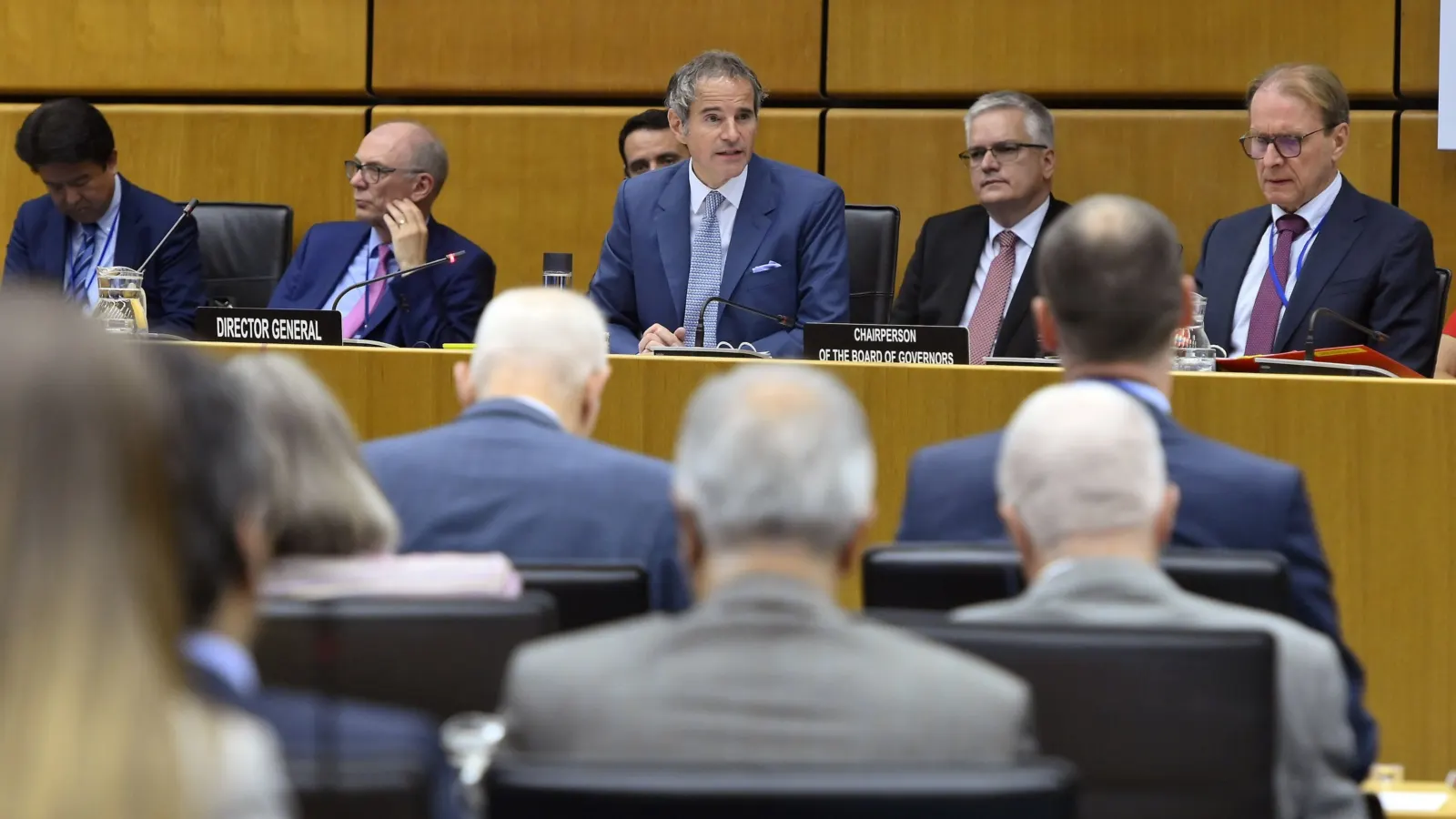
On 20 November 2025 the IAEA Board of Governors passed a resolution sponsored by the E3 and the United States demanding information on the stockpile, by 19 votes to three (China, Niger and Russia) with 12 abstentions 16. Britain’s IAEA ambassador, Corinne Kitsell, said: “Our message is clear: Iran must resolve its safeguards issues without delay.” 16 Iran then formally told the agency that the Cairo agreement “is considered terminated” 16.
Latest status
In February 2026 the IAEA said it could not verify whether Iran had suspended all enrichment-related activities, nor give any information on the size or location of its enriched uranium 15. A letter from Iran that month called normal safeguards “legally untenable and materially impracticable” 15. The United States and Israel went to war with Iran in late February 8. The IAEA estimated in March that about half of the 60% material, just over 200 kilograms, was probably still at Isfahan 1718.
On 9 September 2026 the IAEA Board voted 23 to three, with eight abstentions, to refer Iran to the Security Council and General Assembly over its “continued non-compliance”, the first such referral in 20 years 1920. Russia, China and Niger voted against 19. Iran’s envoy, Reza Najafi, called the resolution a “political tool” and said: “Iran will cooperate only to the extent that circumstances and safety permit.” 20 Russia and China can veto any new sanctions 1920.
On 3 November a foreign ministry spokesman, Esmaeil Baghaei, said it was too early to discuss resuming inspections and that Grossi must first condemn attacks on Iran’s nuclear facilities 21. “We are still a party to the Nuclear Non-Proliferation Treaty,” he said, according to the Russian agency TASS 21. A lawmaker said ten proposals to withdraw had been registered in parliament 21.
A restricted IAEA report circulated in mid-November said the agency could not conclude that there had been no diversion of declared nuclear material 8. “It is more than a year since the agency lost continuity of knowledge,” Grossi wrote 8. Inspectors visited Bushehr twice in the previous three months 8. On 18 November Grossi told the Board that Iran had given no information on its declared material and facilities apart from Bushehr 22. “Such gradual, technical, incremental steps could pave the way to normal safeguards implementation in Iran,” he said 22.
Why it matters
Snapback restored the UN sanctions lifted in 2015 even though Russia and China voted to keep relief in place 54. But it did not bring inspectors back 822. Iran treats the sanctions as void and Resolution 2231 as expired 314, and the IAEA referral rests with a Council where Russia and China can block further action 19. Without access, the agency says it cannot determine whether declared nuclear material has been diverted 822.
Sources and references
- Official documentUK Government (FCDO), “Iran nuclear: E3 foreign ministers’ letter announcing triggering of snapback, 28 August 2025”, 28 August 2025. Link
- ReportArms Control Association, “European Countries Move to Restore UN Sanctions on Iran”, September 2025. Link
- ArticleThe National, “Iran recalls ambassadors from Germany, France and Britain over return of UN sanctions”, 27 September 2025. Link
- Official documentUK Government (FCDO), “E3 joint statement on Iran: activation of the snapback”, 28 September 2025. Link
- ArticleThe National, “UN Security Council votes to reimpose ‘snapback’ sanctions on Iran”, 19 September 2025. Link
- Official documentUK Government (FCDO), “UK reimposes UN sanctions on Iran”, 1 October 2025. Link
- ArticleAssociated Press via WDIV, “UN watchdog hasn’t been able to verify Iran’s stockpile of near weapons-grade uranium in months (AP)”, 12 November 2025. Link
- ArticleJefferson City News Tribune / Bloomberg News, “Iran extends shutout of UN nuclear inspectors (Bloomberg)”, 15 November 2026. Link
- ArticleThe National, “Iran and IAEA reach deal on resuming nuclear inspections”, 9 September 2025. Link
- ArticleThe Express Tribune, “Iran, IAEA agree new cooperation framework”, 10 September 2025. Link
- ArticleDawn, “Bid to lift UNSC nuclear sanctions on Iran fails to pass”, 20 September 2025. Link
- ArticleAnadolu Agency, “Russia, China regret UN Security Council’s failure to delay snapback sanctions on Iran”, 27 September 2025. Link
- ReportBaker McKenzie Sanctions News, “Sanctions on Iran reinstated following triggering of JCPOA snapback by E3”, 13 October 2025. Link
- ArticleThe National, “Iran confirms end of nuclear deal and says its restrictions are considered terminated”, 18 October 2025. Link
- ArticlePBS NewsHour / Associated Press, “UN nuclear watchdog says it’s unable to verify whether Iran has suspended all uranium enrichment (AP)”, 27 February 2026. Link
- ReportArms Control Association, “IAEA Passes Resolution on Iran”, December 2025. Link
- ArticleThe National, “IAEA inspections at bombed Iranian nuclear sites key to lifting sanctions”, 27 June 2026. Link
- ReportUN News, “World News in Brief: Iran nuclear inspections, deadly church attack in Jordan, El Fasher”, 23 October 2026. Link
- ArticleKhaleej Times / AFP, “IAEA board refers Iran to UN Security Council over nuclear ‘non-compliance’ (AFP)”, 9 September 2026. Link
- ArticleGulf News, “IAEA board refers Iran to UN Security Council”, 9 September 2026. Link
- ArticleThe Defense Post (citing TASS), “Iran says too early for IAEA inspections”, 3 November 2026. Link
- ArticleAnadolu Agency, “Return to diplomacy, negotiations on Iran’s nuclear program imperative: UN nuclear watchdog”, 18 November 2026. Link
Sources and references are provided for transparency and further reading. Allegations and claims are attributed to their respective sources. Triple Frontiers distinguishes reported allegations from independently established facts.
The Frontier Brief
The week’s essential international reporting and new investigations, every Friday.