One veto can stop the UN. What it can still do for Gaza, Lebanon and Syria
Five countries have vetoed 252 Security Council drafts since 1946, by our count, and reform is unlikely. Yet the Council has agreed frameworks for all three fronts; what they lack is delivery on the ground.
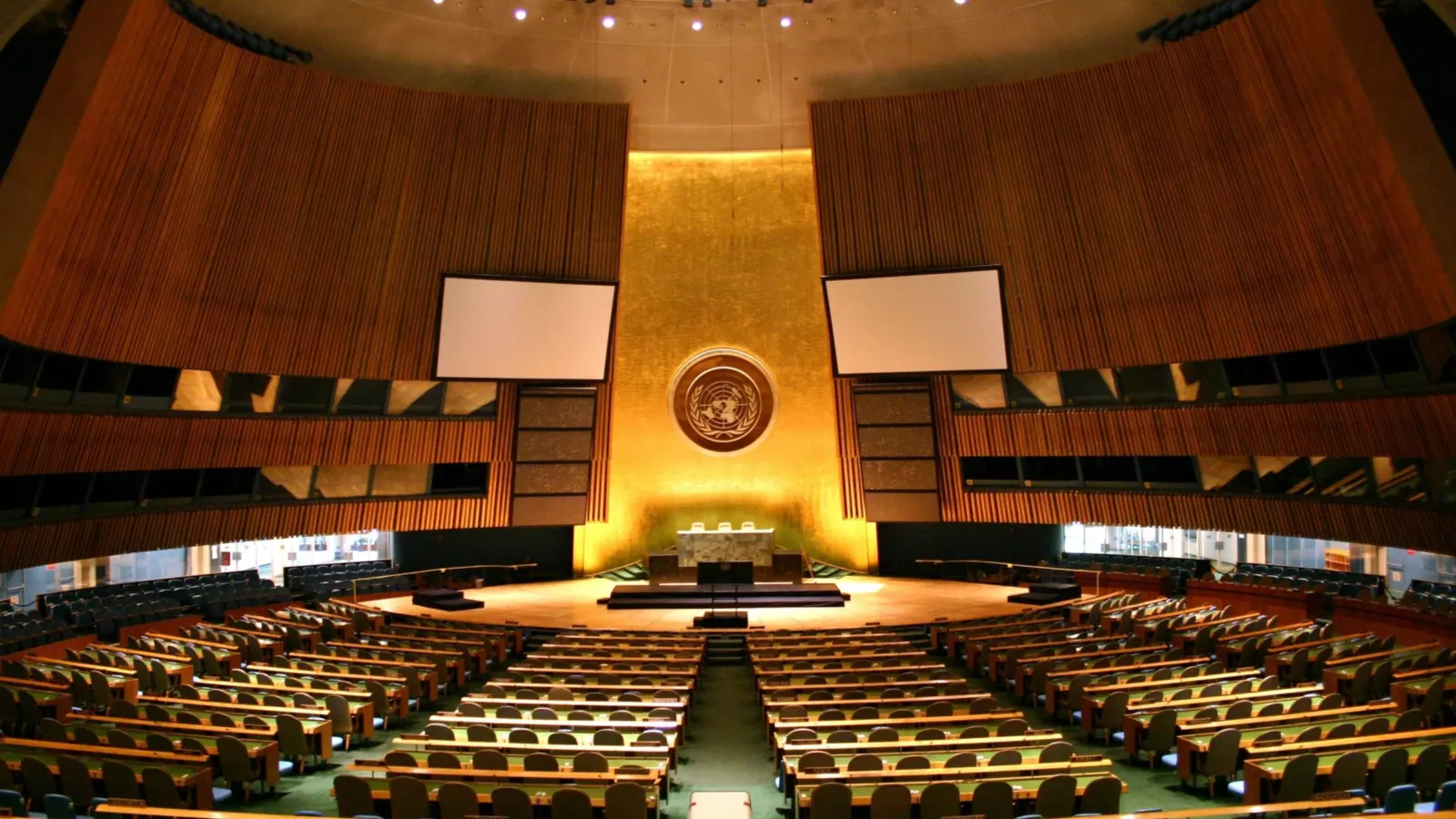
NEW YORK The first veto in the history of the United Nations Security Council was cast by the Soviet Union on 16 February 1946, on a complaint brought by Lebanon and Syria 1. Eighty years later, Lebanon, Syria and the Palestinian territories are all covered by Council resolutions, and none has a settled peace 234.
Can the UN keep the peace when one vote can stop it? The record gives a two-part answer. A veto lets any of the five permanent members block action against itself or a state it protects, because substantive decisions need their “concurring votes” 5. Yet on all three fronts the Council has agreed frameworks without a veto: resolution 1701 for Lebanon, the final UNIFIL mandate, the Golan observer force and resolution 2803 for Gaza 2637. What those frameworks lack is delivery by the parties on the ground 428. Our investigation published today asked why the UN cannot make Israel comply; this analysis looks at the veto itself and what each front’s framework requires.
How often one vote has stopped the Council
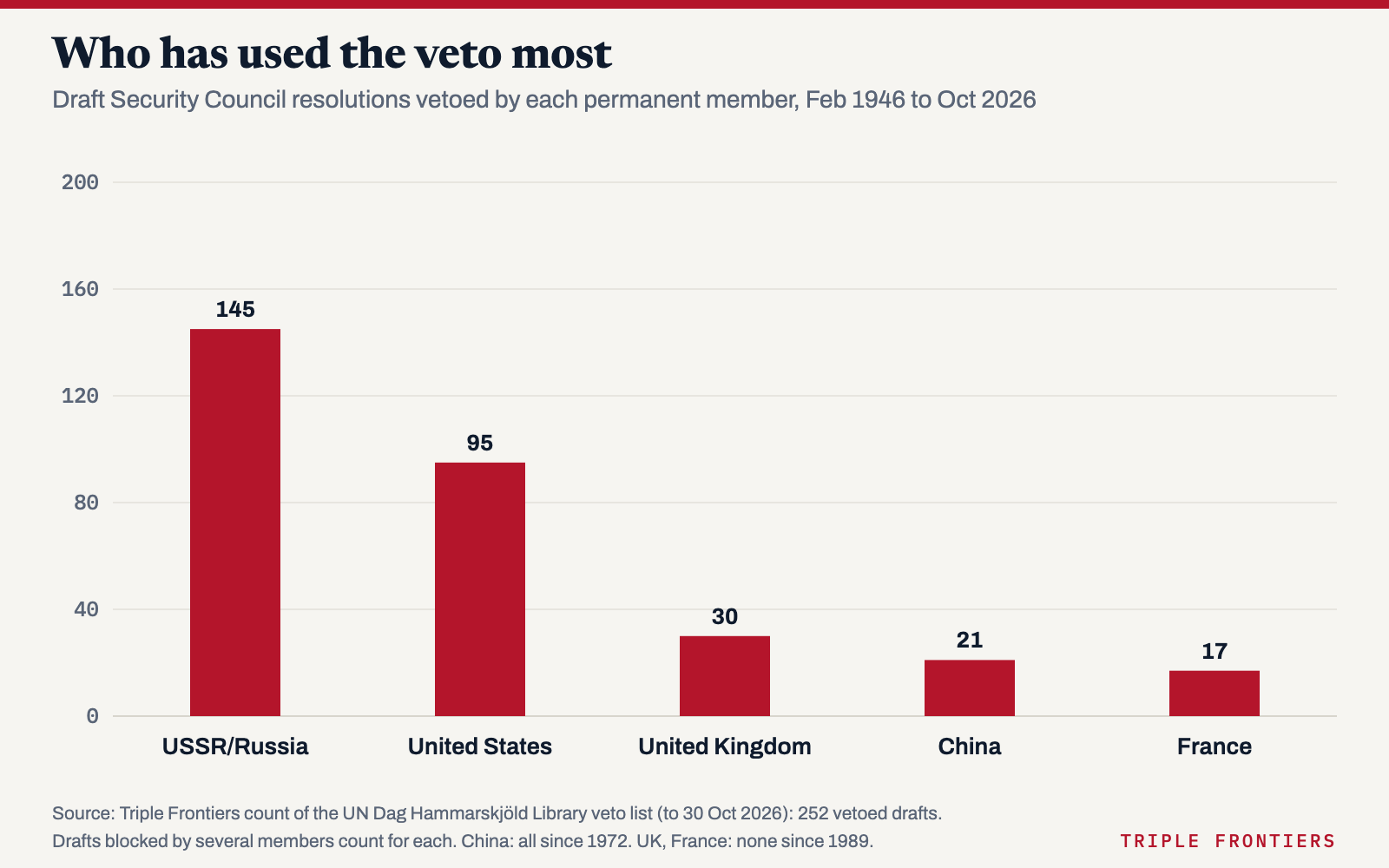
By our count of the UN Dag Hammarskjöld Library’s official list, 252 draft resolutions have been vetoed since 1946: 145 by the Soviet Union and Russia, 95 by the United States, 30 by the United Kingdom, 21 by China and 17 by France, with a draft blocked by two members counted for each 19. Britain and France have not cast a veto since December 1989 110.
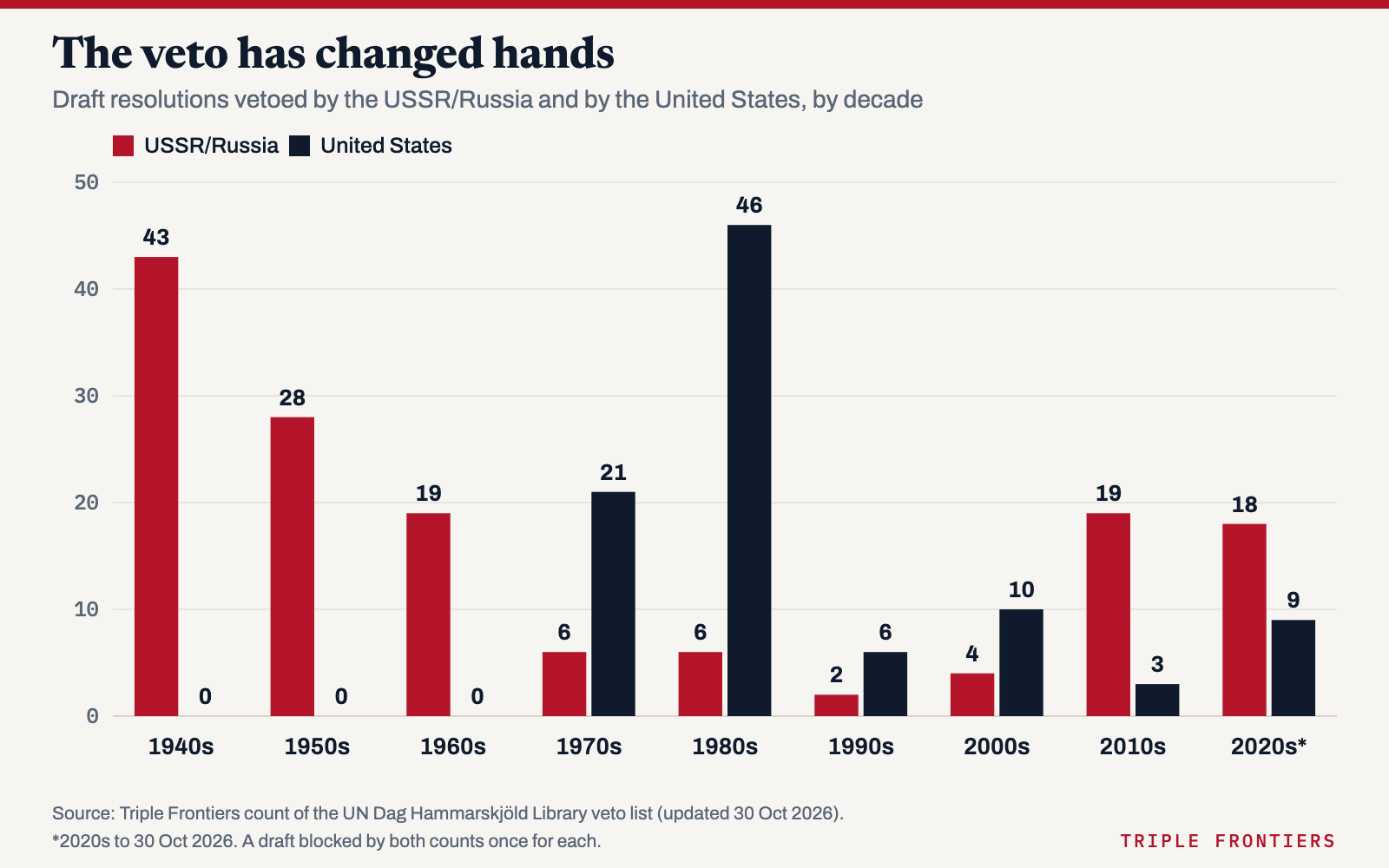
The heaviest user has changed over time. The Soviet Union cast 43 vetoes in the 1940s; the United States cast 46 in the 1980s, many on Middle East drafts; Russia, often joined by China, led again in the 2010s, including on drafts concerning Syria 1. Even so, the Council adopted 50 resolutions in 2023, 46 in 2024 and 44 in 2025, against six, seven and three vetoes 19.
The brakes that already exist
The Charter’s own limit is Article 27(3): in decisions on the peaceful settlement of disputes, “a party to a dispute shall abstain from voting” 5. Lawfare cited estimates of five to ten cases between 1946 and 1960, starting with Britain and France abstaining on foreign troops in Syria and Lebanon, and called the rule “obligatory in theory but voluntary in practice”; it does not cover enforcement action under Chapter VII 11. A 2025 analysis on the EJIL: Talk! law blog described Argentina’s abstention over the Eichmann case in 1960 as “presumably the last case” 12.
Voluntary restraint has grown instead. France says 127 states now back the French-Mexican initiative of 2015 to restrain vetoes in cases of mass atrocities, including Britain, which joined in 2026 as the second permanent member 10. A Code of Conduct drawn up by the Accountability, Coherence and Transparency (ACT) group had 121 member-state signatories by June 2022; France and Britain are on the list, the United States, Russia and China are not 1314. Without the most frequent veto users, Lawfare concluded, these principles “remain aspirational” 11.
Since resolution 76/262 of April 2022, every veto triggers a General Assembly debate 15. By November 2025, 17 vetoes had triggered 17 meetings; Liechtenstein said the debates show a veto is not the “end of the conversation” 16. The 1950 Uniting for Peace resolution lets the Assembly act when the Council is blocked, but its recommendations are, in UN legal commentary, “devoid of any binding legal force” 17.
Why the veto is unlikely to go
Changing the veto means amending the Charter, which under Article 108 requires ratification by two thirds of members “including all the permanent members of the Security Council” 18. The 2024 Pact for the Future promised to “intensify efforts to reach an agreement on the future of the veto, including discussions on limiting its scope and use” 19. But reformers disagree. Brazil, Germany, India and Japan said in September that the Council is “currently unable to effectively discharge its core responsibility” and seek new permanent seats 20; the 12-state Uniting for Consensus group opposes new permanent seats and backs abolishing the veto 21; the African Union wants two permanent African seats “including the veto while it exists” 22.
What the Council has managed anyway
Resolution 1701, adopted on 11 August 2006 after a 34-day war between Israel and Hezbollah, expanded the UN Interim Force in Lebanon (UNIFIL) and set the goal of an area between the Blue Line and the Litani River free of weapons other than the Lebanese state’s and UNIFIL’s 2. In August 2025 the Council unanimously extended UNIFIL “for a final time” to 31 December 2026 623; in June 2026 it unanimously renewed the UN Disengagement Observer Force (UNDOF) on the Golan Heights to the same date 3. It removed Syria’s President Ahmed al-Sharaa from its ISIL and Al-Qaida sanctions list in November 2025, with only China abstaining 24, and Russia and China abstained rather than veto resolution 2803 on Gaza 7.
These tools matter, research suggests. A review by political scientists Barbara Walter, Lise Morjé Howard and Virginia Page Fortna found “an extraordinary relationship between peacekeepers and peace, notwithstanding a number of well-known problems” 25. Fortna’s study of ceasefires found that demilitarised zones, third-party guarantees, peacekeeping and joint commissions make peace last longer 26.
An equal right to exist, in the documents
The Charter’s purposes include “equal rights and self-determination of peoples”, and it bars force “against the territorial integrity or political independence of any state” 27. Resolution 242 of 1967 affirms the right of “every State in the area” to “live in peace within secure and recognized boundaries free from threats or acts of force” 28. The Arab League’s 2002 peace initiative offered Israel “normal relations” in return for withdrawal from territories occupied since 1967 and a Palestinian state with East Jerusalem as its capital 29.
The New York Declaration, endorsed by the General Assembly by 142 votes to 10 in September 2025, calls for a Palestinian state “living side by side, in peace and security with Israel” and condemns both Hamas’s 7 October attacks on civilians and Israel’s attacks on civilians in Gaza 30. Israel’s UN ambassador Danny Danon called it “another hollow gesture”; Prime Minister Benjamin Netanyahu said “there will be no Palestinian state” 31.
Gaza: a mandate without delivery
Resolution 2803 endorsed the US plan, a Board of Peace and an International Stabilization Force, with no timeline for Palestinian statehood 7. By October 2026 the force had not deployed and Israel had pushed its “yellow line” of control westward instead of withdrawing, AP reported 32. On 17 November the Board told the Council that Israel had still not let the Palestinian technocratic administration start work, and that “a ceasefire that delivers nothing visible cannot be sustained indefinitely” 4.
Netanyahu said in August that forces will stay until Hamas is “genuinely disarmed”; a senior Hamas official told NPR the group would hand over weapons only after Israel withdrew from parts of Gaza 33. Palestinian elections due in November were postponed to 11 September 2027; the PLO cited Israel’s refusal to admit election materials to Gaza, which Israel’s foreign minister called “yet another ridiculous lie” 34. The International Crisis Group urges that Hamas’s decommissioning proceed “in lockstep” with Israeli withdrawals 35. (Background: our Gaza ceasefire report.)
Lebanon: UNIFIL’s mandate ends on 31 December
The November 2024 ceasefire was announced as “designed to be a permanent cessation of hostilities” 36. After war resumed in 2026, Lebanon, Israel and the United States signed a framework in June tying Israeli withdrawal to the verified disarmament of non-state armed groups; as of November progress has stalled, and Israel’s buffer zone covers about 5% of Lebanon, the Congressional Research Service says 2.
In October Netanyahu challenged the Lebanese army to clear two pilot zones: “Can you do it? Good. Can’t you? We’ll take care of it.” Defence Minister Israel Katz said troops “will not move from the security zone as long as Hezbollah has not been disarmed throughout Lebanon”; President Joseph Aoun said “Israel has not complied with the framework agreement” 37. Hezbollah’s leader Naim Kassem called the framework a “humiliation” 38.
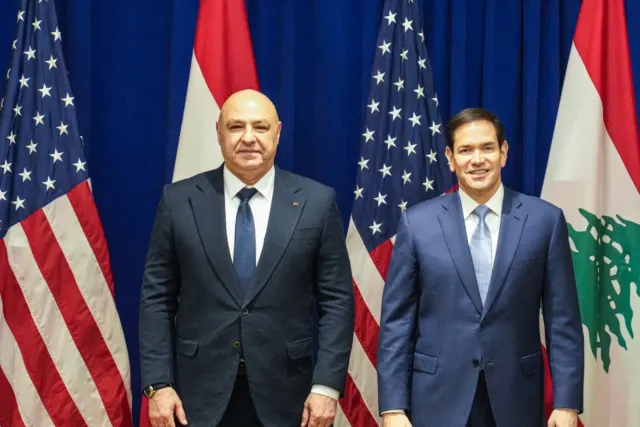
UNIFIL reports daily violations, “mainly by the Israel Defense Forces”, and says that on what follows the mission “nothing has been decided” 39. Prime Minister Nawaf Salam wants an international presence “with a mandate from the UN Security Council”; US Secretary of State Marco Rubio said it “doesn’t have to be a military mission” 40. (More: our Lebanon ceasefire report.)
Syria: a 1974 line in question
When Bashar al-Assad fell in December 2024, Israeli troops seized the UN-patrolled buffer zone on the Golan Heights; Netanyahu said it was to protect Israeli residents after Syrian troops abandoned their positions 41. Since then the US has revoked its main Syria sanctions orders and repealed the Caesar Act 42.
US-mediated talks have not produced a deal. Foreign Minister Asaad al-Shaibani said the sides agreed “almost everything” on paper early in 2026, including a buffer zone where only UN forces would be present; Damascus wants Israel back to its positions of 8 December 2024 and the 1974 disengagement agreement restored 8. An Israeli official said in September: “We did not think that, as part of a security arrangement or security agreement, we should withdraw from the buffer zone” 43. On 18 November al-Shaibani said Syria remains committed to a security understanding and to redeploying UNDOF, and put Israeli airstrikes since Assad’s fall at more than 1,000 44. (See our report on Syria after Assad.)
What happens next
The UNIFIL and UNDOF mandates both run to 31 December 2026, and France holds the pen on Lebanon at the Council, the US ambassador, Mike Waltz, has said 6340. The Gaza force and Board of Peace mandates expire at the end of 2027 7. Each decision needs nine votes and no veto 5.
Sources and references
- ReportUN Dag Hammarskjold Library, “Veto List (in reverse chronological order), embedded table of the Security Council vetoes research guide”, 30 October 2026. Link
- Official documentCongressional Research Service (via EveryCRSReport), “Lebanon: Background and U.S. Relations (R44759), updated 9 November 2026”, 9 November 2026. Link
- ReportUN News via GlobalSecurity.org, “Security Council extends critical stabilisation force in Syria (UN News, reproduced)”, 25 June 2026. Link
- ArticleAP via WMUR, “Board of Peace delivers bleak report on Gaza, warning of ceasefire collapse without immediate action”, 17 November 2026. Link
- Official documentUnited Nations, “UN Charter, Chapter V: The Security Council (Article 27)”, 26 June 1945. Link
- ReportUN Meetings Coverage via GlobalSecurity.org, “Unanimously adopting resolution 2790 (2025), Security Council extends mandate of UNIFIL (SC/16159, reproduced)”, 28 August 2025. Link
- ArticleAP via Anchorage Daily News, “UN Security Council approves the Trump administration’s plan for Gaza’s future”, 17 November 2025. Link
- ArticleReuters via Al-Monitor, “Syria, Israel hold US-mediated talks to ease tensions, Syria news agency says (Reuters)”, 24 August 2026. Link
- ReportUN Dag Hammarskjold Library, “Security Council Vetoes research guide”, 23 September 2026. Link
- Official documentFrench Ministry for Europe and Foreign Affairs, “France’s proposals to strengthen the United Nations (Regulating the use of the veto, reforming the Security Council)”, 22 September 2026. Link
- ReportLawfare, “Must Russia Abstain on Security Council Votes Regarding the Ukraine Crisis?”, 11 February 2022. Link
- ReportEJIL: Talk! (European Journal of International Law blog), “Abstaining from Abstention: UNSC Resolution 2774 (2025) and Obligatory Abstention under Article 27(3)”, 18 November 2025. Link
- ReportGlobal Centre for the Responsibility to Protect, “List of signatories to the ACT Code of Conduct”, 8 June 2022. Link
- ReportACT Group / Global Centre for R2P, “List of Supporters of the Code of Conduct regarding Security Council action against genocide, crimes against humanity or war crimes (as of 8 June 2022)”, 8 June 2022. Link
- ReportUN General Assembly, “Resolutions of the 76th session (A/RES/76/262, 26 April 2022, adopted without a vote)”, 26 April 2022. Link
- ReportUN Meetings Coverage, “General Assembly delegates demand overhaul of Security Council veto (GA/12733)”, 20 November 2025. Link
- ReportUN Audiovisual Library of International Law, “Uniting for Peace, GA resolution 377 (V): introductory note by Christian Tomuschat”. Link
- Official documentUnited Nations, “UN Charter, Chapter XVIII: Amendments (Article 108)”, 26 June 1945. Link
- ReportUnited Nations, “Pact for the Future, Global Digital Compact and Declaration on Future Generations (Action 39-41)”, 22 September 2024. Link
- Official documentGerman Federal Foreign Office, “G4 Joint Ministerial Statement”, 22 September 2026. Link
- ArticleAnadolu Agency, “12-country group opposes new permanent seats in UN Security Council reform”, 24 September 2026. Link
- ReportAfrican Union Commission, “AUC Chairperson reaffirmed Africa’s united & principled position on UN Security Council reform”, 11 May 2026. Link
- ArticleAP via PBS NewsHour, “UN votes to end its peacekeeping operations in Lebanon next year after nearly 5 decades”, 28 August 2025. Link
- ReportUN News, “Security Council lifts terror-related sanctions on Syrian President”, 6 November 2025. Link
- ReportCambridge University Press, “The Extraordinary Relationship between Peacekeeping and Peace (Walter, Howard, Fortna), British Journal of Political Science 51(4)”, 24 November 2020. Link
- ReportVirginia Page Fortna / RePEc, “Scraps of Paper? Agreements and the Durability of Peace (abstract), International Organization 57(2)”, April 2003. Link
- Official documentUnited Nations, “UN Charter, Chapter I: Purposes and Principles”, 26 June 1945. Link
- Official documentAvalon Project, Yale Law School, “Security Council Resolution 242 (1967), text”, 22 November 1967. Link
- Official documentUN (UNISPAL), “Arab Peace Initiative, Arab League Beirut summit (letter from Lebanon)”, 24 April 2002. Link
- ReportUN (UNISPAL), “General Assembly endorses New York Declaration (GA/12707 meeting coverage)”, 12 September 2025. Link
- ArticleAP via Anchorage Daily News, “UN assembly votes overwhelmingly to back a two-state solution to the Israel-Palestinian conflict”, 12 September 2025. Link
- ArticleAP via Anchorage Daily News, “A US-brokered ceasefire was supposed to end the war in Gaza. A year later progress has stalled”, 10 October 2026. Link
- ArticleNPR, “Netanyahu rejects Trump’s Gaza Peace Plan, demands Hamas disarm first”, 9 August 2026. Link
- ArticleAP via KSAT, “Mahmoud Abbas postpones Palestinian legislative elections another year”, 10 October 2026. Link
- ReportInternational Crisis Group (ecoi.net copy), “Hollow Promises: Resetting Gaza’s Ceasefire (Middle East Report No. 257)”, 24 August 2026. Link
- Official documentThe White House (archived), “Remarks by President Biden announcing cessation of hostilities between Israel and Hezbollah”, 26 November 2024. Link
- ArticleYnetnews, “Israel, Lebanon hold US-mediated military talks as tensions mount over Hezbollah disarmament”, 21 October 2026. Link
- ArticleAP via PBS NewsHour, “Lebanon’s deal with Israel requires Hezbollah to disarm. That might be difficult”, 27 June 2026. Link
- ReportUN Geneva Multimedia Newsroom, “South Lebanon update – UNIFIL”, 12 November 2026. Link
- ArticleThe National, “Waltz visits Beirut as UN peacekeepers set to leave with Lebanon and Israel still at odds”, 16 November 2026. Link
- ArticleAP via PBS NewsHour, “Syrian government falls to rebel offensive in stunning end to Assad family’s 50-year rule”, 8 December 2024. Link
- Official documentUS Treasury, Office of Foreign Assets Control, “Syria Sanctions – Inactive and Archived”. Link
- ArticleAnadolu Agency, “Israeli bid for security deal with Syria failed on buffer zone dispute: Report”, 3 September 2026. Link
- ArticleMiddle East Monitor (Anadolu report), “Syria remains ‘committed’ to security understanding with Israel, revival of 1974 disengagement deal: Foreign minister (Anadolu)”, 18 November 2026. Link
Sources and references are provided for transparency and further reading. Allegations and claims are attributed to their respective sources. Triple Frontiers distinguishes reported allegations from independently established facts.
The Frontier Brief
The week’s essential international reporting and new investigations, every Friday.