No UN chief by 1 January? What the rules say as the race to succeed Guterres stalls
A ninth Security Council straw poll left every candidate opposed by at least two permanent members, with Antonio Guterres's term ending on 31 December. We read the Charter and the General Assembly's rules, and the precedents, to explain what happens if the deadline passes.

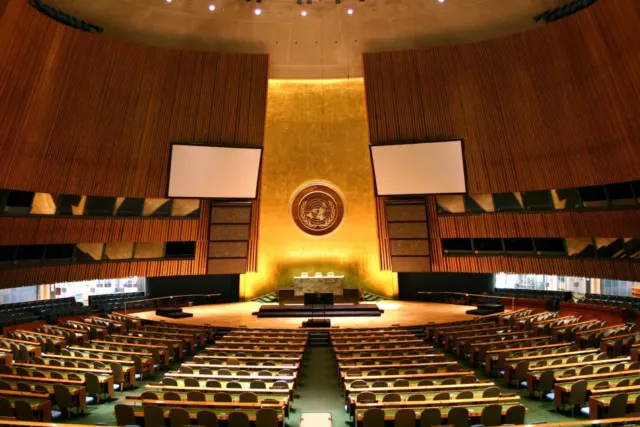
NEW YORK Every one of the eight candidates to lead the United Nations drew “discourage” votes from at least two of the Security Council’s five permanent members in a secret poll on Friday 20 November, according to a tally seen by PassBlue, a New York news site that covers the UN 1. António Guterres’s term as secretary-general ends on 31 December, so the Council has less than six weeks to agree on a successor 1.
The UN Charter does not say what happens if it fails 23. No secretary-general has ever left office without a replacement, Reuters reported on 19 November 3.
What happened in Friday’s poll?
A straw poll is an informal, secret vote in which each of the Council’s 15 members marks every candidate “encourage”, “discourage” or “no opinion” 4. In later rounds the five permanent members (Britain, China, France, Russia and the United States, known as the P5) use coloured ballots, showing whether a veto-holder is against a candidate 45.
Friday’s ninth poll was the second with colour-coded ballots 16. Rebeca Grynspan, a former vice president of Costa Rica, kept the lead with 10 encourage, four discourage and one no opinion, according to PassBlue 14. Three permanent members encouraged her and two discouraged her 16.
Rafael Grossi of Argentina, head of the UN nuclear watchdog, had eight encourage, six discourage and one no opinion, with three of the discourage votes from permanent members 164. Lana Nusseibeh of the United Arab Emirates had seven, six and two, with three P5 members against her 16. Feridun Sinirlioğlu of Turkey, who heads the Organization for Security and Co-operation in Europe, had five encourage and 10 discourage, four of them from permanent members 16. Carolyn Rodrigues Birkett of Guyana, a former foreign minister, matched Grynspan’s three-to-two split among the P5 14.
Mike Waltz, the US ambassador to the UN, said: “Unfortunately, there hasn’t been consensus yet. I don’t think you’ll see consensus today” 6. Of candidates without enough support, he said: “If they haven’t received it, we think it’s probably time to step aside and let the council consider a narrower field” 6. Minh-Thu Pham of the Starling Institute said: “There’s still no consensus and we seem to have taken a step backwards” 6.
Grynspan’s results, poll by poll
- 1st, 30 July: 10 encourage, 1 discourage, 4 no opinion 4
- 2nd, 21 August: Rodrigues-Birkett narrowly led; figures not reported 7
- 3rd, 18 September: 9 encourage, 5 discourage 7
- 4th, 29 September: 10 encourage, 3 discourage, 2 no opinion 82
- 5th, 7 October: 9 encourage, 6 discourage, 0 no opinion 2
- 6th, 16 October (first colour-coded): 9 encourage, with 2 discourage from permanent members 910
- 7th, 30 October: 11 encourage, 4 discourage 1110
- 8th, 5 November: 12 encourage, 3 discourage 116
- 9th, 20 November (colour-coded): 10 encourage, 4 discourage, 1 no opinion; P5 split 3–2 16
All figures are unofficial, from diplomats or tallies seen by journalists 14. PassBlue gives the date of the eighth poll as 6 November; Jewish Insider and The National give 5 November 1116.
Is a “discourage” from a permanent member a veto?
Not formally. The National described Grynspan’s two P5 discourage votes and Sinirlioğlu’s four as “vetoes” 6. But a straw poll is not a decision 5.
Under the Council’s provisional rule 48, its recommendation for secretary-general is “discussed and decided at a private meeting”, according to scprocedure.org, a reference site on Council procedure 5. Straw polls take place in informal meetings beforehand; the coloured ballots only signal “whether a particular nominee’s candidacy might ultimately be vetoed” 5. The veto applies to the formal resolution recommending a candidate, which needs at least nine of 15 votes and no negative vote from a permanent member 35. A permanent member can abstain without blocking 15.
A real veto looks different. In 1996 the United States “cast a negative vote in a 19 November private meeting”, ending Boutros Boutros-Ghali’s bid for a second term, the UN’s own review of that year records 122.
What do the Charter and the General Assembly’s rules say?
Article 97 of the UN Charter is one sentence on the subject: “The Secretary-General shall be appointed by the General Assembly upon the recommendation of the Security Council” 13. It sets no date and no fallback 132.
The General Assembly has added procedural steps in a series of resolutions, starting with resolution 69/321 of 11 September 2015 14. The latest, resolution 79/327 of 5 September 2025, says the process should start with a joint letter in the last quarter of the year before the incumbent’s term ends 14. It says the process “should end with the swearing into office of the Secretary-General-designate” during “the last quarter of the year prior to assuming office” 14. That is guidance, not a hard deadline: PassBlue notes there is no official deadline to choose the next leader 1.
Resolution 79/327 does cover one emergency. If there is “an unforeseen interruption in the term of office”, the Assembly and the Council should “convene without delay to initiate an expedited selection and appointment process” 14. The paragraph is written for a term cut short; it does not address a term that ends on schedule without a successor, and it does not create an acting post 14.
Has the UN been this close to the wire before?
In 1981 Kurt Waldheim of Austria sought a third term against Salim Ahmed Salim of Tanzania 15. The Council went through 16 rounds of voting in which China blocked Waldheim and Salim was also blocked, according to Gonzalo Gutiérrez, a Peruvian diplomat who was at the UN at the time, writing in El Comercio 152. Both withdrew in early December; Javier Pérez de Cuéllar of Peru was recommended on 11 December by resolution 494 and appointed by the Assembly on 15 December, for a term starting on 1 January 1982 15. Straw polls have been used in every selection since 1981 5.
In 1996, after the US blocked Boutros-Ghali, the Council recommended Kofi Annan of Ghana on 13 December, by acclamation, for a term from 1 January 1997 161.
The 1950 case is the one that went further. After the Soviet Union vetoed a second term for Trygve Lie of Norway, the Assembly extended his term by three years without a Council recommendation, through resolution 492 (V) 25. Moscow called it illegal, and Lie resigned in 1952 2. Scprocedure.org argues that a similar move today would not fit Article 97, because since 1976 the Council’s recommendations have fixed the start and end dates of each term 5.
Stephen Schlesinger, quoted by PassBlue, said about 113 days had passed since the first straw poll this year, the longest selection period on record 1.
Is there an interim or acting arrangement?
Neither Article 97 nor resolution 79/327 provides for an acting secretary-general 1314. There is one precedent: after Dag Hammarskjöld died in 1961, Security Council resolution 168 recommended U Thant as acting secretary-general 5. That required a Council decision.
Others have floated options. Kirill Logvinov, a Russian foreign ministry official, told the TASS news agency that ideas under consideration include temporarily extending Guterres’s term or naming another official, Reuters reported 3. Richard Gowan of the International Crisis Group told The National in October that a more likely stopgap would be a group of senior UN officials, with one acting as senior administrative officer without the title of acting secretary-general 2.
“As far as I can tell, on January 1, if there’s no secretary-general, no one is in charge,” Daniel Safran-Hon, a former UN official, told Reuters 3. The UN spokesperson declined to comment on contingency planning, according to Reuters on 19 November 3.
What happens next?
Remaining candidates can keep going, withdraw, or be withdrawn by the governments that nominated them; under resolution 79/327, a nominating state may also put forward a new candidate 14. Once the Council adopts a recommendation, the General Assembly makes the appointment 13.
In 1981 and 1996 the Council’s choice came between 11 and 13 December 1516. On 16 October Waltz said: “We’re going to get this done, I’m confident, before the end of the year” 9. After Friday’s vote he said Washington would welcome a candidate from Latin America 6. The Council has 39 days until Guterres’s term ends on 31 December 1.
Sources and references
- ArticlePassBlue (Damilola Banjo), “UN secretary-general race remains deadlocked as veto powers fail to reach consensus”, 20 November 2026. Link
- ArticleThe National (Adla Massoud), “What happens if the UN cannot agree on Antonio Guterres’s successor?”, 7 October 2026. Link
- ArticleReuters via TimesLIVE, “Analysis: UN could soon be leaderless as race to succeed Guterres stalls (Reuters)”, 19 November 2026. Link
- ArticleReuters via Internazionale, “Informal poll shows Costa Rica’s Grynspan ahead in race to be next UN chief (Reuters)”, 31 July 2026. Link
- Reportscprocedure.org (companion to The Procedure of the UN Security Council), “The Procedure of the UN Security Council: selection of the Secretary-General (chapter 7, section 5q)”. Link
- ArticleThe National (Adla Massoud), “UN secretary-general race: ninth straw poll”, 20 November 2026. Link
- ArticleThe National, “UN Security Council holds third straw poll in race for next secretary general”, 18 September 2026. Link
- ArticleThe National, “Costa Rica’s Rebeca Grynspan leads fourth Security Council straw poll”, 29 September 2026. Link
- ArticleAssociated Press via ClickOrlando (Edith M. Lederer), “Latest vote shows no candidate for UN chief has the required support of all five key powers (AP)”, 16 October 2026. Link
- ArticleDaily Monitor (Uganda), “Twists and turns as top UN members hold 7th straw poll”, 31 October 2026. Link
- ArticleJewish Insider, “Rebeca Grynspan gains ground in latest U.N. secretary-general straw poll”, 5 November 2026. Link
- Official documentUN Meetings Coverage and Press Releases, “Security Council review of 1996 (SC/6313)”, 14 January 1997. Link
- Official documentUN Office of Legal Affairs, Codification Division, “Charter of the United Nations, Article 97 (Repertory of Practice)”, 4 May 2026. Link
- Official documentUN General Assembly, “A/RES/79/327 Revitalization of the work of the General Assembly”, 5 September 2025. Link
- ArticleEl Comercio (Peru), “Nueva York, 1981: la historia secreta de una eleccion en Naciones Unidas (opinion, Gonzalo Gutierrez, Peruvian diplomat)”, 26 August 2026. Link
- Official documentUN Meetings Coverage and Press Releases, “Security Council recommends Kofi Annan for appointment as Secretary-General (SC/6304)”, 13 December 1996. Link
Sources and references are provided for transparency and further reading. Allegations and claims are attributed to their respective sources. Triple Frontiers distinguishes reported allegations from independently established facts.
The Frontier Brief
The week’s essential international reporting and new investigations, every Friday.