The fall of El Fasher: what UN investigators found, and what has happened since
The Rapid Support Forces took the last army stronghold in Darfur in October 2025 after an 18-month siege. The UN documented more than 6,000 killings in three days, and its fact-finding mission says the assault bore the hallmarks of genocide. A year on there is no ceasefire.
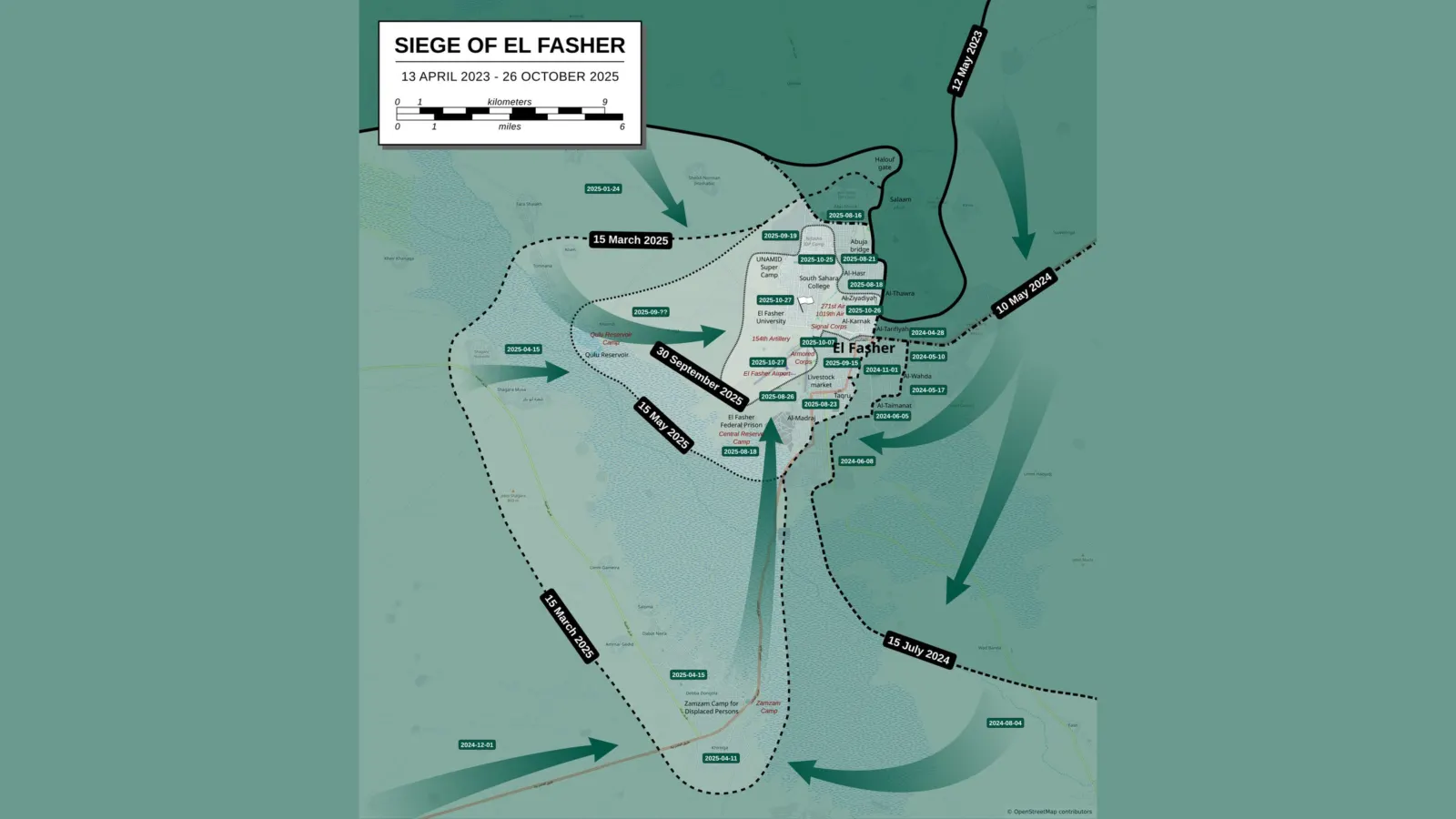
EL FASHER, Sudan On 26 October 2025 the paramilitary Rapid Support Forces (RSF) overran the Sudanese army’s 6th Infantry Division base in El Fasher, the capital of North Darfur, ending a siege of roughly 18 months 115. The next day the army chief, General Abdel Fattah al-Burhan, said in a televised address that the leadership there had withdrawn “to a safe location” because of “the systematic destruction and killing of civilians” 1. The city had been the army’s last major stronghold in Darfur; its fall left the RSF in control of the region’s five state capitals 315.
What happened over the following days has since been documented by the UN human rights office, a UN fact-finding mission, Amnesty International, Médecins Sans Frontières and satellite analysts. Their findings are among the gravest of Sudan’s war, which began in April 2023.
The siege
The RSF encircled El Fasher from May 2024. Amnesty International says the siege involved near-daily shelling and restrictions on aid, and describes the famine that followed as manufactured 15. In early November 2025 the Famine Review Committee of the Integrated Food Security Phase Classification (IPC) confirmed famine conditions in El Fasher and in Kadugli, South Kordofan, and projected a risk of famine in 20 further areas across Darfur and Kordofan 4. About 260,000 people were in the city when it fell, according to UN figures reported by the Associated Press 13.
The takeover
The first public estimates of the killing were far below what investigators later found. On 31 October 2025 the UN said the death toll could reach the hundreds, while groups allied to the army accused the RSF of killing more than 2,000 civilians 2. The World Health Organization said it had verified that at least 460 patients and others were killed in attacks on the Saudi Maternity Hospital, one of the last functioning hospitals in the city 2. Within days, Yale University’s Humanitarian Research Lab reported satellite imagery showing clusters of objects consistent with human bodies and said: “Indicators that mass killing is continuing are clearly visible” 3.
In February 2026 the UN human rights office (OHCHR) published its report on the offensive. Based on hundreds of interviews with victims and witnesses, it documented more than 6,000 killings in the first three days alone, and said the overall death toll over the weeks-long offensive was “undoubtedly significantly higher” 6. In one incident, it found, around 500 people were killed when RSF fighters fired heavy weapons at people sheltering in a university dormitory 6. OHCHR reported summary executions of men and boys accused of collaborating with the army, often singled out for their non-Arab ethnicity, as well as rape, abductions for ransom and torture, and concluded that these acts amount to war crimes and possibly crimes against humanity 6. “Persistent impunity fuels continued cycles of violence,” said Volker Türk, the UN High Commissioner for Human Rights 6.
Yale’s lab, in a December 2025 report covering the first month after the takeover, said it had a “high degree of confidence” that the RSF carried out large-scale, systematic mass killings, including door-to-door killings, and identified at least 150 clusters consistent with human remains along with a campaign to bury, burn and remove bodies 7.
“Hallmarks of genocide”
On 19 February 2026 the UN Independent International Fact-Finding Mission for Sudan said the siege and takeover of El Fasher bore “hallmarks of genocide” against the Zaghawa and Fur communities 1011. It said the evidence established at least three underlying acts of genocide, including killing members of a protected group 10. “The RSF acted with intent to destroy, in whole or in part, the Zaghawa and Fur communities in El Fasher,” said Mona Rishmawi, a member of the mission 10. This is the mission’s assessment; no court has ruled on it.
In July 2026 Amnesty International concluded, on the basis of 247 interviews, 89 videos and satellite imagery, that the RSF committed crimes against humanity and ethnic cleansing in its campaign for El Fasher, and said some of the conduct may be relevant to the crime of genocide 15. “It is a stain on the conscience of humanity,” said its secretary general, Agnès Callamard 15. The International Criminal Court’s deputy prosecutor, Nazhat Shameem Khan, told the UN Security Council in January 2026 that her office had concluded war crimes and crimes against humanity were committed by the RSF in El Fasher. “This criminality is being repeated in town after town in Darfur,” she said 89. No arrest warrant related to El Fasher has been reported.
The RSF’s response
Within days of the takeover, the RSF leader, Mohamed Hamdan Dagalo, known as Hemedti, vowed accountability for “anyone who has made a mistake” 2. On 30 October the RSF said it had arrested fighters accused of abuses, including a commander known as Abu Lulu, who was seen in videos executing unarmed men; an RSF-led coalition also said many incriminating videos had been fabricated by the army 2. In May 2026 Reuters, citing nine sources, reported that Abu Lulu had been released and was back in combat in Kordofan. The RSF-led Tasis administration denied it, calling the report “untrue, malicious, and completely false” 14.
In February 2026 the UN Security Council’s Sudan sanctions committee imposed travel bans and asset freezes on four RSF commanders over El Fasher, among them Hemedti’s brother and deputy, Abdelrahim Dagalo, and Abu Lulu. The committee cited a video it said showed Abdelrahim Dagalo “giving direct orders to his fighters to not take captives but to kill everyone” 13. Hemedti himself was not listed 13. In September 2026 the Tasis administration rejected a further report by the UN fact-finding mission as biased, saying it relied on remote testimony and ignored violations by the army 17.
A year on
Many of El Fasher’s people are still unaccounted for. AP, citing UN officials, reported that only about 40% of the city’s residents managed to flee 13. A month after the takeover, MSF said only around 10,000 survivors had reached Tawila, about 60 kilometres away, where camps already held more than 650,000 people displaced from El Fasher; it found people living on an average of 1.5 litres of water a day, a tenth of the humanitarian minimum 5. “Humanitarian access is blocked, people still alive are trapped,” said Myriam Laaroussi, MSF’s emergency coordinator in Darfur 5.
In October 2026 Amnesty reported that, according to figures from humanitarian organisations, fewer than 70,000 people remain in El Fasher, a city of more than a million before the war, and that former detainees described being held by the RSF for months and released only after paying ransom or escaping 16. “A pervasive pall of fear hangs over El Fasher today,” Callamard said 16. Amnesty said the RSF did not respond to its findings 16.
The war has moved on. The RSF took the army’s base at Babanusa in West Kordofan on 1 December 2025 and the Heglig oil area a week later 2021. Hemedti, sworn in as head of the RSF-led Tasis parallel government in August 2025, declared a unilateral three-month truce in November 2025 after the army rejected a US-backed truce proposal drawn up with the so-called Quad of mediating countries; Burhan rejected the same plan, saying: “Any initiative that recognizes the rebels, we do not accept” 1819. In October 2026 Burhan said “we have no negotiations with anyone” 22, and UN-hosted talks in Geneva ended without a ceasefire 23. In November the army and its allies reported gains in West Kordofan and the defection of several RSF commanders; both sides’ battlefield claims are unverified 242526.
Why it matters
The fall of El Fasher completed the RSF’s control of Darfur and deepened Sudan’s de facto division between an army-held east and an RSF-held west with its own parallel government. The killings there are the most thoroughly documented of the war, by UN investigators, human rights groups and satellite analysis, and they point to ethnic targeting of the Zaghawa and Fur in the same region where the ICC has already convicted a former Janjaweed leader for crimes committed two decades ago 9. Whether anyone is held to account for El Fasher, and whether outside powers can turn competing truce plans into a ceasefire, will shape what is left of Sudan.
How it unfolded
-
The RSF tightens its siege of El Fasher, the army’s last stronghold in Darfur.
-
Key moment. The RSF overruns the army’s 6th Infantry Division base; the army withdraws.
-
Hemedti vows accountability; the RSF says it has arrested fighters, including Abu Lulu.
-
Famine confirmed in El Fasher and Kadugli.
-
Key moment. OHCHR documents more than 6,000 killings in the first three days.
-
Key moment. UN fact-finding mission says the assault bore ‘hallmarks of genocide’.
-
UN Security Council committee sanctions four RSF commanders.
-
Amnesty finds crimes against humanity and ethnic cleansing.
-
Geneva talks end without a ceasefire.
Sources and references
- ArticleRadio Dabanga, “North Darfur capital falls to RSF as UN warns of ‘atrocities and mass displacement'”, 28 October 2025. Link
- ArticleAFP (via Al-Monitor), “Sudan’s RSF says arrests fighters accused of abuses in El-Fasher”, 31 October 2025. Link
- ArticleAFP (via The Defense Post), “Satellite images suggest mass killings persist in Sudan’s El-Fasher”, 1 November 2025. Link
- Official documentFAO, WFP and UNICEF, “Famine conditions confirmed in Sudan’s El Fasher and Kadugli as hunger and malnutrition ease where conflict subsides”, 4 November 2025. Link
- ReportMédecins Sans Frontières, “People who escaped El Fasher are struggling to survive one month after RSF takeover”, 26 November 2025. Link
- ArticleUN News, “‘Like a scene out of a horror movie’: UN report warns of war crimes in Sudan’s El Fasher”, 13 February 2026. Link
- ArticleRadio Dabanga, “Yale lab ‘confirms RSF mass killings and cover-up in El Fasher'”, 18 December 2025. Link
- ArticleRadio Tamazuj, “ICC prosecutor tells Security Council about RSF crimes in Darfur”, 20 January 2026. Link
- ReportHuman Rights Watch, “ICC’s Work Vital for Justice in Darfur”, 26 January 2026. Link
- ArticleRadio Dabanga, “UN mission to Sudan: Darfur atrocities bear ‘hallmarks of genocide'”, 19 February 2026. Link
- ArticleAfricanews, “UN probe finds evidence of genocide in Darfur city of El-Fasher”, 19 February 2026. Link
- ArticleArab News, “‘If RSF actions in El-Fasher are not genocide, then what is?’ Sudan’s UN ambassador tells Arab News”, 20 February 2026. Link
- ArticleAssociated Press (via KSAT), “UN sanctions 4 commanders in Sudan’s paramilitary force accused of atrocities in Darfur”, 25 February 2026. Link
- ArticleReuters (via WHBL), “Commander who was filmed killing civilians in Sudan is back in combat, sources say”, 18 May 2026. Link
- ReportAmnesty International, “Sudan: RSF atrocities in El Fasher ‘a stain on the conscience of humanity’ – new report”, 1 July 2026. Link
- ReportAmnesty International, “Sudan: El Fasher civilians suffer unlawful killings, detention and torture one year after city’s capture by the RSF”, 23 October 2026. Link
- ArticleRadio Dabanga, “RSF-aligned gov’t rejects UN fact-finding report as biased”, 8 September 2026. Link
- ArticleReuters (via Citizen Digital), “RSF leader Hemedti sworn in as head of parallel Sudanese government”, 31 August 2025. Link
- ArticleSudans Post, “RSF leader declares three-month truce after army rejects U.S. proposal”, 24 November 2025. Link
- ArticleSudan War Monitor, “Sudanese Army Base in Babanusa Overrun After Protracted Siege”, 1 December 2025. Link
- ArticleSudans Post, “RSF fighters seize Heglig oilfields”, 8 December 2025. Link
- ArticleDaily Trust (via AllAfrica), “Sudan’s Al-Burhan Rules Out Talks With Paramilitary RSF”, 12 October 2026. Link
- ArticleAFP (via Arab News), “No military solution in Sudan: UN envoy”, 21 October 2026. Link
- ArticleAsharq Al-Awsat, “Sudanese Army, RSF Clash in Fierce Battles in Kordofan”, 7 November 2026. Link
- ArticleAnadolu Agency, “Senior RSF commander defects to Sudanese army after 13 years with paramilitary group”, 10 November 2026. Link
- ArticleArab News, “Are defections, battlefield losses beginning to unravel Sudan’s RSF?”, 16 November 2026. Link
Sources and references are provided for transparency and further reading. Allegations and claims are attributed to their respective sources. Triple Frontiers distinguishes reported allegations from independently established facts.
The Frontier Brief
The week’s essential international reporting and new investigations, every Friday.