AI’s spending gap: $730bn going in, and the revenue still to come
Amazon, Alphabet, Microsoft and Meta plan about $730bn of capital spending this year, increasingly paid for with debt. The leading AI developers earn a fraction of what they have committed to spend. We set out the figures, the historical comparisons and the case that demand is real.
Key findings
- Amazon, Alphabet, Microsoft and Meta plan about $730bn of capital spending in 2026, our sum of their guidance. Confirmed
- Three of the four had negative free cash flow in the latest quarter or year; only Microsoft remained positive. Confirmed
- Amazon, Alphabet, Meta, Microsoft and Oracle sold more than $370.7bn of bonds in 2026 to early November, about a fifth of a record US investment-grade total. Confirmed
- OpenAI reported $13.1bn of 2025 revenue against a compute target of about $600bn by 2030; Anthropic has signed about $900bn of compute commitments. Confirmed
- A Brookings-published paper projects AI investment at 3.63% of US GDP a year to 2032, above the railroad boom’s 2.2%; this is a projection. Confirmed
Confirmedbacked by documents or on-record sourcesAllegedclaimed by sources, not provenDisputedcontested by the parties involved
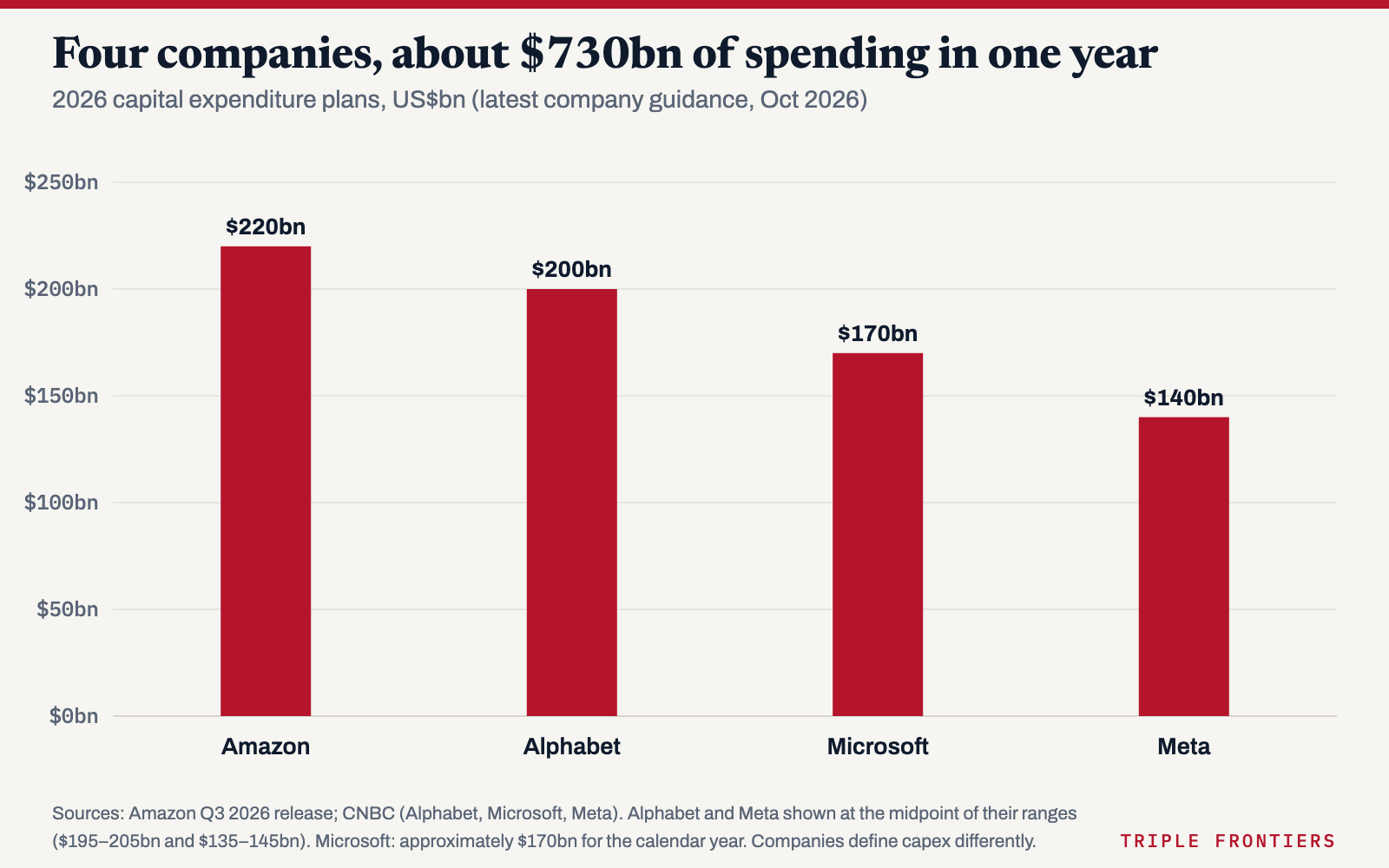
Four American technology companies plan to spend about $730bn on capital projects in 2026, largely data centres for artificial intelligence 12. Amazon expects about $220bn of capital expenditure this year, Alphabet $195bn to $205bn, Microsoft $170bn and Meta $135bn to $145bn 2345. The total is Triple Frontiers’ sum of the companies’ own guidance, using the midpoints of Alphabet’s and Meta’s ranges; each defines capital spending slightly differently 35.
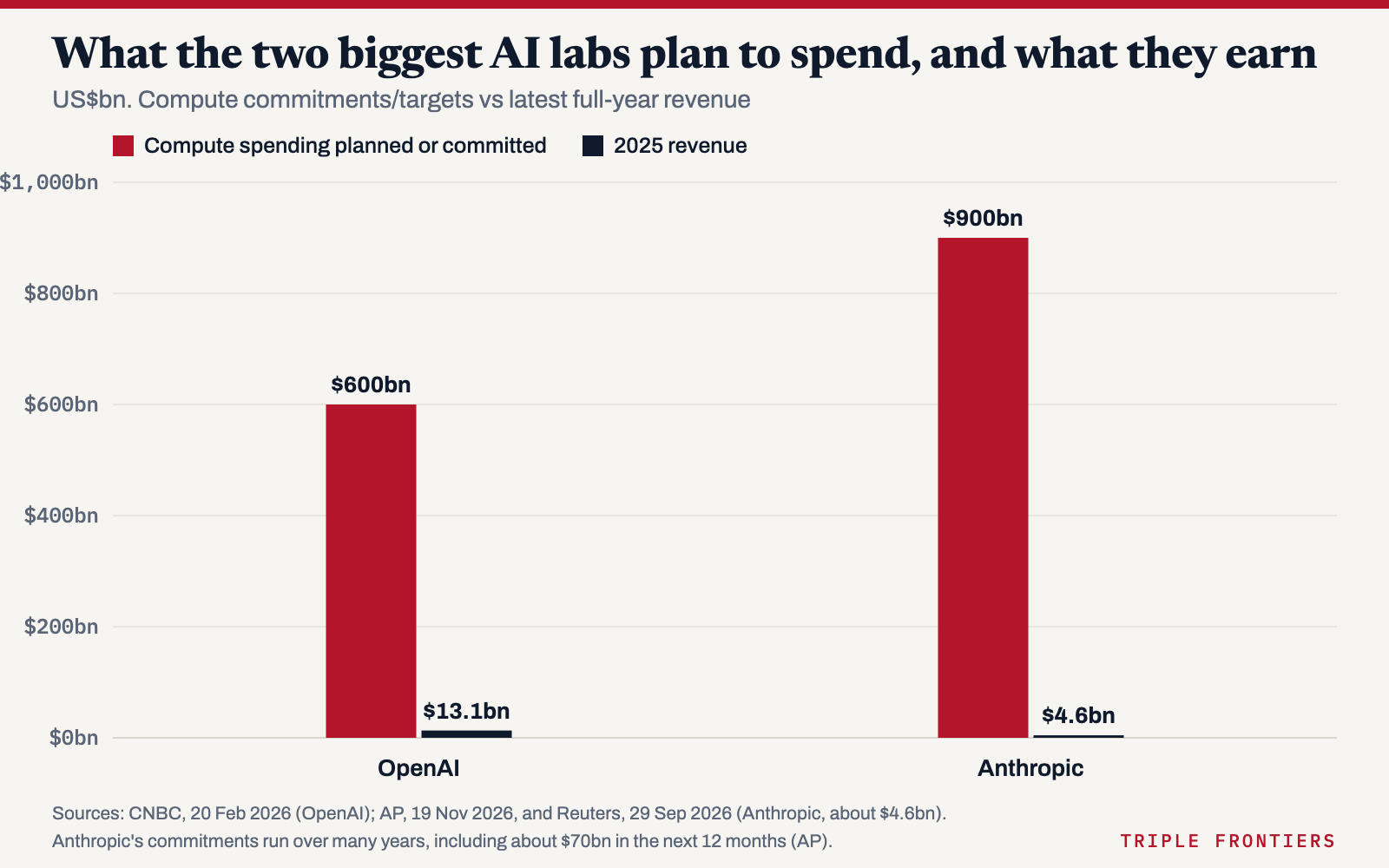
The revenue from AI is growing fast, but from a much smaller base. OpenAI took in $13.1bn in revenue in 2025, according to people familiar with its finances who spoke to CNBC, and is targeting about $600bn of computing spend by 2030 6. Anthropic, which listed on Nasdaq this week, has signed deals requiring it to spend $900bn on computing power and infrastructure in the coming years, the Associated Press reported, against revenue of about $16.3bn in the first half of 2026, according to Reuters 78.
Whether that gap is a bubble or the early stage of a long build-out is the question markets are now trading on. Triple Frontiers reviewed company earnings releases, bond market data, the AI labs’ disclosed figures as reported by wire services, and published research on past investment booms. The figures below are what the record shows; the forecasts are labelled as forecasts.
How big is the spending?
Amazon said its free cash flow, the cash left after capital spending, turned to an outflow of $42.4bn over the twelve months to September, driven by a $94.8bn year-on-year increase in purchases of property and equipment that it said “primarily reflects investments in artificial intelligence” 2. Alphabet reported negative free cash flow of $9.07bn in the third quarter and Meta negative $2.12bn; Microsoft was the only one of the four still positive, at $18.63bn, down 27% 13.
None of the four is slowing. Alphabet’s finance chief said its capital spending would “increase significantly” in 2027 3. Microsoft trimmed its forecast for the year from $175bn to $170bn after delays in capacity from third parties, a figure CNBC said still showed no sign of a slowdown 49.
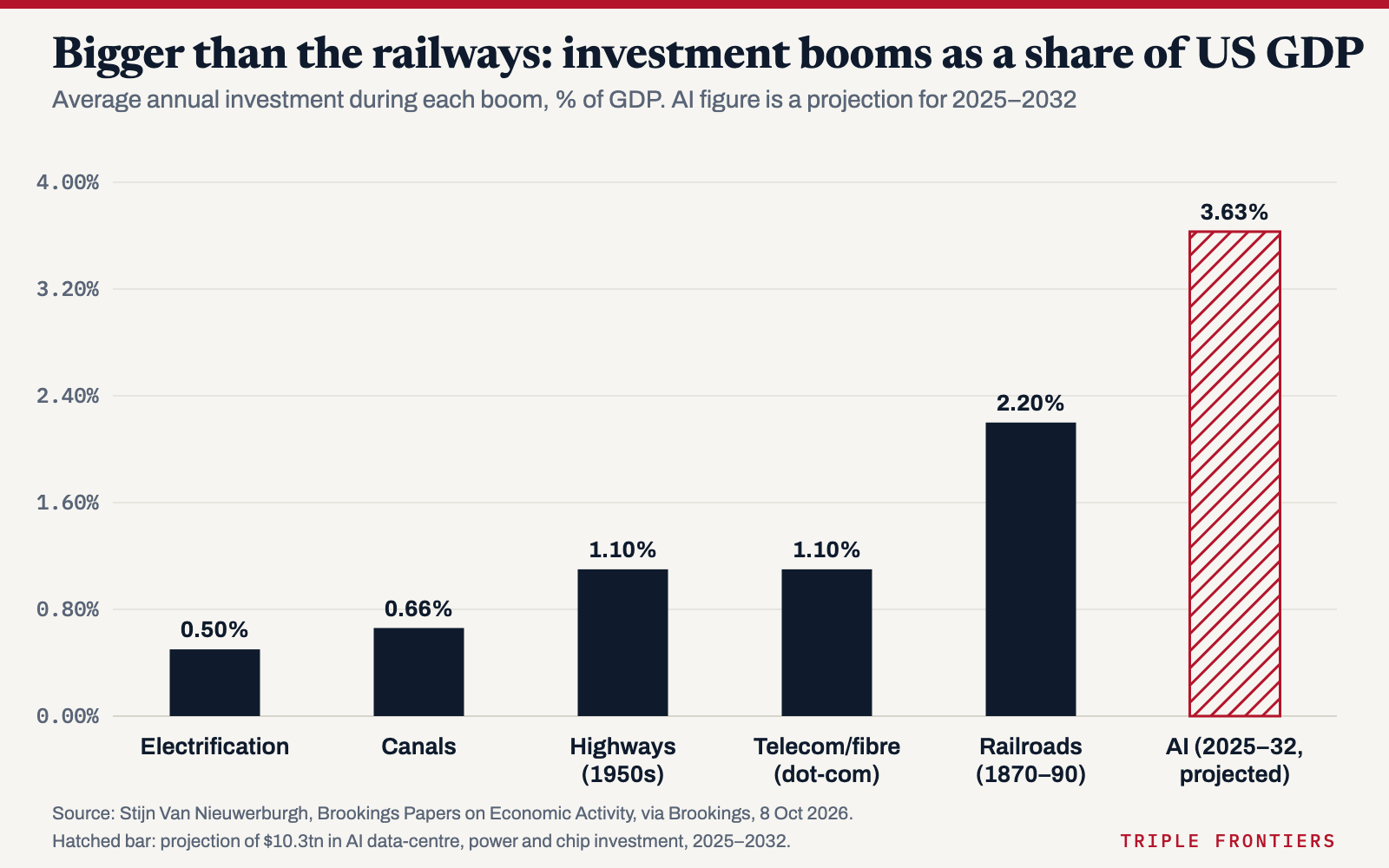
Investment on this scale is unusual by historical standards. A paper by the Columbia Business School economist Stijn Van Nieuwerburgh, published by Brookings, projects that AI investment in data centres, power and chips could total $10.3tn from 2025 to 2032, or 3.63% of US GDP a year 10. On the same basis he puts the railroad boom of 1870 to 1890 at about 2.2% of GDP, the 1950s highway build-out and the telecom and fibre boom of the dot-com era at about 1.1% each, canals at 0.66% and electrification at about 0.5% 10. The AI figure is a projection; the others are history.
Who is paying for it?
Increasingly, lenders and new shareholders. US companies sold a record $1.88tn of investment-grade bonds in 2026 to early November, and Amazon, Alphabet, Meta, Microsoft and Oracle accounted for more than $370.7bn of it, about a fifth, according to LSEG data reported by Reuters 11. Meta announced a $95bn offering of new shares to fund its AI plans in October 12, after a $27bn deal with the private credit firm Blue Owl Capital to finance a data centre in Louisiana 13.
Chipmakers are also financing their own customers. Nvidia’s finance chief, Colette Kress, said the company’s credit guarantees had reached $118bn, including $105bn of support for a data centre project in Ohio that will be leased to OpenAI for 20 years, Fortune reported 14.
There is also a question about how fast the equipment loses value. Chris Brightman of the investment firm Research Affiliates argues that “the economic life of AI hardware is [a lot] shorter than its accounting life”, because newer chips make older ones uncompetitive within a few years 15. If he is right, the depreciation that companies record understates the true cost of the build-out 15.
How much revenue is coming back?
The two leading AI labs’ revenue is rising quickly, and so are their losses. OpenAI’s $13.1bn in 2025 revenue came with $8bn of cash burn, CNBC reported; the company projects more than $280bn of revenue in 2030 6. Anthropic’s revenue grew roughly twelvefold in 2025 to nearly $4.6bn while it lost $42bn, most of it an accounting charge on convertible financing, Reuters reported 16. In the first half of 2026 its net loss was $80.7bn, again largely from the rising value of convertible bonds, and the company warned in its prospectus that its revenue growth rate could decline 8.
Consumer use is wide but mostly free. ChatGPT had 900 million weekly users and 50 million paying subscribers in February, OpenAI said, or roughly one paying user in 18 17. Business adoption is lower. The US Census Bureau’s business survey found that between 17% and 20% of American firms used AI from December 2025 to May 2026 18. A 2025 study from MIT, based on 150 interviews, a survey of 350 employees and 300 public deployments, found that most corporate generative AI pilots had delivered little or no measurable effect on profit and loss 19.
How wide is the gap?
Several analysts have tried to measure it. In June 2024 David Cahn of the venture firm Sequoia Capital estimated how much AI revenue the industry’s chip spending implied and concluded that “the $125B hole is now a $500B hole” 20. In September 2025 the consultancy Bain & Company estimated that $2tn of annual revenue would be needed by 2030 to fund the computing power that expected AI demand requires, and that even counting AI-related savings the world would be $800bn short 21.
Both estimates rest on assumptions about prices, costs and demand, and both predate the latest growth in AI revenue. They measure the size of the bet, not its outcome.
Are markets losing faith?
AI-linked shares have fallen sharply this month. On 5 November, Nvidia fell 9.3%, AMD 17.3%, Micron 17.5% and Broadcom 10.4% in a broad sell-off of AI-linked shares, CNBC reported 22. On 19 November the Dow Jones index lost 2.2% and the Nasdaq 2.3%, as investors weighed whether AI would deliver the productivity and profit growth companies are counting on, according to CBS News 23.
Industry leaders have used the word bubble themselves. Sam Altman, OpenAI’s chief executive, said in 2025 that in bubbles “smart people get overexcited about a kernel of truth” 24. Jeff Bezos called it “a kind of industrial bubble, as opposed to financial bubbles”, the kind that can leave useful infrastructure behind 24. Sundar Pichai, Alphabet’s chief executive, acknowledged “irrationality” in the boom and said no company would be immune if it burst 25.
The case that demand is real
The companies doing the spending say their customers are queuing. “We still have demand that exceeds supply,” Microsoft’s finance chief, Amy Hood, said in October 9. Oracle’s remaining performance obligations, contracted revenue not yet booked, stood at $664bn in September 26. “I don’t worry about a bubble, because I see committed demand for it,” Oracle’s co-chief executive Clay Magouyrk told CNBC 27.
Sceptics question how firm some of those commitments are. “OpenAI made commitments that it’s highly unlikely they’ll be able to live up to,” Gil Luria, an analyst at D.A. Davidson, told CNBC 27. Whether the revenue arrives in time to pay for the build-out is a question these figures cannot settle. They do show the scale of the wager: about $730bn of spending by four companies this year, financed increasingly with borrowed money, against AI developers whose revenue so far is a small fraction of the computing they have committed to buy, and who report large net losses 678.
The documents
-
Amazon third-quarter 2026 results29 October 2026. Company release: $220bn capex guidance and $42.4bn free cash outflow.Read (Amazon third-quarter 2026 results)
-
The $10 trillion question: financing the AI buildoutBrookings, 8 October 2026. Van Nieuwerburgh's comparison of investment booms.Read (The $10 trillion question: financing the AI buildout)
-
AI's $600B QuestionSequoia Capital, June 2024. David Cahn's revenue-gap estimate.Read (AI's $600B Question)
-
Bain Global Technology Report 202523 September 2025. The $2tn revenue requirement and $800bn shortfall.Read (Bain Global Technology Report 2025)
-
US Census Bureau: AI use by businessesMay 2026. Business Trends and Outlook Survey data.Read (US Census Bureau: AI use by businesses)
How we reported this
Capital spending figures are the companies’ own guidance as published in their releases or reported by CNBC; the $730bn total uses the midpoints of Alphabet’s and Meta’s ranges and is our sum 2345. OpenAI does not publish audited accounts; its figures are as reported by CNBC from people familiar with its finances 6. Anthropic’s figures are from its prospectus as reported by Reuters and the Associated Press 7816. Where sources gave different figures, we named the source for each. Forecasts, including revenue projections and the Brookings investment estimate, are labelled as such.
Disclosure: Triple Frontiers uses AI tools, including Anthropic’s Claude, in research and drafting, as set out in our standards. This report includes figures about Anthropic and OpenAI; we used only numbers published by the companies or reported by named news organisations.
Sources and references
- ArticleCNBC, “Big Tech needs legacy businesses to grow to fund AI buildout”, 30 October 2026. Link
- ArticleAmazon via Business Wire/Finviz, “Amazon.com announces third quarter results (company release)”, 29 October 2026. Link
- ArticleCNBC, “Alphabet Q3 2026 earnings”, 28 October 2026. Link
- ArticleCNBC, “AI buildout hits snag as Google and Microsoft put off raising capex forecasts”, 29 October 2026. Link
- ArticleCNBC, “Meta Q3 2026 earnings live updates”, 21 October 2026. Link
- ArticleCNBC, “OpenAI resets spend expectations, targets around $600 billion by 2030”, 20 February 2026. Link
- ArticleAP via Korea JoongAng Daily, “Anthropic prices its IPO at $83 per share”, 19 November 2026. Link
- ArticleReuters via Khaleej Times, “Anthropic’s IPO filing shows explosive growth, risks and staggering costs”, 26 October 2026. Link
- ArticleCNBC, “Microsoft Q1 fiscal 2027 earnings”, 28 October 2026. Link
- ArticleBrookings Institution, “The $10 trillion question: financing the AI buildout”, 8 October 2026. Link
- ArticleReuters via Yahoo Finance, “Big Tech set to drive US corporate bond sales to annual record high”, 6 November 2026. Link
- ArticleSemafor, “Meta announces $95B offering to fund AI”, 26 October 2026. Link
- ArticleReuters via Yahoo Finance, “Meta in $27 billion financing deal with Blue Owl Capital”, 22 October 2025. Link
- ArticleFortune, “Nvidia’s equity stakes and guarantees”, 18 November 2026. Link
- ArticleFortune, “Hyperscalers spending billions on hardware”, 15 April 2026. Link
- ArticleThe Next Web (citing Reuters), “Anthropic lost $42bn in 2025 as revenue grew 12-fold, Reuters reports”, 29 September 2026. Link
- ArticleTechCrunch, “ChatGPT reaches 900M weekly active users”, 27 February 2026. Link
- ArticleUS Census Bureau, “AI use by businesses”, 26 May 2026. Link
- ArticleFortune, “MIT report: 95% of generative AI pilots at companies are failing”, 18 August 2025. Link
- ArticleSequoia Capital (David Cahn), “AI’s $600B Question”, 20 June 2024. Link
- ArticleBain & Company, “$2 trillion in new revenue needed to fund AI’s scaling trend”, 23 September 2025. Link
- ArticleCNBC, “AI data centre stocks sell off after midterms”, 6 November 2026. Link
- ArticleCBS News (AP contributed), “Dow tumbles as Wall Street confronts AI fears”, 20 November 2026. Link
- ArticleFortune, “Bezos calls AI an industrial bubble”, 4 October 2025. Link
- ArticleAFP via BNN Bloomberg, “Google boss warns no company immune if AI bubble bursts”, 18 November 2025. Link
- ArticleCNBC, “Oracle Q1 fiscal 2027 earnings”, 10 September 2026. Link
- ArticleCNBC, “AI data centres and debt”, 31 December 2025. Link
Sources and references are provided for transparency and further reading. Allegations and claims are attributed to their respective sources. Triple Frontiers distinguishes reported allegations from independently established facts.
Corrections and updates
The Frontier Brief
The week’s essential international reporting and new investigations, every Friday.