Thirty years of climate texts: how fossil fuels got into the COP decisions, and who took them out
We searched the main decisions of UN climate summits from Berlin in 1995 to Belém in 2025. Fossil fuels were named in those of three meetings, each time in softer words than the drafts. Antalya's COP31 collapsed on 22 November over their absence.
Key findings
- In the main decisions we searched from 1995 to 2019, including Kyoto and Paris, the word ‘fossil’ does not appear; the 1992 Convention names fossil fuels only to protect dependent economies. Confirmed
- Glasgow’s 2021 pact was the first COP decision to target coal: ‘phasedown of unabated coal power’, after China and India proposed ‘phase down’ from the floor. Confirmed
- Dubai’s 2023 stocktake decision calls for ‘transitioning away from fossil fuels in energy systems’ after phase-out language was dropped; Carbon Brief names OPEC members including Saudi Arabia among opponents. Confirmed
- The main decisions adopted in Baku (2024) and Belém (2025) do not contain the word ‘fossil’; Brazil moved a fossil fuel roadmap outside the decision. Confirmed
- Antalya’s COP31 ended without a cover decision; the EU’s lead minister says ‘some oil states’ hijacked it and Saudi Arabia opposed EU amendments, while Saudi Arabia, for the Arab Group, says all solutions should stay on the table. Disputed
Confirmedbacked by documents or on-record sourcesAllegedclaimed by sources, not provenDisputedcontested by the parties involved
In the main decisions of the UN climate summits we read, from Berlin in 1995 to Belém in 2025, the words “fossil fuel” appear in those of three meetings: Glasgow in 2021, Sharm el-Sheikh in 2022 and Dubai in 2023 12345. Before Glasgow, none of the decisions we searched named coal, oil or gas as something to cut 67891011121314. After Dubai, the main decisions adopted in Baku and Belém did not name them at all 1516.
On Sunday 22 November 2026 the 31st summit, COP31 in Antalya, Türkiye, ended without adopting its main text after the European Union and others rejected a draft that did not mention fossil fuels 1718. COP stands for Conference of the Parties, the yearly meeting of the countries that signed the 1992 UN climate convention 19. Triple Frontiers read the decision texts themselves, searched each one for the words “fossil”, “coal” and “subsidies”, and matched the changes in wording to the day-by-day account of the talks in the Earth Negotiations Bulletin, a reporting service run by the International Institute for Sustainable Development (IISD) 202122.
The pattern is consistent. Fossil fuels entered the texts late, each time in softer words than the first drafts, and the countries that objected are named in the negotiators’ accounts: India and China at Glasgow, Saudi Arabia and the Arab Group and the Like-Minded Developing Countries at Dubai, and, by the account of the EU’s lead minister, Saudi Arabia again at Antalya 202317.
1992 to 2019: fossil fuels as an interest to protect
The 1992 Framework Convention on Climate Change does mention fossil fuels, but not as a problem to solve 19. Its preamble recognises “the special difficulties” of countries “whose economies are particularly dependent on fossil fuel production, use and exportation” 19. Article 4 lists countries “highly dependent on income generated from the production, processing and export, and/or consumption of fossil fuels” among those whose needs must be considered 19.
The first summit, in Berlin in 1995, adopted the Berlin Mandate, which launched talks on a protocol; its decisions do not contain the word “fossil” 6. The Kyoto Protocol, adopted in 1997, set binding emission limits for industrialised countries 7. Its Article 2 lists policies they could use, including the “progressive reduction or phasing out of market imperfections, fiscal incentives, tax and duty exemptions and subsidies in all greenhouse gas emitting sectors” 7. It does not name fossil fuels; oil and gas appear as a category of emission sources in its annex, not as something to reduce 7.
The same holds for the decisions we checked from Bali in 2007, Copenhagen in 2009, Cancún in 2010, Durban in 2011, Katowice in 2018 and Madrid in 2019: none contains the word “fossil” 10811121314.
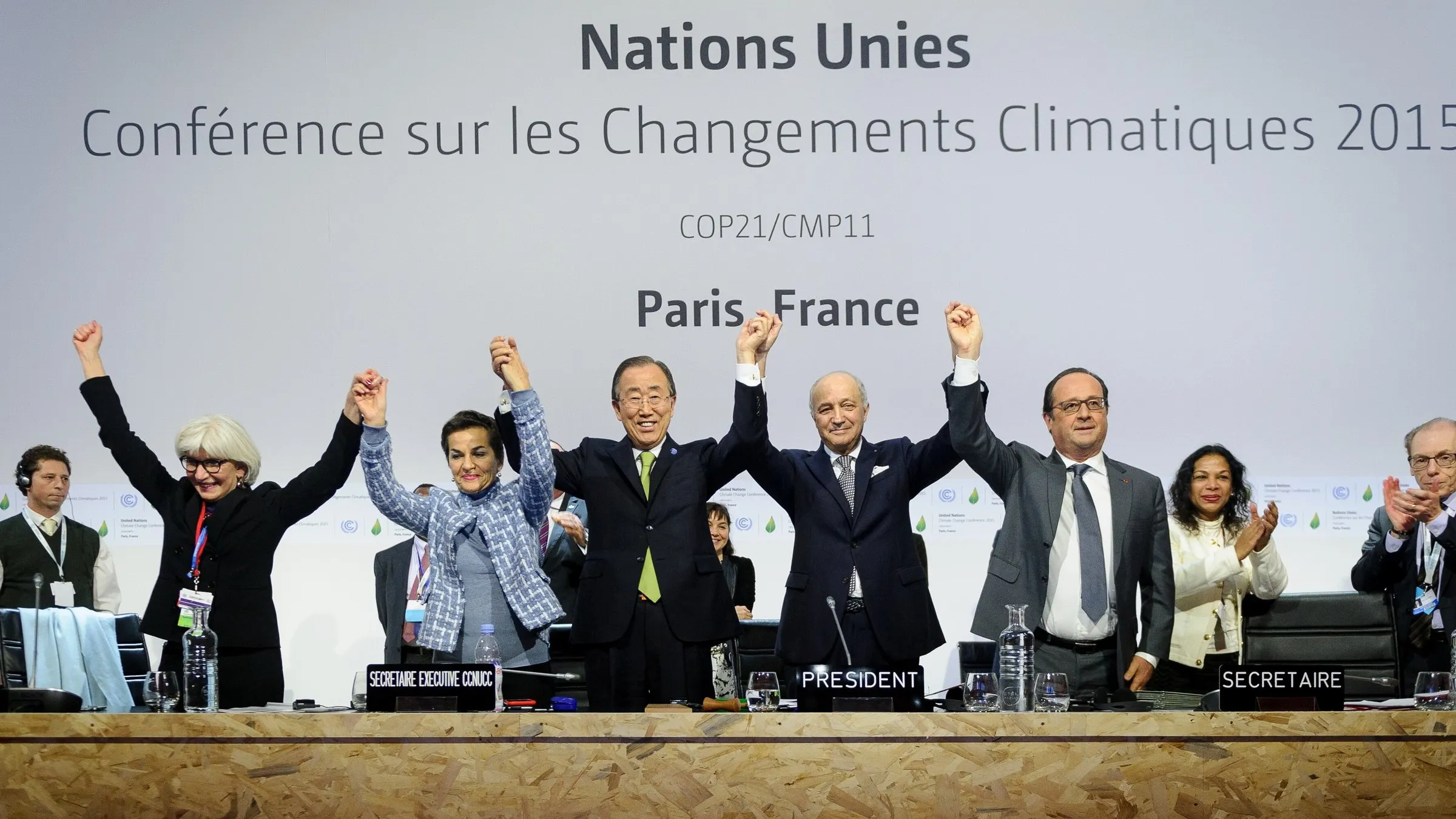
The Paris Agreement, adopted in December 2015, is the treaty that set the goal of holding warming “well below 2” degrees 9. We searched the full decision 1/CP.21, with the agreement annexed to it: it contains neither “fossil”, nor “coal”, nor “subsidies” 9. Its one reference to energy is in the decision’s opening paragraphs, on “universal access to sustainable energy in developing countries” through renewable energy 9.
Glasgow 2021: coal enters, and “phase-out” becomes “phasedown”
The Glasgow Climate Pact, adopted in November 2021, was in Carbon Brief’s words the “first-ever COP decision to explicitly target action against fossil fuels” 24. The Earth Negotiations Bulletin said it included “for the first time” a reference to phasing down unabated coal power 25.
The adopted text, paragraph 36 of decision 1/CMA.3 and paragraph 20 of decision 1/CP.26, calls on countries to accelerate “efforts towards the phasedown of unabated coal power and phase-out of inefficient fossil fuel subsidies” 21. The first draft, on 10 November, had called for accelerating “the phasing-out of coal and subsidies for fossil fuels”, according to Carbon Brief 24. A draft of 13 November spoke of “the phase-out of unabated coal power and inefficient fossil fuel subsidies” 24.
The last change came in the closing plenary. According to the bulletin, the US, China, India, South Africa and others had wanted to limit the text to unabated coal and inefficient subsidies, while the Alliance of Small Island States (AOSIS) and the least developed countries called for phasing out all coal and all fossil fuel subsidies 20. After “an informal huddle” with the US, the EU and the COP26 president, Alok Sharma, China and India proposed the “phase down” amendment from the floor 20. The Environmental Integrity Group, a bloc that includes Switzerland, the EU, the Marshall Islands, Fiji and Antigua and Barbuda said they were disappointed with the language and how it was introduced, but accepted it “in the spirit of compromise” 20. Carbon Brief noted the coal change was largely symbolic because the text set no timelines 24.
Sharm el-Sheikh 2022: the Glasgow line, word for word
A year later in Egypt the cover decisions repeated Glasgow’s sentence almost word for word, in paragraph 16 of decision 1/CP.27 and paragraph 28 of decision 1/CMA.4 34. Many countries had wanted to go further and phase down “all fossil fuels, not just coal”, the bulletin reported 25. The EU said in the closing plenary that there was no agreement to phase out fossil fuels “despite the support of over 80 countries”, in the bulletin’s summary 25. During the talks, Saudi Arabia, speaking for the Arab Group, said references to renewable energy should be complemented by abatement and removal technologies and that the focus should be on emissions 25.
Dubai 2023: “transitioning away”
The first global stocktake, the Paris Agreement’s review of collective progress, was concluded at COP28 in Dubai 5. Paragraph 28 of decision 1/CMA.5 calls on countries to contribute, “in a nationally determined manner”, to global efforts including “transitioning away from fossil fuels in energy systems, in a just, orderly and equitable manner” so as to reach net zero by 2050 5. The same paragraph repeats the coal phase-down and calls for “phasing out inefficient fossil fuel subsidies that do not address energy poverty or just transitions, as soon as possible” 5. Paragraph 29 adds that “transitional fuels can play a role in facilitating the energy transition while ensuring energy security” 5.
According to Carbon Brief, this was “the first time a COP decision has explicitly called out all fossil fuels” 23. Earlier drafts had offered options including “a fossil fuel phase-out”; a draft of 11 December dropped “phase-out” and was widely rejected 2321. Carbon Brief reported that OPEC members in the Arab Group, “including Saudi Arabia”, were prominent among those opposing phase-out language, and that the Like-Minded Developing Countries, a negotiating group that includes China and India, opposed it too 23. The bulletin said opponents “preferred to focus on emissions, rather than their sources”, which would leave room for carbon capture and for natural gas as a “transitional fuel” 21.
Fossil fuels in the main COP texts
-
Climate convention names fossil fuels only to protect dependent economies.
-
Kyoto Protocol: phase out subsidies in emitting sectors; no ‘fossil’.
-
Key moment. Paris Agreement and decision 1/CP.21: no ‘fossil’, ‘coal’ or ‘subsidies’.
-
Key moment. Glasgow: ‘phasedown of unabated coal power’, after India-China amendment.
-
Sharm el-Sheikh repeats Glasgow; ‘all fossil fuels’ not agreed.
-
Key moment. Dubai: ‘transitioning away from fossil fuels in energy systems’.
-
Baku: no ‘fossil’ in the CMA decisions adopted.
-
Belém: Mutirão decision silent; Brazil launches roadmaps outside it.
-
Key moment. Antalya: cover decision not adopted over fossil fuel omission.
Baku, Belém and Antalya: the retreat
The first decision adopted at COP29 in Baku in 2024 set a new climate finance goal 15. The seven decisions in the addendum we searched do not contain the word “fossil” 15. “Fossil fuels are largely missing from the decisions adopted in Baku,” the bulletin wrote; a draft on following up the stocktake, which referred back to Dubai’s energy paragraph, was not adopted 26. In talks on a just transition, the Like-Minded Developing Countries, Russia and a few others rejected recognising economic opportunities from transitioning away from fossil fuels 26.
At COP30 in Belém in 2025 the main outcome, the “Global Mutirão” decision, recalls the Dubai stocktake decision by number but does not mention fossil fuels, coal or subsidies for them 16. The bulletin reported that many delegations wanted some reference to a fossil fuel phase-out, possibly through roadmaps, but it did not make it into the adopted decision 22. During the talks the Arab Group said that text “targeting any sector of their economies” was off the table 22. Brazil’s presidency responded by announcing two roadmaps of its own, outside the decision: one on the transition away from fossil fuels, one on deforestation, to report back at COP31 22.
In Antalya, the first draft of the cover decision called for countries to accelerate the Dubai commitment and contained a call for the accelerated phasing out of fossil fuels, RTÉ reported; by 19 November both had gone, along with a reference to Brazil’s roadmap 27. The final draft did not mention coal, oil or gas, according to AFP, and introduced “an oblique reference” to the Dubai deal 18. Ireland’s climate minister, Darragh O’Brien, speaking for the EU, said the bloc would not endorse a decision “that does not even mention fossil fuels” 18. Panama, the Marshall Islands, Vanuatu and Belize also rejected it, AFP reported 18. COP31 president Murat Kurum said there would be “no new text from now on” 1728.
The case against reading too much into the words
A missing sentence does not cancel an old one: the failure in Antalya “does not erase the obligations agreed by previous UN conferences”, according to AFP and Reuters reporting carried by RTÉ, and the Dubai paragraph stands 175. Even the Glasgow and Dubai texts leave each country to act “in line with national circumstances” or “in a nationally determined manner”, and set no dates for coal 2524.
Some of the work has also moved outside the decisions. By 20 November six European countries had published national roadmaps for moving away from fossil fuels and 21 others, including Brazil, had said they would, the bulletin reported; it added that “a few Parties block any references to it in the cover decision negotiations” 29.
The next tests are already set. The second global stocktake is due in 2028, and countries are still arguing over whether the IPCC, the UN’s climate science panel, will publish its next reports in time for it 18. COP32 is due to meet in Ethiopia in 2027 22. Whether its main decision repeats the words agreed in Dubai, “transitioning away from fossil fuels in energy systems”, is the clearest measure of whether Antalya was a pause or a reversal 5.
The documents
-
UN Framework Convention on Climate Change (1992)Certified text. Preamble and Article 4 on fossil-fuel-dependent economies.Read (UN Framework Convention on Climate Change (1992))
-
Kyoto Protocol, in decision 1/CP.3FCCC/CP/1997/7/Add.1. Article 2.1(a)(v) on subsidies in emitting sectors.Read (Kyoto Protocol, in decision 1/CP.3)
-
Decision 1/CP.21 and the Paris AgreementFCCC/CP/2015/10/Add.1, 36 pages. No 'fossil', 'coal' or 'subsidies'.Read (Decision 1/CP.21 and the Paris Agreement)
-
Glasgow Climate Pact, decision 1/CMA.3FCCC/PA/CMA/2021/10/Add.1. Paragraph 36: coal phasedown, subsidy phase-out.Read (Glasgow Climate Pact, decision 1/CMA.3)
-
Sharm el-Sheikh Implementation Plan, decision 1/CP.27FCCC/CP/2022/10/Add.1. Paragraph 16 repeats Glasgow.Read (Sharm el-Sheikh Implementation Plan, decision 1/CP.27)
-
First global stocktake, decision 1/CMA.5FCCC/PA/CMA/2023/16/Add.1. Paragraphs 28 and 29.Read (First global stocktake, decision 1/CMA.5)
-
Baku decisions 1-7/CMA.6FCCC/PA/CMA/2024/17/Add.1. No 'fossil'.Read (Baku decisions 1-7/CMA.6)
-
Global Mutirão decision text, BelémFCCC/PA/CMA/2025/L.24, eight pages. Recalls 1/CMA.5; no 'fossil'.Read (Global Mutirão decision text, Belém)
-
Earth Negotiations Bulletin, COP26 summaryVol. 12 No. 793. The India-China amendment and reactions.Read (Earth Negotiations Bulletin, COP26 summary)
-
Earth Negotiations Bulletin, COP30 summaryVol. 12 No. 888. Mutirão talks and Brazil's roadmaps.Read (Earth Negotiations Bulletin, COP30 summary)
Saudi Arabia and the Arab Group. At Sharm el-Sheikh in 2022 Saudi Arabia, for the Arab Group, said the focus should be on emissions and that renewable energy should be complemented by abatement and removal technologies 25. In Dubai it called for upholding the various approaches in the Convention and Paris Agreement to address emissions “regardless of the sources of those emissions”, in the bulletin’s summary 21. In Antalya the Saudi negotiator Mohammad Ayoub, for the Arab Group, said: “We believe that climate change requires all solutions on the table and that countries select from these solutions depending on their national circumstances” 18. A Saudi representative told the closing plenary he was surprised at the resistance to technology, Reuters reported 28.
European Union. After Dubai the EU welcomed the outcome “for signaling the beginning of the end of fossil fuels”, the bulletin reported 21. In Antalya Darragh O’Brien said: “It is unconscionable that we would have a climate act that makes no reference to fossil fuel, no reference to transitioning away from fossil fuels” 1728. He told AFP the summit had been “hijacked by some oil states” 18. He told RTÉ that Saudi Arabia had opposed the EU’s amendments and, in his view, had far too much influence 17.
India. In Glasgow India’s environment minister, Bhupender Yadav, asked: “How can anyone expect that developing countries can make promises about phasing out coal and fossil fuel subsidies?” He added: “Developing countries have still to deal with their development agendas and poverty eradication” 30. In 2022 India said the Glasgow pact should not have the same status as the Convention and the Paris Agreement 25.
China. China co-proposed the Glasgow “phase down” amendment with India 20. At Sharm el-Sheikh it said it was developed countries, not developing countries, that were backsliding on commitments 25.
Small island states. AOSIS called in Glasgow for phasing out all coal and all fossil fuel subsidies 20. “We see a litany of loopholes,” its statement said after Dubai 31. “It does not deliver on a subsidy phaseout, and it does not advance us beyond the status quo” 31. In Antalya the Marshall Islands climate envoy, Kathy Jetnil-Kijiner, said: “We will not compromise our future to benefit fossil fuel interests” 18.
How we reported this
We downloaded the official decision documents of the summits listed below from the UN Official Document System, because the UNFCCC website refused automated access, and searched the full extracted text of each for “fossil”, “coal” and “subsidies” 695. We counted the decision addenda we opened: COP1, COP3, COP13, COP15, COP16, COP17, COP21, COP24, COP25, COP26, COP27, the Paris Agreement meetings of 2021 to 2024, and the Belém Mutirão text, document FCCC/PA/CMA/2025/L.24 67108111291314132451516. We did not read the decisions of the other summits, technical decisions filed in separate addenda, or the Kyoto Protocol meetings’ decisions, so our statements of absence apply to these documents alone 615. Mentions in annexed technical reports, such as the finance committee’s figures on fossil fuel subsidies in the Glasgow addendum, were not counted as cover-decision wording 1. We could not open the Antalya draft texts on the UNFCCC site and relied on RTÉ, AFP, Reuters and the Earth Negotiations Bulletin for their content 27182829. Who objected is stated where the bulletin, Carbon Brief or a named minister said so; Carbon Brief pages were read through a fetching tool, and its quotations are as reported there 202423.
Sources and references
- Official documentUNFCCC (via UN Official Document System), “FCCC/CP/2021/12/Add.1: Decisions of COP26 (Glasgow), incl. 1/CP.26 Glasgow Climate Pact”. Link
- Official documentUNFCCC (via UN Official Document System), “FCCC/PA/CMA/2021/10/Add.1: Decision 1/CMA.3, Glasgow Climate Pact”. Link
- Official documentUNFCCC (via UN Official Document System), “FCCC/CP/2022/10/Add.1: Decision 1/CP.27, Sharm el-Sheikh Implementation Plan”. Link
- Official documentUNFCCC (via UN Official Document System), “FCCC/PA/CMA/2022/10/Add.1: Decision 1/CMA.4, Sharm el-Sheikh Implementation Plan”. Link
- Official documentUNFCCC (via UN Official Document System), “FCCC/PA/CMA/2023/16/Add.1: Decision 1/CMA.5, Outcome of the first global stocktake”. Link
- Official documentUNFCCC (via UN Official Document System), “FCCC/CP/1995/7/Add.1: Decisions of COP1 (Berlin), incl. 1/CP.1 Berlin Mandate”, 6 June 1995. Link
- Official documentUNFCCC (via UN Official Document System), “FCCC/CP/1997/7/Add.1: Decisions of COP3 (Kyoto), incl. 1/CP.3 and the Kyoto Protocol”, 25 March 1998. Link
- Official documentUNFCCC (via UN Official Document System), “FCCC/CP/2009/11/Add.1: Decisions of COP15 (Copenhagen), incl. 2/CP.15 Copenhagen Accord”, 30 March 2010. Link
- Official documentUNFCCC (via UN Official Document System), “FCCC/CP/2015/10/Add.1: Decision 1/CP.21, Adoption of the Paris Agreement (Agreement annexed)”, 29 January 2016. Link
- Official documentUNFCCC (via UN Official Document System), “FCCC/CP/2007/6/Add.1: Decisions of COP13 (Bali), incl. 1/CP.13 Bali Action Plan”, 14 March 2008. Link
- Official documentUNFCCC (via UN Official Document System), “FCCC/CP/2010/7/Add.1: Decisions of COP16 (Cancun), incl. 1/CP.16”. Link
- Official documentUNFCCC (via UN Official Document System), “FCCC/CP/2011/9/Add.1: Decisions of COP17 (Durban), incl. 1/CP.17”. Link
- Official documentUNFCCC (via UN Official Document System), “FCCC/CP/2018/10/Add.1: Decisions of COP24 (Katowice)”. Link
- Official documentUNFCCC (via UN Official Document System), “FCCC/CP/2019/13/Add.1: Decisions of COP25 (Madrid), incl. 1/CP.25”. Link
- Official documentUNFCCC (via UN Official Document System), “FCCC/PA/CMA/2024/17/Add.1: Decisions 1-7/CMA.6 (Baku), incl. new collective quantified goal on climate finance”, 27 March 2025. Link
- Official documentUNFCCC (via UN Official Document System), “FCCC/PA/CMA/2025/L.24: Global Mutirao: Uniting humanity in a global mobilization against climate change (proposal by the President, Belem)”. Link
- ArticleRTE, “COP31 climate talks collapse (AFP/Reuters)”, 22 November 2026. Link
- ArticlePhys.org / AFP, “COP31 fails to agree on climate deal in chaotic finale (AFP: Perry, Thomet, Ozerkan)”, 22 November 2026. Link
- Official documentUnited Nations, “United Nations Framework Convention on Climate Change (certified text, UN Treaty Collection)”, 9 May 1992. Link
- ReportIISD Earth Negotiations Bulletin, “Earth Negotiations Bulletin Vol. 12 No. 793, COP26 final summary”, 16 November 2021. Link
- ReportIISD Earth Negotiations Bulletin, “Earth Negotiations Bulletin Vol. 12 No. 842, COP28 final summary”, 18 December 2023. Link
- ReportIISD Earth Negotiations Bulletin, “Earth Negotiations Bulletin Vol. 12 No. 888, COP30 final summary”, 25 November 2025. Link
- ReportCarbon Brief, “COP28: Key outcomes agreed at the UN climate talks in Dubai”, December 2023. Link
- ReportCarbon Brief, “COP26: Key outcomes agreed at the UN climate talks in Glasgow”, November 2021. Link
- ReportIISD Earth Negotiations Bulletin, “Earth Negotiations Bulletin Vol. 12 No. 818, COP27 final summary”, November 2022. Link
- ReportIISD Earth Negotiations Bulletin, “Earth Negotiations Bulletin Vol. 12 No. 865, COP29 final summary”, 26 November 2024. Link
- ArticleRTE, “COP31 draft climate deal removes mention of fossil fuels (George Lee)”, 19 November 2026. Link
- ArticleCNBC, “COP31 climate talks break down as EU and others reject deal (Reuters)”, 22 November 2026. Link
- ReportIISD Earth Negotiations Bulletin, “Earth Negotiations Bulletin Vol. 12 No. 911, COP31 #10”, 20 November 2026. Link
- ArticleScientific American / E&E News, “Why India Defended Coal at the Close of the COP26 Climate Summit (E&E News)”, November 2021. Link
- ArticleNBC New York / CNBC, “Pacific Islands lash out at COP28 presidency: ‘We weren’t in the room’ when deal was announced (CNBC)”, 13 December 2023. Link
Sources and references are provided for transparency and further reading. Allegations and claims are attributed to their respective sources. Triple Frontiers distinguishes reported allegations from independently established facts.
Corrections and updates
The Frontier Brief
The week’s essential international reporting and new investigations, every Friday.