Trump’s tariffs explained: current rates, trade deals, court rulings and who pays
The Supreme Court struck down the Liberation Day tariffs in February 2026, but new tariffs under older trade laws, sector duties of up to 100% and a fight with Canada keep the average US tariff far above its level before 2025.
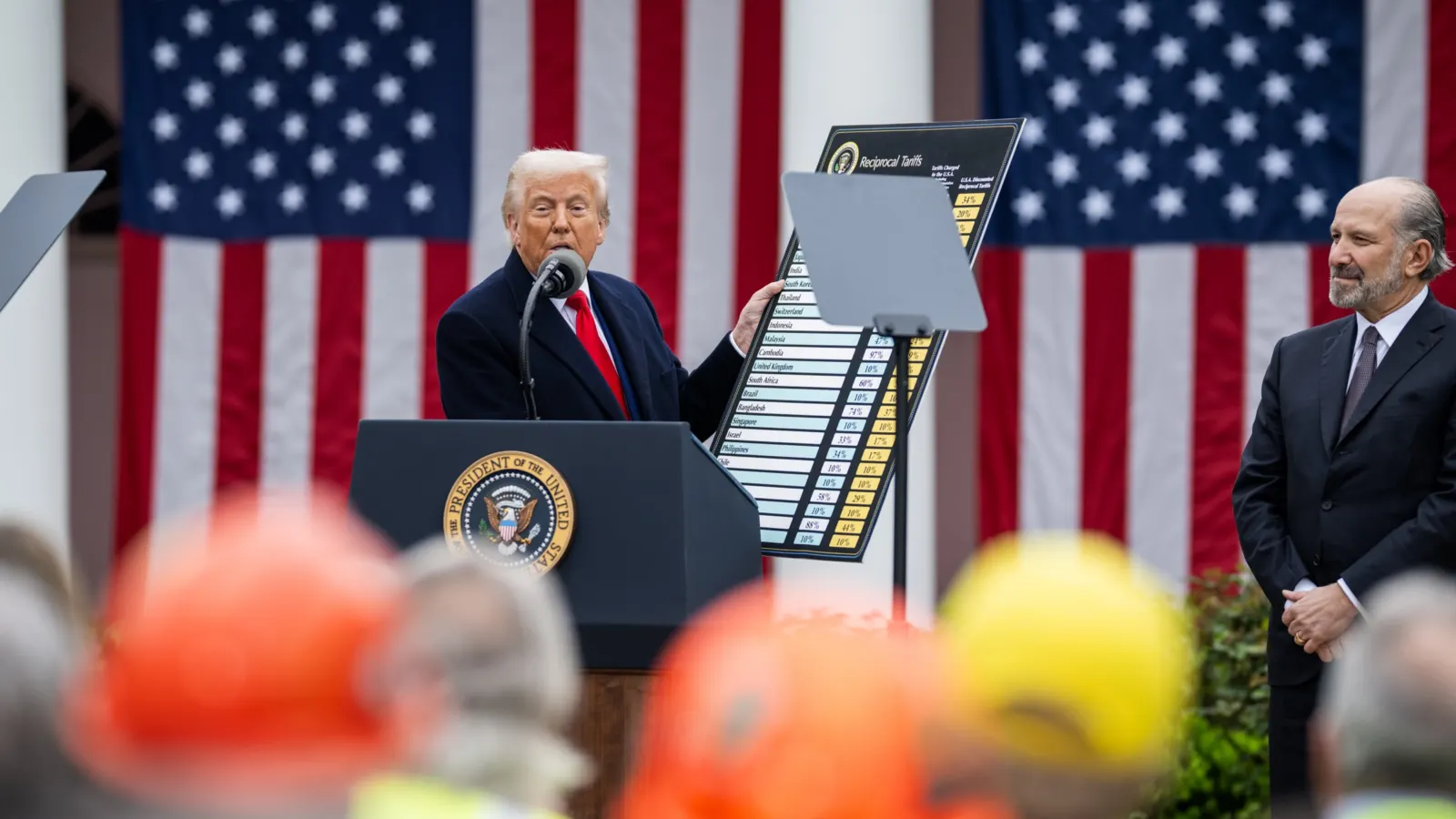
Trump’s tariffs are the import taxes the United States has imposed on almost every trading partner since 2025, first under an emergency-powers law and, since the Supreme Court struck those down in February 2026, under older trade laws. As of 24 November 2026 goods from most countries face a 10% or 12.5% “forced labour” tariff, with much higher sector tariffs on metals, cars, medicines and other goods, a 50% tariff on a list of Canadian products, and refunds of the struck-down duties still being paid.
The short version
- The “Liberation Day” tariffs of 2 April 2025 used the International Emergency Economic Powers Act (IEEPA), a 1977 sanctions law. The Supreme Court ruled 6–3 on 20 February 2026 that the law does not let a president impose tariffs.
- Country tariffs were rebuilt under other laws: a temporary 10% surcharge, then, from 24 July 2026, tariffs of 10% or 12.5% on 60 economies.
- Sector tariffs under Section 232, a national-security trade law, were not affected by the ruling. Steel, aluminium and copper pay up to 50%, cars 25% (15% for the EU, Japan and South Korea), and patented medicines up to 100%.
- Deals with the UK, the EU, Japan and South Korea now matter mainly for those sector tariffs; the EU deal took effect on 1 July 2026.
- Canada has no deal and faces 50% on about $20 billion of goods since 22 August 2026. The US–China truce runs to 10 January 2027.
- Studies by the New York Fed and the Kiel Institute find US importers and consumers have paid about 90% or more of the cost.
- Democrats won the 3 November midterm elections promising to roll the tariffs back, but they lack the votes to override a presidential veto.
Where things stand
As of 24 November 2026:
- The legal basis. No tariff is collected under IEEPA since the Supreme Court’s ruling in Learning Resources, Inc. v. Trump. The stopgap 10% surcharge under Section 122 of the Trade Act of 1974 expired on 24 July, as the accounting firm UHY reported that day.
- The broad tariff. Since 24 July, the US Trade Representative (USTR) has taxed imports from 60 economies it found had failed to ban goods made with forced labour.
- Refunds. A Customs and Border Protection (CBP) declaration filed on 10 November said $128.4 billion in refunds had been certified and sent to the Treasury for payment as of 5 November, according to a summary by the tax firm Sterlinx.
- China. China extended its truce measures, including suspension of a 24% tariff, to 10 January 2027, as set out in our explainer on the US–China truce.
- Congress. After the 3 November elections, House Democratic leader Hakeem Jeffries said “We should restore congressional authority as it relates to tariffs”, CNBC reported on 8 November. Trump told CNBC on 4 November: “If I took tariffs off — we have 3,000 plants under construction right now.”
Current tariff rates
Headline rates as of 24 November 2026; many goods are exempt. “MFN” is the normal tariff the US charges all World Trade Organization members.
| Country or sector | Rate | Legal basis | In force since | Source |
|---|---|---|---|---|
| UK, Canada, Mexico, India, Indonesia, Malaysia, Bangladesh and 10 other economies | 10% on top of MFN (USMCA-qualifying Canadian and Mexican goods exempt) | Section 301 (forced labour) | 24 July 2026 | USTR; Greenberg Traurig |
| EU, Taiwan | Higher of 10% or the MFN rate | Section 301 (forced labour) | 24 July 2026 | Greenberg Traurig |
| Japan, South Korea, Switzerland | Higher of 12.5% or the MFN rate | Section 301 (forced labour) | 24 July 2026 | Greenberg Traurig |
| China, Vietnam, Thailand, Australia, Singapore and other investigated economies | 12.5% on top of MFN | Section 301 (forced labour) | 24 July 2026 | Greenberg Traurig |
| China (all US tariffs combined) | 35.2% trade-weighted average, covering 89% of goods (22 August 2026) | Section 301 (2018 and 2026 actions), Section 232 | Various | Peterson Institute |
| Brazil | Extra 25%, on top of 12.5% (37.5% in total); beef, orange juice and civil aircraft exempt | Section 301 (digital trade and other practices) | 22 July 2026 | Federal Register; UHY |
| Canada (listed goods incl. dairy, alcohol, wood and consumer products) | 50%, on about $20 billion of imports; energy, potash and Section 232 goods excluded | Section 338, Tariff Act of 1930 | 22 August 2026 | White House; Covington |
| Steel, aluminium, copper | 50% on full value; 25% for derivative products; UK 25% (some derivatives 15%); some EU and Japanese derivatives capped at 15% including MFN to end-2027 | Section 232 | Revised by proclamations of 2 April and 1 June 2026 | White House; Congressional Research Service |
| Cars and parts | 25%; EU, Japan, South Korea 15% in total; UK 10% within a quota; US content of USMCA vehicles exempt | Section 232 | April 2025 (cars), May 2025 (parts) | Congressional Research Service |
| Softwood lumber; upholstered furniture, kitchen cabinets, vanities | 10%; 25% | Section 232 | 14 October 2025 | Tax Foundation; White House |
| Patented medicines | 100%; 15% for EU, Japan, South Korea, Switzerland, Liechtenstein; 20% or 0% for companies with onshoring or pricing deals; generics exempt | Section 232 | 31 July 2026 for large companies | White House; Tax Foundation |
| Certain advanced AI chips (e.g. Nvidia H200) | 25% | Section 232 | January 2026 | White House |
| Low-value parcels (under $800) | Duty-free “de minimis” treatment suspended; normal tariffs apply | CBP rules of June 2026 | 29 August 2025 (worldwide) | Triple Frontiers |
How we got here
- Trump orders tariffs of 25% on Canada and Mexico and 10% on China under IEEPA, citing migration and drugs (White House).
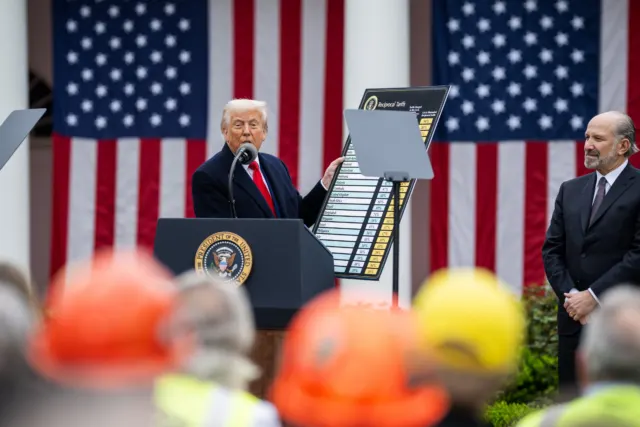
- On “Liberation Day” Trump announces a 10% tariff on all countries from 5 April and higher rates from 9 April (White House). The next day the Dow falls about 4%, the market’s worst day in five years (NPR).
- Trump pauses the higher rates for 90 days but raises China’s to 125% (executive order). The S&P 500 has its biggest one-day gain since October 2008 (Reuters).
- The UK reaches the first deal: 10%, and a quota of 100,000 cars a year at 10% (White House).
- In Geneva, the US and China each suspend 24 percentage points of their extra tariffs for 90 days (joint statement).
- The Court of International Trade rules that IEEPA does not authorise the tariffs (our history of the Liberation Day tariffs).
- Steel and aluminium tariffs double to 50%; the UK stays at 25% (Sandler, Travis & Rosenberg).
- The EU and US agree a deal at Turnberry, Scotland, with a 15% ceiling on most US tariffs (European Commission).
- Trump adds 40% to Brazil’s tariff over the prosecution of Jair Bolsonaro (our report) and ends duty-free parcels worldwide from 29 August (White House).
- Trump resets country rates: 15% for the EU and Japan, 10% for countries not listed (White House).
- The Federal Circuit appeals court affirms 7–4 that IEEPA does not authorise the tariffs, which stay in place pending appeal (Federal Circuit Blog).
- The Japan deal is implemented: 15% and $550 billion of Japanese investment (White House).
- After a Trump–Xi meeting in Busan, the US cuts fentanyl tariffs and China pledges rare-earth licences and soybean purchases (White House).
- South Korea gets 15%, including on cars, against $350 billion of investment (our report).
- The Supreme Court rules 6–3 that IEEPA does not authorise tariffs (NPR). Trump proclaims a 10% Section 122 surcharge from 24 February (proclamation).
- Trump imposes 100% on patented medicines and applies metals tariffs to full value (White House).
- The EU deal enters into force after the European Parliament’s approval on 16 June (France 24). The same day the US declines to extend the US–Mexico–Canada Agreement (USMCA), triggering annual reviews (DLA Piper).
- Trump imposes 50% tariffs on Canadian goods under Section 338, its first use for tariffs (Holland & Knight).
- The Section 122 surcharge expires and forced-labour tariffs on 60 economies begin, two days after a 25% tariff on Brazil (Greenberg Traurig; Federal Register).
- The Canadian tariffs take effect after talks fail; Canada’s counter-tariffs on $27.6 billion of US goods follow on 8 September (Covington).
- Democrats win the midterms in what CNBC called a landslide; 65% of voters in its poll said tariffs had hurt the economy.
- China extends its truce measures to 10 January 2027 (our US–China explainer).
Key numbers
| Figure | What it measures | Source and date |
|---|---|---|
| $317.8bn gross, $144.6bn refunded, $173.2bn net | US customs duties in fiscal year 2026 (October 2025 to September 2026) | US Treasury Monthly Treasury Statement, September 2026 |
| $19.2bn net ($31.4bn a year earlier) | Customs duties in October 2026, after $6.7bn of refunds | US Treasury, October 2026 |
| 7.2% (2025: 7.7%) | Effective tariff rate: customs revenue as a share of imports, 2026 estimate | Tax Foundation, updated November 2026 |
| 11.8% (2022: 1.5%) | Applied tariff rate: statutory rates weighted by imports, 2026 estimate | Tax Foundation |
| About $820 per household | Average tax increase from tariffs in 2026 (about $1,000 in 2025) | Tax Foundation |
| $105.0bn | US goods and services trade deficit, September 2026; year to date, down 12.2% on 2025 | Bureau of Economic Analysis and Census Bureau, 4 November 2026 |
| +0.4% (core +0.3%) | Monthly rise in consumer prices, October 2026; no annual rate was published because of the 2025 shutdown | CNBC, on Bureau of Labor Statistics data, 10 November 2026 |
| 35.2% / 31.9% | Average US tariff on Chinese goods / Chinese tariff on US goods | Peterson Institute, 22 August 2026 |
Who actually pays the tariffs
Trump has said foreign producers and middlemen bear the cost. When economists at the Federal Reserve Bank of New York concluded otherwise, Kevin Hassett, director of the White House National Economic Council, told CNBC: “The paper is an embarrassment.” He argued that “consumers were made better off by the tariffs” because real wages rose, Fortune reported on 18 February.
The research points the other way. The New York Fed study, published on 12 February, found that “nearly 90 percent of the tariffs’ economic burden fell on U.S. firms and consumers”. Foreign exporters’ share rose late in 2025, from 6% in January–August to 14% in November. Germany’s Kiel Institute, using more than 25 million shipment records, put the US share at about 96%. “The claim that foreign countries pay these tariffs is a myth,” said Julian Hinz, its research director. When US tariffs on India rose to 50% in August 2025, Kiel found, Indian exporters did not cut prices; they shipped less.
Who inside America pays is less settled. A review by Kimberly Clausing and Maurice Obstfeld of the Peterson Institute in August found that studies agree US buyers bore about 90% of the 2025 burden, but differ on how fast importers pass costs to shoppers.
The October price data fit that mixed picture: consumer prices rose 0.4% in the month, but apparel, a category sensitive to tariffs, rose only 0.1%. Anna Paulson, president of the Philadelphia Fed, said tariff effects were “beginning to fade” but that “inflation pressures are still very much with us”, CNBC reported.
The court fight: what the Supreme Court did and did not decide
The ruling was narrower than “the Supreme Court struck down Trump’s tariffs” suggests. Chief Justice John Roberts wrote that a president “must identify clear congressional authorization” to impose tariffs. “When Congress grants the power to impose tariffs, it does so clearly and with careful constraints. It did neither here,” he wrote. The judgment covered only IEEPA and, as Justice Brett Kavanaugh noted in dissent, said nothing about how refunds should work (NPR).
That left the White House free to use laws that grant tariff powers explicitly, each with limits. Section 122 allows up to 15% for 150 days. Trump said on 21 February that he would raise it to “the fully allowed, and legally tested, 15% level”, Fortune reported, but the surcharge ran at 10% until it expired, according to UHY and the Tax Foundation.
Each new basis brings new lawsuits. The Court of International Trade held the Section 122 surcharge unlawful in May but limited its order to the plaintiffs, as our Liberation Day explainer reports. In August the same court upheld the end of duty-free parcels, as our de minimis report explains. The Canadian tariffs face the first court test of Section 338: the plaintiff argues that later trade laws displaced it and that Canada’s measures do not discriminate against the US, CNBC reported.
Refunds are the other front. About $122 billion had been certified for payment by mid-September, according to C.H. Robinson’s summary of a CBP court filing, and $128.4 billion by 5 November (Sterlinx). The government is appealing a universal refund order at the Federal Circuit, and only about 1% of the roughly 330,000 affected importers had won relief in their own lawsuits, Forwarder News reported.
The deals: what survived the ruling
The 2025 deals were built around IEEPA country rates: 10% for the UK, 15% for the EU, Japan and South Korea. Once those were struck down, what still mattered were the caps on sector tariffs, especially on cars.
The European Commission says the EU deal sets a single 15% ceiling covering cars, semiconductors, medicines and lumber. In return the EU removes tariffs on US industrial goods. Steel and aluminium derivatives remain the exception, at up to 50%: the US must bring them into line by the end of 2026 or the EU may suspend its concessions. It expires at the end of 2029 unless renewed. Bernd Lange, chair of the European Parliament’s trade committee, called it “still far from perfect, but it is considerably stronger”, France 24 reported. Friction continues: in July Trump announced an investigation into EU fines on US tech companies (our Digital Markets Act report).
Japan and South Korea traded investment pledges, $550 billion and $350 billion respectively, for the 15% rate. The deals are not fixed: Trump threatened in January 2026 to raise some Korean tariffs back to 25% until its parliament passed the investment law, and Korean officials fear a separate US investigation into industrial overcapacity could push tariffs above the 15% ceiling, as our South Korea report sets out.
The forced-labour tariffs are lighter for some partners. The EU and Taiwan pay the higher of 10% or the normal rate, not 10% on top of it, and the 17 economies on the lower 10% rate have a forced-labour import ban, a commitment to one in a trade agreement, or partial rules, according to USTR.
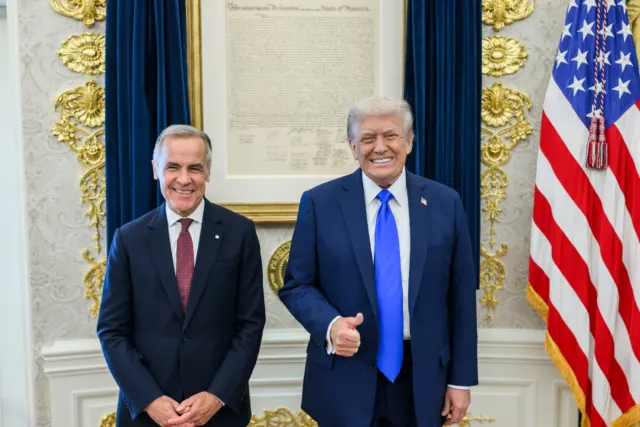
Canada has no deal. Prime Minister Mark Carney said of the US negotiators, “they asked too much and offered too little,” before Canada retaliated, as our report on Carney’s government records. “You are at war when you get attacked,” he said, The National reported.
What to watch next
- 4 December 2026: A 15% Section 232 tariff and minimum import prices on polysilicon and its derivative products take effect, according to the Tax Foundation and the White House.
- 7 December 2026: Comments close on CBP’s proposed rules for low-value parcels, as our de minimis report notes.
- 8 December 2026: October trade figures are published, according to the BEA. The Federal Reserve meets on 8–9 December (CNBC).
- 9 December 2026: The government’s response to the importers’ motion for universal refunds is due, Forwarder News reported.
- End of 2026: Deadline for the US to bring EU steel and aluminium derivative tariffs within the 15% ceiling, according to the Commission.
- When the new Congress meets: Senator Ron Wyden, who is expected to chair the Senate Finance Committee, has reportedly named the Canada tariffs the “first target”, CNBC reported.
- 10 January 2027: The US–China truce measures expire unless extended (our explainer).
- 1 July 2027: The repeal of the duty-free parcel exemption in US law takes effect (our report).
Questions readers ask
What is the tariff on China now?
There is no single rate. Chinese goods pay the 12.5% forced-labour tariff on top of Section 301 tariffs from 2018 and sector tariffs. The Peterson Institute put the average US tariff on Chinese goods at 35.2% on 22 August 2026, down from 126.1% before the Geneva truce of May 2025. China’s average tariff on US goods was 31.9%.
Did the Supreme Court strike down Trump’s tariffs?
Partly. On 20 February 2026 it ruled 6–3 that IEEPA does not allow a president to impose tariffs, ending the “Liberation Day” and fentanyl-related tariffs. Tariffs under other laws, such as those on steel and cars, were not affected.
Are tariff refunds being paid?
Yes, to importers, not consumers. A Customs and Border Protection court filing put the refunds certified for payment at $128.4 billion as of 5 November 2026, according to a summary by the tax firm Sterlinx. Importers that have not sued are seeking a court order to make sure they are included.
What tariffs does the UK face?
Most UK goods pay 10% on top of the normal tariff. Cars pay 10% within a quota of 100,000 a year, and steel and aluminium generally 25%.
What tariffs does the EU face?
Most EU goods pay the higher of 10% or the normal tariff. Cars, chips, medicines and lumber fall under the deal’s 15% ceiling; some steel and aluminium products still pay up to 50%.
Are there tariffs on Canada and Mexico?
Goods that qualify under the USMCA are exempt from the forced-labour tariff, but not from Section 232 sector tariffs. Canada also faces 50% on a list of products worth about $20 billion, which applies even to USMCA-qualifying goods.
Sources
- The White House — Fact Sheet: President Donald J. Trump Imposes Tariffs on Imports from Canada, Mexico and China, 1 February 2025
- The White House — Fact Sheet: President Donald J. Trump Declares National Emergency to Increase our Competitive Edge, 2 April 2025
- OPB / NPR — Stocks sink in another brutal day over Trump tariffs shock, 4 April 2025
- The White House — Modifying Reciprocal Tariff Rates to Reflect Trading Partner Retaliation and Alignment (Executive Order 14266), 9 April 2025
- The Star / Reuters — Wall Street rebounds sharply on tariff pause, 10 April 2025
- The White House — Fact Sheet: U.S.-UK Reach Historic Trade Deal, 8 May 2025
- The White House — Joint Statement on U.S.-China Economic and Trade Meeting in Geneva, 12 May 2025
- Sandler, Travis & Rosenberg — Section 232 Tariffs on Steel and Aluminum Doubled to 50 Percent, 5 June 2025
- The White House — Fact Sheet: Suspending the De Minimis Exemption for Commercial Shipments Globally, 30 July 2025
- The White House — Fact Sheet: President Donald J. Trump Further Modifies the Reciprocal Tariff Rates, 31 July 2025
- Federal Circuit Blog — Federal Circuit affirms Court of International Trade’s invalidation of President Trump’s tariffs, 29 August 2025
- The White House — Fact Sheet: President Donald J. Trump Implements a Historic U.S.-Japan Framework Agreement, 5 September 2025
- The White House — Fact Sheet: President Donald J. Trump Strikes Deal on Economic and Trade Relations with China, 1 November 2025
- The White House — Fact Sheet: President Donald J. Trump Adjusts Imports of Timber, Lumber, and Their Derivative Products, 31 December 2025
- The White House — Fact Sheet: President Donald J. Trump Takes Action on Certain Advanced Computing Chips, 14 January 2026
- Federal Reserve Bank of New York, Liberty Street Economics — Who Is Paying for the 2025 U.S. Tariffs?, 12 February 2026
- Kiel Institute — America’s own goal: Americans pay almost entirely for Trump’s tariffs, 19 January 2026
- Fortune — How much do Americans pay for tariffs? Trump adviser fumes, 18 February 2026
- MPR News / NPR — Supreme Court strikes down Trump’s tariffs, 20 February 2026
- WAMC / NPR — Supreme Court strikes down Trump’s tariffs, 20 February 2026
- The White House — Imposing a Temporary Import Surcharge to Address Fundamental International Payments Problems, 20 February 2026
- Fortune — Trump raises global tariffs to 15% after Supreme Court ruling, 21 February 2026
- The White House — Fact Sheet: President Donald J. Trump Strengthens Tariffs on Steel, Aluminum, and Copper Imports, 2 April 2026
- The White House — Fact Sheet: Imposing Tariffs on Patented Pharmaceutical Products, 2 April 2026
- Congressional Research Service — Section 232 Automotive Tariffs: Issues for Congress (IN12545), 11 May 2026
- France 24 / AFP — Europe signs off on long-awaited US tariff deal, 16 June 2026
- DLA Piper — US declines to extend the USMCA: Key considerations for foreign investment protection, 16 July 2026
- USTR — USTR Section 301 Action on Brazil’s Unreasonable Acts, Policies, and Practices, 15 July 2026
- Federal Register — Notice of Action: Brazil’s Acts, Policies and Practices, 20 July 2026
- The White House — Fact Sheet: President Donald J. Trump Imposes Additional Tariffs on Canada, 20 July 2026
- USTR — USTR Takes Action in Forced Labor Section 301 Investigations, 23 July 2026
- Greenberg Traurig — USTR Imposes New Section 301 Forced Labor Tariffs on Imports from 60 Economies, 24 July 2026
- UHY — Tariff reset: Section 122 expires as Section 301 duties expand, 24 July 2026
- European Commission — The EU-US trade deal: restoring stability and predictability, updated 27 July 2026
- Holland & Knight — 50 Percent Opening Bid: Canadian Imports Subject to Section 338 Tariffs Amid USMCA Talks, 29 July 2026
- Peterson Institute — Who pays for tariffs? Insights from recent research, 3 August 2026
- The White House — Fact Sheet: Imposing Tariffs on Polysilicon and its Derivatives, 6 August 2026
- Peterson Institute — US-China Trade War Tariffs: An Up-to-Date Chart, updated 22 August 2026
- The National — Canada to hit back dollar for dollar in trade war after Trump’s 50 per cent levy, 23 August 2026
- Covington — Section 338 Tariffs on Canada Take Effect as Canada Announces Retaliatory Response, 31 August 2026
- Congressional Research Service — Section 232 Tariffs on Steel and Aluminum (IN12519), 17 September 2026
- C.H. Robinson — CBP Reports Major Progress on IEEPA Refunds; CAPE Phase 3 Launches October 6, 17 September 2026
- World Trade Organization — Trade forecast press release, 8 October 2026
- CNBC — Trump sued over 50% tariffs on Canada in latest trade challenge, 20 October 2026
- Bureau of Economic Analysis — U.S. International Trade in Goods and Services, September 2026, 4 November 2026
- CNBC — How Democrats will try to end Trump’s tariffs, 8 November 2026
- CNBC — Consumer prices rose more than expected in October, complicating Fed’s inflation fight, 10 November 2026
- Forwarder News — The IEEPA refund class asks for everyone’s money, 13 November 2026
- Sterlinx Global — USA Update: IEEPA Refunds Pass $128 Billion as CBP Expands CAPE Phase 3 Access, 13 November 2026
- Tax Foundation — Trump Tariffs: Tracking the Economic Impact of the Trump Trade War, updated 23 November 2026
- US Treasury, Fiscal Data — Monthly Treasury Statement, Table 4: Customs Duties, data to 31 October 2026
The Frontier Brief
The week’s essential international reporting and new investigations, every Friday.