Iraqi forces enter Kataib Hezbollah’s Jurf al-Sakhar: what the deal gives the militia
Government troops moved into Jurf al-Sakhar, closed to the Iraqi state since 2014, under a deal that sends Kataib Hezbollah's fighters elsewhere in Iraq. The group keeps its weapons, a source says it is not leaving, and Iran's Quds Force commander was in Baghdad for the talks.
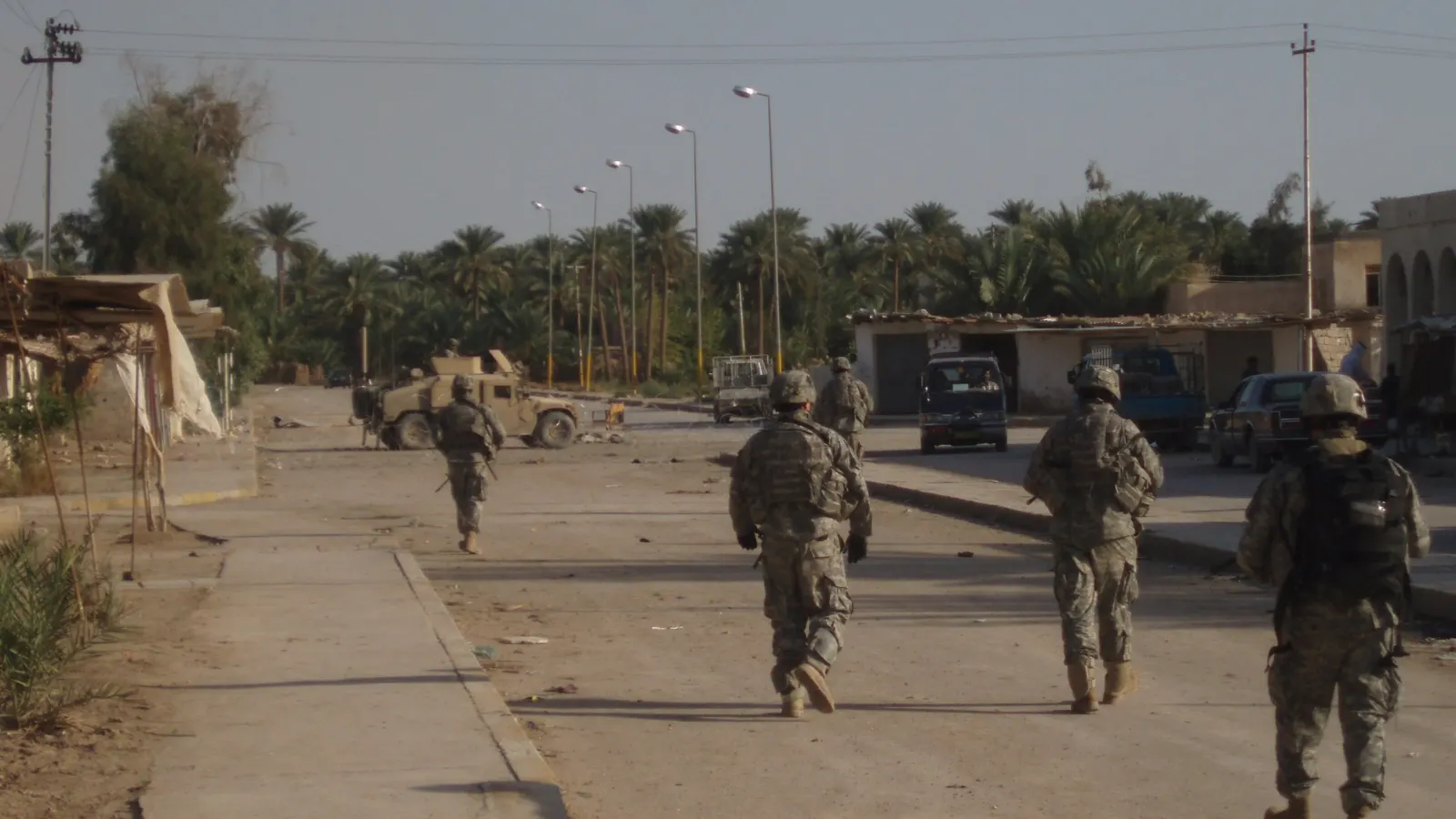
BAGHDAD Iraqi security forces rolled into Jurf al-Sakhar on Friday 20 November with tanks and armoured vehicles, entering a town in Babil province that Kataib Hezbollah has held for more than a decade 12. They went in under a compromise deal reached late on Thursday, brokered by senior Shia political leaders 13.
“From Jurf Al Sakhar, we begin asserting state authority across all of Iraq,” Prime Minister Ali al-Zaidi said in an address on Friday 1. “Our decision is firm: no weapons outside the authority of the state, no weapons except Iraq’s weapons.” 1
Kataib Hezbollah is Iran’s most powerful militia ally in Iraq, according to Reuters 12. Washington designated it a terrorist organisation in 2009 4. The move comes while the US and Israel are at war with Iran, a war that began on 28 February, and while US President Donald Trump presses Mr Zaidi to disarm the militias 42.
The forces taking over report to a new joint headquarters that brings together the army, federal police, energy police and units of the Popular Mobilisation Forces (PMF), a force set up in 2014 to fight Islamic State and later recognised as an official security force 142.
What does the deal give Kataib Hezbollah?
Three senior security officials told Reuters the deal let government forces enter on Friday, with Kataib Hezbollah fighters withdrawing to other parts of Iraq 32.
On 17 November a source in the Shia Coordination Framework alliance told Shafaq News of a proposal to move the group’s brigades to the Iraq-Syria border while a limited number of its commanders and fighters stay at designated positions 5. Two days later Lieutenant General Saad Maan, head of the government’s Security Media Cell, named al-Qaim, a town in Anbar province near the Syrian border, as one option 6. “They may have a mission in al-Qaim or elsewhere,” he said 6. “These brigades are respected, have contributed greatly, and will be assigned duties in other areas.” 6
In their place, an army brigade, a federal police brigade and two PMF brigades each take a sector, with an energy police regiment guarding the oil pipelines, AFP and Rudaw reported 78.
The timetable differs by source. Al Arabiya reported that the withdrawal would be phased over one month, according to Iran International 4. Ali al-Daffayi, a Coordination Framework figure, claimed the group would be replaced within 10 to 14 days, Rudaw reported 8. Mr Maan said it was “a matter of days” 6.
Under Mr Zaidi’s terms the militias keep their arms, Ynet reported 9. Kataib Hezbollah has refused to hand them over, and Mr Zaidi has set 30 June 2027 as the deadline for armed groups to disarm or come under direct state control 23.
Why does Jurf al-Sakhar matter?
The town lies about 60km southwest of Baghdad, according to The National and Alhurra; Reuters, cited by France 24, and Iran International put it about 50km south of the capital 11024. It is a mainly Sunni farming town on the Euphrates, near roads linking Baghdad, Karbala and Anbar, and Iran International reported it has served as a financial hub for evading sanctions on Iran 14.
The army and Shia militias, Kataib Hezbollah among them, retook it from Islamic State in an offensive that began on 23 October 2014 411. It was renamed Jurf al-Nasr and has been closed to state institutions for more than a decade 110. Residents have not been allowed home: more than 100,000 people from the town and nearby villages remain displaced, according to Shafaq News as cited by Iran International, while Iraq’s displacement ministry counted about 6,000 families still away in May 2024 411.
The latest standoff began when an investigation accused Kataib Hezbollah of running a network that siphoned state oil through tampered pipelines 42. Officials cited by Reuters put the value at hundreds of millions of dollars, while government sources told the broadcaster MBN it was about $2 billion a year 210. Nine senior security and oil officials were dismissed, and Mr Zaidi referred the pipeline investigation to the judiciary 27.
The group denies the accusations 210. Its senior official Abu Talib al-Saeedi called the sites abandoned, rudimentary refineries and accused the investigating committee of falsifying its findings, and a group statement said Mr Zaidi’s office was “fabricating lies” 127.
A real handover or a show?
On 17 November Mr Saeedi told AFP that a withdrawal “will not happen, not even over our dead bodies” 7. On Friday a group source told AFP it had “allowed the government a way out of the predicament it created” but would not leave Jurf al-Sakhar 3. Its leader, Abu Hussein al-Hamidawi, told fighters late on Thursday to return to normal, adding: “The future holds serious challenges, and confronting them will require men like you.” 6
Omar Mohammed, an Iraqi historian known for the Mosul Eye project, called the operation “a theatrical show” 4. Lahib Hagel of the International Crisis Group told The National: “If it’s enforced as planned, it will break the last stronghold of Kataib Hezbollah since the war on ISIS.” 1 Hagel also questioned whether the group would keep its influence through the PMF brigades that take over 1.
That is a live question because Kataib Hezbollah is itself part of the PMF: it forms several PMF battalions, and its fighters draw state salaries 2. Hayder al-Shakeri of Chatham House told Middle East Eye the deal let both sides step back without either appearing to surrender fully 3.
Where does Iran fit in?
Esmail Qaani, commander of Iran’s Quds Force, arrived in Baghdad late on Monday 16 November 310. Kataib Hezbollah said Mr Hamidawi met Mr Qaani and Hadi al-Amiri, head of the Badr Organisation, in the talks that produced the deal 4. A day before he arrived, government spokesman Haider al-Aboudi called the standoff an internal Iraqi affair and denied Iranian involvement through mediation 13.
Coordination Framework figures warned Mr Zaidi that Baghdad’s Green Zone would be hit with rockets and drones if forces stormed the town, MBN reported 10. On 11 November Kataib Hezbollah said: “No amount of pressure will deter us from defending Iran and preventing its enemies from isolating it.” 9
What happens next?
On Friday morning Kataib Hezbollah’s yellow flags were still flying deeper inside the town, Iran International reported, and as of 20 November a group source had told AFP it would not leave, according to Middle East Eye 43. The joint headquarters’ stated tasks are to oversee security, protect oil infrastructure and reopen key roads 1. The other promise is the displaced: on 15 November the government said it was preparing conditions for residents to return 13.
Sources and references
- ArticleThe National, “Iraq’s Ali Al Zaidi says Jurf Al Sakhar is start of state asserting control”, 20 November 2026. Link
- ArticleFrance 24, “Iraqi security forces to deploy in Hezbollah stronghold under compromise deal (with Reuters)”, 20 November 2026. Link
- ArticleMiddle East Eye, “Iraq security forces deploy in Kataeb Hezbollah stronghold following ‘compromise’ deal”, 20 November 2026. Link
- ArticleIran International, “Iraq begins taking back town held for a decade by Iran’s strongest militia ally”, 20 November 2026. Link
- ArticleShafaq News, “Source: Kataib Hezbollah relocation to Syria border proposed”, 17 November 2026. Link
- ArticleRudaw, “Kata’ib Hezbollah might be relocated to another Iraqi province: Security official”, 19 November 2026. Link
- ArticleArab News Pakistan / AFP, “Iraq orders army and allied forces into Kataeb Hezbollah stronghold (AFP)”, 17 November 2026. Link
- ArticleRudaw, “Iraq assigns Jurf al-Sakhr center to federal police under new security plan”, 18 November 2026. Link
- ArticleYnet News, “Iraqi forces enter Kataib Hezbollah’s Jurf al-Sakhar stronghold after more than 12 years”, 20 November 2026. Link
- ArticleAlhurra (MBN), “Zaidi and Qaani reportedly agree on Kataib Hezbollah withdrawal from Jurf al-Sakhar”, 17 November 2026. Link
- ArticleShafaq News, “Jurf al-Sakhr and Iraq’s push to disarm factions”, 18 August 2026. Link
- ArticleShafaq News, “Kataib Hezbollah: clash with Iraqi forces a distant dream”, 17 November 2026. Link
- ArticleShafaq News, “Iraq confirms forces will enter Jurf Al-Sakhr”, 15 November 2026. Link
Sources and references are provided for transparency and further reading. Allegations and claims are attributed to their respective sources. Triple Frontiers distinguishes reported allegations from independently established facts.
The Frontier Brief
The week’s essential international reporting and new investigations, every Friday.