Six hours of martial law: how South Korea removed and prosecuted its president
Yoon Suk Yeol's December 2024 decree lasted one night. It cost him the presidency, produced South Korea's first criminal conviction of a former leader for insurrection, and is still before the courts.
SEOUL Late on 3 December 2024, President Yoon Suk Yeol went on television and declared emergency martial law, accusing South Korea’s opposition-controlled parliament of “anti-state activities” and promising: “I will eliminate anti-state forces as quickly as possible and normalize the country” 1. Armed soldiers were sent to the National Assembly; police blocked its entrance and military helicopters landed in the grounds 1.
Lawmakers got in anyway. All 190 members present in the 300-seat assembly voted to lift the decree, and Yoon’s cabinet formally ended martial law at about 4.30am on 4 December, roughly six hours after it began 1. The constitutional consequences took far longer to play out, and they are still unfolding nearly two years later.
Impeachment and removal
The National Assembly impeached Yoon by 204 votes to 85 on 14 December 2024, after members of his own People Power Party had boycotted a first attempt a week earlier 2. On 15 January 2025 he became the first sitting South Korean president to be arrested, and on 26 January prosecutors indicted him on a charge of leading an insurrection, one of the few offences for which a president has no immunity, and which carries death or life imprisonment 3.
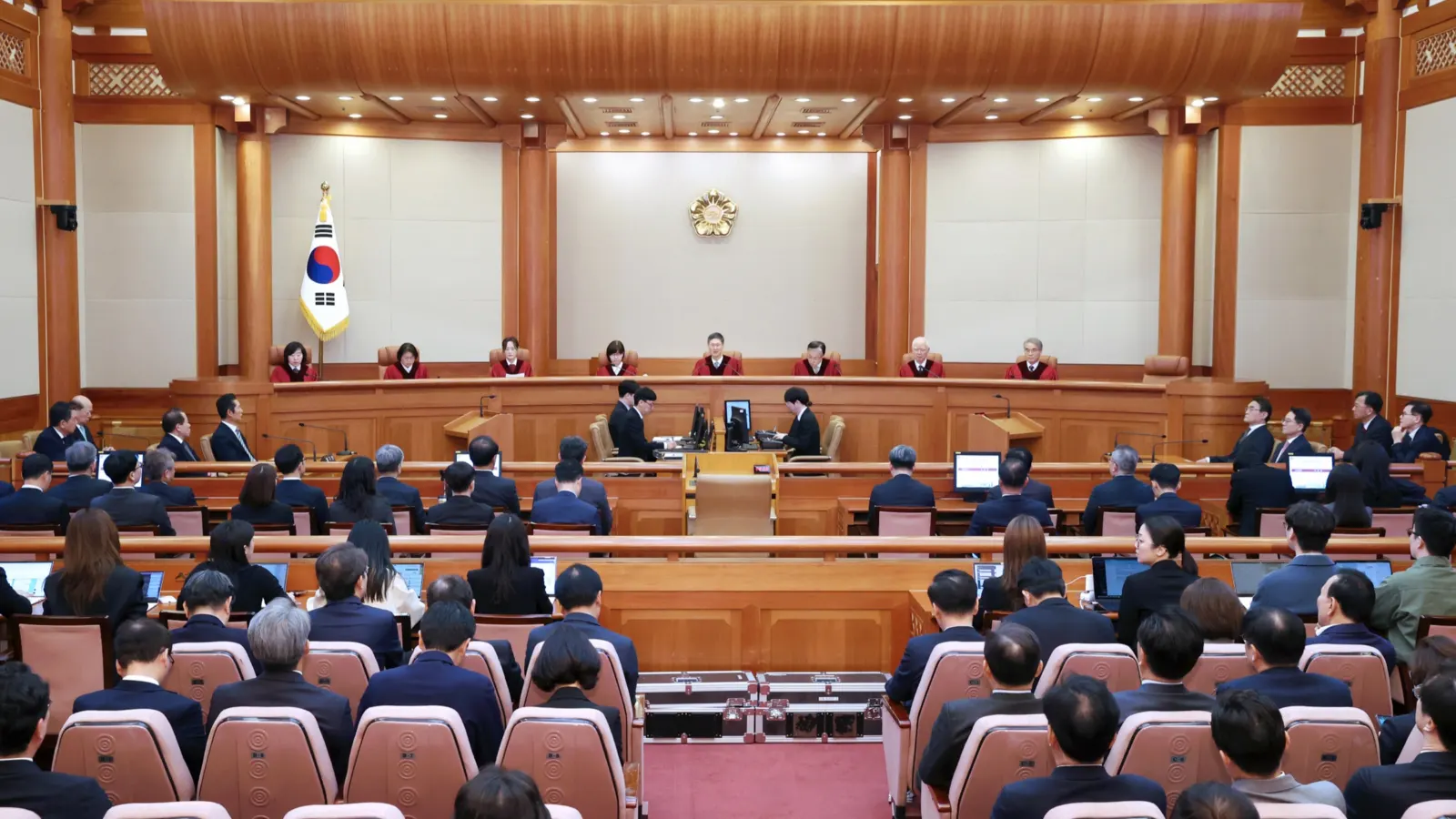
In March, the Seoul Central District Court cancelled his arrest on procedural grounds, citing the timing of the indictment and questions about how the investigation had been conducted, and he was released without any finding on the merits 4. On 4 April 2025, the Constitutional Court ruled 8–0 to uphold the impeachment and remove him from office with immediate effect, finding his actions were grave violations of democratic governance and the rule of law 5.
The snap election that followed, on 3 June 2025, was won by the Democratic Party’s Lee Jae-myung with about 49 per cent of the vote. Turnout was estimated at 79.4 per cent, the highest in a presidential election since 1997 6.
How it unfolded
-
Key moment. Yoon declares emergency martial law; troops are sent to the National Assembly.
-
Parliament votes 190–0 to lift the decree; it ends about six hours after it began.
-
The National Assembly impeaches Yoon, 204–85.
-
Yoon becomes the first sitting South Korean president to be arrested.
-
Key moment. The Constitutional Court rules 8–0 to remove him from office.
-
Lee Jae-myung wins the snap presidential election.
-
Yoon is sentenced to life at first instance for leading an insurrection.
-
The Supreme Court makes a seven-year obstruction sentence final.
-
Scheduled appeal verdict in the insurrection case.
The criminal cases
Yoon was arrested again in July 2025 at the request of special counsel prosecutors and has remained in custody 15. His legal position as of November 2026 rests on several separate cases at different stages, and the distinctions matter.
- Insurrection: convicted at first instance, under appeal. On 19 February 2026 the Seoul Central District Court convicted Yoon of leading an insurrection and sentenced him to life imprisonment, finding that sending troops to the National Assembly amounted to “rioting”, a required element of the offence 78. “It is recognized that Yoon Suk Yeol acted with the purpose of subverting the Constitution,” the court said 7. Both sides appealed. Prosecutors again sought the death penalty, and the Seoul High Court will deliver its verdict on 26 January 2027 16. The conviction is not final.
- Obstruction: final. In a case centred on obstructing his own arrest, Yoon was sentenced to five years in January 2026 14; the Seoul High Court raised that to seven years on 29 April 9, and the Supreme Court upheld the seven-year term on 9 July 2026, his first final conviction arising from the martial-law affair 1415.
- Drone flights over Pyongyang: convicted at first instance, under appeal. On 12 June 2026 the Seoul Central District Court sentenced Yoon to 30 years for benefiting the enemy and abuse of power, finding that drone flights over North Korea’s capital in October 2024 were meant to provoke the North and create conditions for martial law. His lawyers say the flights were a legitimate military operation and have appealed 1213.
Former officials have also been convicted. On the same day as Yoon’s life sentence, former defence minister Kim Yong-hyun received 30 years, and senior military and police commanders received terms of 10 to 18 years; two officials were acquitted 7. In May 2026 an appeals court reduced former prime minister Han Duck-soo’s sentence from 23 to 15 years but upheld his insurrection conviction, ruling that the December 2024 decree was itself unconstitutional and unlawful 10.
“A mere formality for a predetermined conclusion.”
Yoon Suk Yeol’s defence lawyers, on the February 2026 verdict
Yoon denies insurrection. In his final statement on appeal he argued that declaring martial law is not in itself an insurrection and that the decree was intended as a warning to an opposition he accused of abusing its legislative power 16.
Why it matters
South Korea’s democracy is younger than many of its institutions: it has elected its presidents directly only since 1987, after decades of military-backed rule. The martial-law night tested whether the system built since then could stop a sitting president, and the answer came from several directions at once: legislators who reached the chamber and voted the decree down, a Constitutional Court that ruled unanimously, an election with exceptionally high turnout, and courts that have since convicted a former president and his ministers while keeping the appeals process open. The final word on the central charge now rests with the Seoul High Court in January 2027 and, almost certainly, the Supreme Court after that.
Sources and references
- ArticleAssociated Press (via PBS NewsHour), “South Korean parliament defies president, lifts declaration of emergency martial law”, 3 December 2024. Link
- ArticleAssociated Press (via PBS NewsHour), “South Korea’s parliament votes to impeach defiant President Yoon over his martial law order”, 14 December 2024. Link
- ArticleReuters (via Dawn), “South Korea President Yoon indicted for insurrection over martial law decree”, 26 January 2025. Link
- ArticleReuters (via Voice of America), “South Korea’s President Yoon free after court quashes detention”, 8 March 2025. Link
- ArticleThe Korea Herald, coverage of the Constitutional Court’s impeachment ruling, 4 April 2025. Link
- ReportInternational IDEA, Democracy Tracker: Republic of Korea, June 2025. Link
- ArticleThe Korea Herald, first-instance insurrection verdicts for Yoon and co-defendants, 19 February 2026. Link
- ArticleABC News (via ABC7), “South Korean court sentences president to life in prison”, 19 February 2026. Link
- ArticleThe Korea Herald, “Yoon Suk Yeol’s sentence rises to 7 years in prison on appeal”, 29 April 2026. Link
- ArticleThe Korea Times (Yonhap), appeals court reduces ex-PM Han Duck-soo’s sentence but upholds insurrection conviction, 7 May 2026. Link
- ArticleThe Korea Herald, appellate trial begins in Yoon’s insurrection case, 14 May 2026. Link
- ArticleThe Korea Times (Yonhap), ex-President Yoon sentenced to 30 years in drone infiltration case, 12 June 2026. Link
- ArticleAssociated Press (via KPBS), ousted President Yoon given prison term for drone flights over Pyongyang, 12 June 2026. Link
- ArticleKorea JoongAng Daily, Supreme Court upholds seven-year prison term for ex-President Yoon, 9 July 2026. Link
- ArticleUPI, South Korea’s Supreme Court upholds seven-year sentence for obstruction of justice, 9 July 2026. Link
- ArticleThe Korea Times (Yonhap), appeals court to rule on ex-President Yoon’s martial law case on 26 January, 5 November 2026. Link
Sources and references are provided for transparency and further reading. Allegations and claims are attributed to their respective sources. Triple Frontiers distinguishes reported allegations from independently established facts.
The Frontier Brief
The week’s essential international reporting and new investigations, every Friday.