Fires, parcels and drones: what Europe’s courts have proved about Russian sabotage
Since 2024 governments have tied arson, incendiary parcels, rail sabotage and a drone attack to Russian intelligence, often carried out by recruits hired on Telegram. Some cases have ended in convictions, others are only charges or official attributions. Russia denies involvement.
Key findings
- Six men were sentenced at the Old Bailey on 24 October 2025 over the Russian-directed Leyton arson; organiser Dylan Earl received 17 years in custody, the first sentences under the National Security Act 2023. Confirmed
- Courts in Germany, Lithuania and Poland have convicted people of sabotage-related crimes for Russian intelligence, though a Stuttgart court acquitted two of three defendants. Confirmed
- Lithuanian prosecutors say Russian military intelligence organised the July 2024 DHL and DPD incendiary parcels; five men are on trial in Vilnius and have not been convicted. Alleged
- Poland and Germany have attributed the Marywilska fire and the Leipzig airport drone attack to Russia; no one has been convicted for either, and four men are on trial in Warsaw over the Marywilska fire and related arsons. Confirmed
- Russia denies involvement; the Kremlin says no evidence has been presented. Disputed
Confirmedbacked by documents or on-record sourcesAllegedclaimed by sources, not provenDisputedcontested by the parties involved
On 20 March 2024 two industrial units in Leyton, east London, holding supplies for Ukraine, including Starlink satellite equipment, were deliberately set alight. The fire caused about £1 million of damage 12. Nineteen months later, at the Old Bailey on 24 October 2025, the man who organised it, Dylan Earl, was sentenced to 17 years in custody, and his co-organiser Jake Reeves to 12 years 12. They were the first sentences imposed under the UK’s National Security Act 2023 12.
The Leyton case is the clearest court record so far of a campaign that European governments attribute to Russia: arson, incendiary parcels, rail sabotage and, most recently, an armed drone at a German airport. This investigation sets out what courts have proved, what prosecutors have charged and what governments have only asserted, between 2024 and 18 November 2026. Russia denies involvement 34.
From Telegram to the Old Bailey
Police said Earl was in contact with the Wagner Group on Telegram, through an account using the names “Privet Bot” and “Lucky Strike” 1. The Associated Press reported that Earl was recruited through Wagner-linked Telegram channels 5, and that he told his psychiatrist he received 5,000 euros in cryptocurrency for the attack 2.
Earl pleaded guilty to preparatory conduct under section 18 of the National Security Act, aggravated arson and drugs and criminal-property offences. Reeves pleaded guilty to agreeing to accept a material benefit from a foreign intelligence service, and to aggravated arson 1. Three men recruited further down the chain, Nii Mensah, Jakeem Rose and Ugnius Asmena, were convicted of aggravated arson on 8 July 2025 15. AP reported that they did not know they were working for Russia 2. A sixth man, Ashton Evans, was found guilty of failing to disclose information about terrorist acts 1.
Counter Terrorism Policing said Earl’s total sentence was 23 years and Reeves’s 13, including the time in custody, and that the others received shorter terms 1. The judge, Mrs Justice Cheema-Grubb, said Earl was motivated by “simple and ugly greed” 2. The prosecutor, Duncan Penny, told the court the attack was “part of a series of European-wide sabotage operations” 2.
The UK has brought further charges. On 9 September 2026 the Crown Prosecution Service announced that Joshua Cammidge, 31, of Swindon, had been charged under the same Act with assisting a foreign intelligence service and intending to commit an act of sabotage. Prosecutors allege he took instructions from a person believed to be linked to the “GRU Volunteer Corps” 6. He has not been tried 6.
Parcels bound for cargo flights
On 19 July 2024, according to Lithuanian prosecutors, four parcels containing incendiary devices were sent from Vilnius through DHL and DPD. One ignited at Leipzig airport, one in a DPD truck in Poland and one at a DHL warehouse in Birmingham; the fourth failed to ignite. No one was injured 78.
In September 2025 prosecutors said 15 suspects had been charged, citizens of Russia, Lithuania, Latvia, Estonia and Ukraine, and that the plot had been organised by Russian citizens linked to Russian military intelligence 7. By 18 November 2025 the prosecutor general, Nida Grunskienė, said 16 people had suspect status 9. Investigators said the suspects were recruited through Telegram and promised cryptocurrency 7. Reuters reported that investigators believe the parcels were part of a Russian military intelligence plot to trigger explosions on cargo flights to the United States 8.
The trial of five men opened at Vilnius Regional Court on 17 April 2026 on terrorism charges, with parts held in closed session 10. They face up to 10 years in prison if convicted 8. The man accused of posting the parcels, Aleksandras Šuranovas, has said he did not know they contained explosives. “I would never have agreed to that. I am no spy,” he told the BBC 11.
Lithuania has secured one conviction in a related case. On 24 November 2025 a Vilnius court sentenced a Ukrainian, Daniil Bardadim, who was 17 at the time, to three years and four months for terrorism over the May 2024 arson at IKEA in Vilnius and other offences 12. Prosecutors said he acted on behalf of Russian intelligence 12. In January 2026 prosecutors also charged six foreign nationals with terrorism offences over a failed 2024 arson attack on TVC Solutions, a maker of radio stations for Ukraine’s armed forces, citing “reasonable suspicion” of instructions from the GRU 13.
Poland: arson, rail and consulates
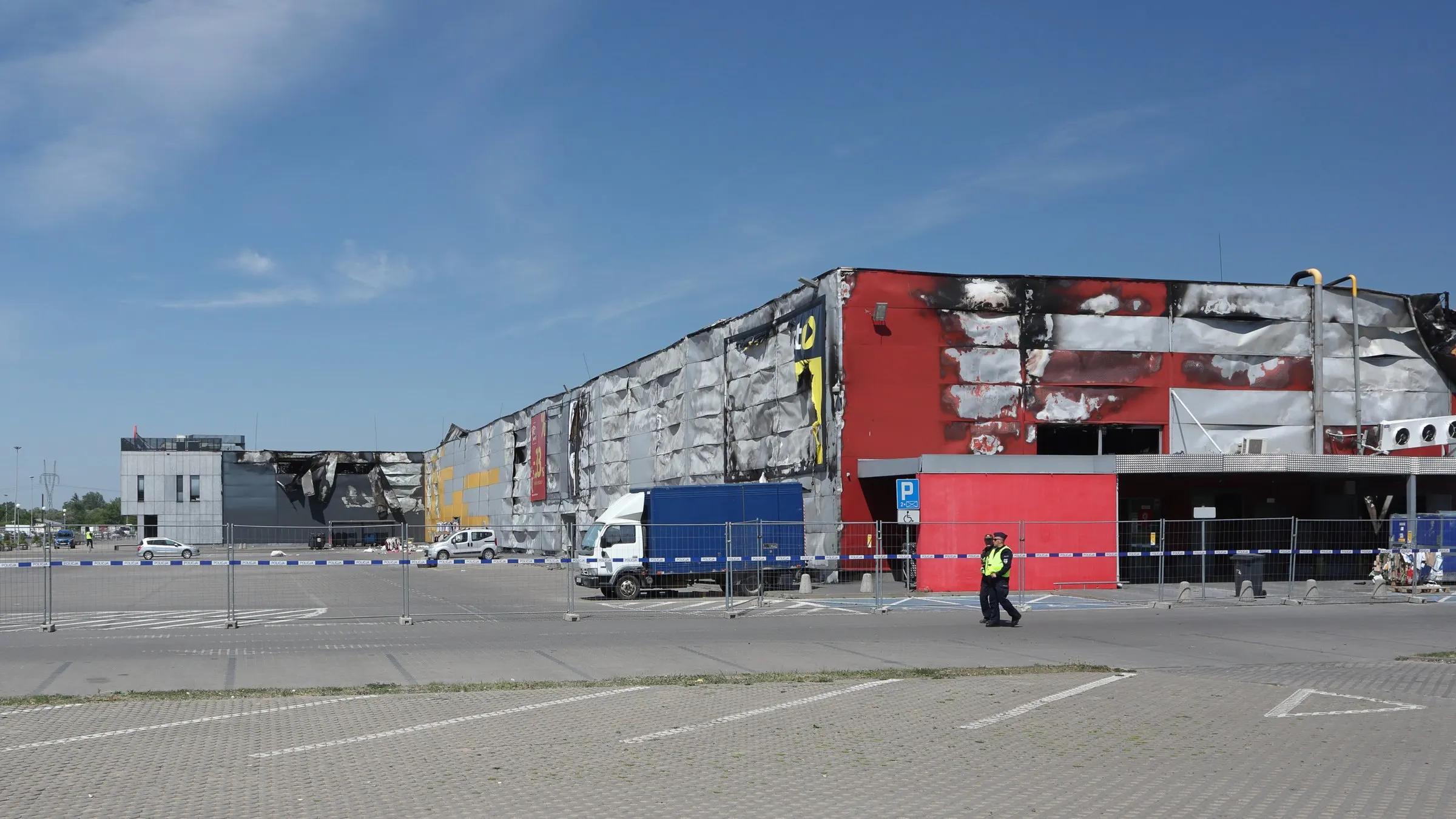
On 12 May 2024 fire destroyed the Marywilska 44 shopping centre in Warsaw, which housed about 1,400 shops and service points 14. A year later Prime Minister Donald Tusk said officials “now know for certain that the massive fire on Marywilska was the result of arson commissioned by Russian services” 14. Poland ordered the Russian consulate in Krakow closed 14.
Four men went on trial behind closed doors in Warsaw in October 2026 over a group of 2024 attacks that prosecutors say Russian intelligence ordered, including the Marywilska 44 fire, a fire at an OBI store in Warsaw and the Vilnius IKEA arson. They have not been convicted 15. Three other members of the same group were convicted in Poland in 2025, with sentences ranging from 16 months to five and a half years 15.
On 15 November 2025 an explosion damaged track near Mika on the Warsaw-Lublin line, which carries deliveries to Ukraine, and a second incident followed near Puławy. No one was hurt 1617. Tusk called it an “unprecedented act of sabotage” and Foreign Minister Radosław Sikorski “an act of state terror” 16. Prosecutors charged two Ukrainians with sabotage of a terrorist nature on behalf of Russian intelligence; officials said they had crossed into Belarus 16. Both remain at large 18. A third Ukrainian, Volodymyr B., is accused of driving one of them to scout the line; prosecutors have sent an indictment against him to the Warsaw Regional Court, and he faces up to life imprisonment if convicted 1819. Poland closed Russia’s last consulate, in Gdańsk 1617.
How it unfolded
-
Key moment. Arson at Leyton warehouses in east London.
-
Fire destroys Marywilska 44 shopping centre in Warsaw.
-
Key moment. Four incendiary parcels sent from Vilnius via DHL and DPD.
-
Poland blames Russian services for Marywilska fire, closes Krakow consulate.
-
Russian drones shot down over Poland; Article 4 invoked.
-
Lithuania says 15 charged in parcel plot.
-
Key moment. Leyton arsonists sentenced, first under National Security Act.
-
Munich court jails Dieter S. for six years.
-
Key moment. Explosion on Warsaw-Lublin railway near Mika.
-
Vilnius court sentences Daniil Bardadim over IKEA arson.
-
Parcel trial opens in Vilnius.
-
Stuttgart court convicts one Ukrainian, acquits two.
-
Key moment. Germany blames Russia for Leipzig airport drone attack.
-
Four men on trial in Warsaw over 2024 arsons.
-
Indictment against Volodymyr B. over rail sabotage announced.
Germany: two verdicts and a drone
On 30 October 2025 a Munich court sentenced Dieter S., a German-Russian, to six years for spying for Moscow and plotting sabotage against German military support for Ukraine; two co-defendants received suspended sentences. He denied the charges 20. On 18 August 2026 a Stuttgart court sentenced a 30-year-old Ukrainian to one year and three months for helping scout sabotage targets for an unnamed Russian state entity by sending parcels fitted with GPS trackers. It acquitted two co-defendants for lack of evidence that they knowingly took part 21.
In August 2026 a drone carrying explosives was found near a Ukrainian Antonov aircraft at Leipzig/Halle airport; the device was defused 22. On 1 September Interior Minister Alexander Dobrindt said: “Taken together, the police investigations, the pattern and intelligence findings prove a Russian responsibility” 22. Germany closed Russia’s consulate general in Bonn, ended the agreement for the Russian House in Berlin and summoned Russia’s ambassador 422.
Drones over airports
On the night of 9 to 10 September 2025 Russian military drones entered Polish airspace and were shot down by Polish and allied forces. Poland invoked Article 4 of the North Atlantic Treaty 23.
Not every incident has been formally attributed. When drones disrupted Copenhagen airport on 22 September 2025, Danish Prime Minister Mette Frederiksen said she could “not rule out” Russian involvement 24.
What the spy chiefs say
In October 2024 MI5’s director general, Ken McCallum, said Russia’s military intelligence was on a “sustained mission to generate mayhem on British and European streets: we’ve seen arson, sabotage and more” 2526. A year later he reported a 35% increase in the number of people MI5 was investigating for state threat activity 27.
In May 2026 Poland’s Internal Security Agency (ABW) said in a report that Russia was moving from “disposable” recruits found online to “complex sabotage cells” relying on organised crime 28. Its chief, Colonel Rafał Syrysko, said: “Russia keeps pushing the limits” 29. In Germany, the head of the BND foreign intelligence service, Martin Jäger, told a parliamentary oversight hearing that “Russia is waging a shadow war against us” 30. AP, which tracks such incidents, counted more than 150 Moscow-linked sabotage and other incidents in Europe since the invasion of Ukraine 28.
Where things stand
As of 18 November 2026, courts have convicted people in the UK, Germany, Lithuania and Poland of crimes linked to Russian intelligence or its proxies 120211215. The parcel trial in Vilnius, the Warsaw arson trial and the UK case against Cammidge are pending; everyone in those cases is presumed innocent 10156. No one has been convicted over the Marywilska fire, which is part of the Warsaw trial, or the Leipzig drone, which Germany has attributed to Russia 141522.
Why it matters
The court records show a repeated method: recruits, often foreign, contacted on Telegram and paid small sums to start fires, while the people giving orders stay in Russia or Belarus 1716. Polish and German officials say the method is changing, from one-off recruits to organised cells and military-grade devices 2822.
The documents
-
Counter Terrorism Policing: Leyton arson sentencing24 October 2025. Names, charges, pleas and sentences of all six defendants, and the Telegram evidence.Read (Counter Terrorism Policing: Leyton arson sentencing)
-
CPS: Man charged with assisting GRU Volunteer Corps9 September 2026. National Security Act charges against Joshua Cammidge.Read (CPS: Man charged with assisting GRU Volunteer Corps)
Russia denies involvement. Kremlin spokesman Dmitry Peskov said in March 2025: “No confirmation of the existence of sabotage campaigns has been established even in the course of special proceedings” 3. On the Copenhagen drones he said that “making unfounded accusations over and over again only leads to such statements no longer being taken seriously” 24. On Leipzig he said: “If such serious accusations are being made, they should be supported by evidence. To my knowledge, none has been presented” 4. Foreign ministry spokeswoman Maria Zakharova promised a “fitting response” to Germany’s measures 22. After Poland closed the Gdańsk consulate, Peskov said: “In this case, one can only express regret” 16.
The Kremlin did not respond to AP’s request for comment on the Leyton case 5. Dieter S. denied the charges in Munich 20. Aleksandras Šuranovas says he did not know the parcels contained explosives 11.
How we reported this
This investigation is based on public records: police and prosecution statements in the UK, Lithuania and Poland, court outcomes as reported by international agencies (AP, Reuters, AFP) and regional outlets, and statements by intelligence chiefs. Each court case is described by its exact stage: charge, trial, conviction or acquittal. Where a government has attributed an incident to Russia without a conviction, we say so. Several judgments may still be under appeal; we found no confirmation that they are final.
We left out claims we could not verify from an opened source, including media identifications of the alleged Leipzig organiser, figures on explosives used, and some Polish sentences reported only in passing.
Sources and references
- Official documentCounter Terrorism Policing, “Men who organised Russia-backed arson at London warehouse jailed”, 24 October 2025. Link
- ArticleAssociated Press (via WDIV ClickOnDetroit), “Men sentenced over London arson attack masterminded by Russia as part of a wider sabotage campaign”, 24 October 2025. Link
- ArticleReuters (via The Star), “Kremlin says allegations of Russian sabotage in Europe and US are ’empty’ and unproven”, 10 March 2025. Link
- ArticleReuters (via Internazionale), “Germany says Russia responsible for drone attack at Leipzig airport”, 1 September 2026. Link
- ArticleAssociated Press (via Arab News), “European intelligence officials warn that a Russian sabotage campaign is escalating”, 9 July 2025. Link
- Official documentCrown Prosecution Service, “Man charged with assisting GRU Volunteer Corps”, 9 September 2026. Link
- ArticleLRT, “Lithuania says it busted Russian-linked network that planned terror attacks in Europe”, 17 September 2025. Link
- ArticleReuters (via KFGO), “Lithuania prosecutes five people over 2024 parcel blasts”, 6 March 2026. Link
- ArticleLRT, “Lithuania identifies 16 suspects in terrorism probe of explosives sent through DHL and DPD”, 18 November 2025. Link
- ArticleDaily Baltic (citing LRT), “Vilnius court opens terrorism trial over explosive parcel attacks”, 17 April 2026. Link
- ArticleUNB (with BBC inputs), “’I am no spy’: Lithuanian courier in Russian parcel bomb plot speaks out”, 11 March 2026. Link
- ArticleLRT / BNS, “Man sentenced in Lithuania over attack on behalf of Russian intelligence”, 24 November 2025. Link
- ArticleEuronews (via Yahoo News), “Lithuania charges six with terrorism over failed arson attack on Ukraine military supplies”, 16 January 2026. Link
- ArticleAssociated Press (via CFJC Today), “Poland orders closure of Russian consulate in Krakow, citing arson attack blamed on Moscow”, 12 May 2025. Link
- ArticleNotes from Poland, “Four go on trial in Warsaw over arson attacks carried out on Russian orders”, 12 October 2026. Link
- ArticleAssociated Press (via KSAT), “Poland to shut Russia’s last consulate in the country after railway sabotage”, 19 November 2025. Link
- ArticleAnadolu Agency, “3rd person charged in connection with rail sabotage case in eastern Poland”, 24 November 2025. Link
- ArticleNotes from Poland, “Poland indicts Ukrainian man for assisting in rail sabotage on behalf of Russia”, 12 November 2026. Link
- ArticleEuropean Pravda, “Ukrainian faces life imprisonment in Poland over railway sabotage (Ukrainian-language)”, 12 November 2026. Link
- ArticleAFP (via Arab News), “German-Russian jailed for six years in Munich sabotage trial”, 30 October 2025. Link
- ArticleReuters (via Cyprus Mail), “German court convicts Ukrainian man over parcel bomb plot tied to Russia”, 18 August 2026. Link
- ArticleAssociated Press (via CKPG Today), “Germany blames Russia for last month’s attempted drone attack at Leipzig airport”, 1 September 2026. Link
- ArticleNotes from Poland, “Poland triggers NATO Article 4 in response to Russian drone violations”, 10 September 2025. Link
- ArticleThe Moscow Times (AFP contributed), “Kremlin denies role in drone flights that disrupted airports in Denmark and Norway”, 23 September 2025. Link
- ArticleCNBC (via NBC Bay Area), “Russia is on a ‘sustained mission’ to create mayhem on Europe’s streets, UK spy chief says”, 8 October 2024. Link
- ArticleAFP (via Dawn), “Russia seeking to cause ‘mayhem’ in UK: MI5”, 9 October 2024. Link
- ArticleCNN (via RNZ), “’A new era’: UK facing rising threats from state actors as well as terrorists, says MI5 chief”, 17 October 2025. Link
- ArticleAssociated Press (via WTOP), “Poland warns Russia is moving from low-cost recruits to professional sabotage cells”, 6 May 2026. Link
- ArticlePolskie Radio (citing PAP), “Russia pushing limits with sabotage campaign in Poland, spy chief warns”, 6 May 2026. Link
- ArticleKeystone-SDA (via blue News), “Intelligence agency sees Germany in a ‘shadow war’ with Russia”, 5 October 2026. Link
Sources and references are provided for transparency and further reading. Allegations and claims are attributed to their respective sources. Triple Frontiers distinguishes reported allegations from independently established facts.
Corrections and updates
The Frontier Brief
The week’s essential international reporting and new investigations, every Friday.