Myanmar’s rare earths: rebels, China and the cost of the magnet supply chain
Kachin rebels seized Myanmar's main heavy rare earth belt in 2024, and China, the only buyer, used its border to push back. Researchers link the trade to poisoned rivers, deadly landslides and forced labour, as mining spreads into Wa-held Shan State.
Key findings
- The Kachin Independence Army took control of all major rare earth mining sites in Kachin Special Region 1, including Pangwa, from the junta-aligned NDA-K in late 2024. Confirmed
- Chinese customs data show imports from Myanmar fell sharply after the takeover, to 311 tonnes in February 2025; ISP-Myanmar puts January-September 2025 exports at $624m, down from $724m. Confirmed
- Reuters reported that China threatened to stop buying minerals from KIA areas unless it halted its Bhamo offensive; Reuters could not confirm the threat was carried out. Alleged
- Researchers and Thai authorities report acidic, arsenic-contaminated water linked to mining; a Chinese industry association says all companies follow environmental rules. Disputed
- A Shan rights group alleges trafficked scam workers were forced to work at Chinese-run mines in UWSA-held Shan State, with junta complicity. Alleged
Confirmedbacked by documents or on-record sourcesAllegedclaimed by sources, not provenDisputedcontested by the parties involved
On 9 November 2026, the lobbying firm DCI Group, writing for the information ministry of Myanmar’s military-controlled government urged the United States to treat the country as “a critical minerals priority, not simply a diplomatic challenge” 1. The military does not hold the principal mines it is offering: the Kachin Independence Army (KIA) seized the main mining areas around Chipwi and Pangwa from military-aligned forces in 2024 1.
Triple Frontiers reviewed research by Global Witness, ISP-Myanmar and a UK-funded academic programme, Chinese customs figures reported by Reuters and others, a Shan human rights group’s testimony, Thai official statements and wire reports to trace who controls Myanmar’s rare earth mines, where the minerals go and what harm researchers say they cause.
A frontier for China’s magnet industry
Global Witness said in May 2024 that Myanmar had become the single largest source of heavy rare earth elements, which are used in permanent magnets for electric vehicles and wind turbines 23. It said Chinese imports of heavy rare earth oxides from Myanmar rose from 19,500 tonnes in 2021 to 41,700 tonnes in 2023, a trade it valued at $1.4 billion in 2023 23. China holds more than 90% of global rare earth processing capacity, according to Rest of World 4.
Before the takeover, most rare earth mining took place in areas under the dual control of the military and the New Democratic Army-Kachin (NDA-K), a militia aligned with it 5. Kachin Special Region 1, including Chipwi and Pangwa, had been held by the NDA-K since a 1989 ceasefire; the militia was formed by Zakhung Ting Ying and Layauk Ze Lum 5. Global Witness counted more than 300 mining sites there in 2023, up more than 40% from 2021 2. It also found mining in areas held by the Kachin Independence Organisation (KIO), the KIA’s political wing: sites in Momauk Township rose from nine in 2021 to more than 40 by the end of 2023 2.
Researchers at the SOC ACE programme, funded by Britain’s Foreign Office, say the mines were opened mainly by small and medium-sized Chinese firms from Jiangxi province 5. They say Beijing did not formally direct firms into Kachin State but tolerated the trade as long as the ore was channelled back into China’s quota and processing system 5.
The KIA takes the mining belt
The KIO/KIA began attacking NDA-K and military positions in north-eastern Kachin in July 2024 5. It captured Pangwa in October 2024 and, by late November, controlled Chipwi and Tsawlaw townships and the Kan Paik Ti crossing, giving it all main China border crossings in Kachin State and the rare earth mining belt 56. The SOC ACE researchers say control of the border, not only of the mines, was the aim, though revenue and leverage over China were “clearly an important consideration” 5.
China closed the official Pangwa border gate after the capture and restricted fuel, medicine, rice and other supplies into KIA-held areas, according to the SOC ACE paper 5. Radio Free Asia reported that China shut six border gates in late October 2024 and that the KIA then sealed its own side, stopping rare earth trucks 7. Lieutenant General Sumlut Gun Maw, the KIA’s vice chief of staff, said the closure was “a significant pressure for us, it is currently the greatest challenge we face” 5.
Chinese imports of rare earth oxides and compounds from Myanmar fell to 311 tonnes in February 2025, down 89% on a year earlier, Reuters reported, citing customs data 6. The KIA imposed a 20% tax and told miners it would allow existing inventories to be shipped to China 6. According to the SOC ACE paper, the KIA also sought a share of concentrates it could sell independently, as Indian interest grew; Beijing opposed this, and the settlement that emerged gave the KIA a 20% levy on exports and checkpoint taxes but no share to sell 5.
How it unfolded
-
Key moment. Global Witness says Myanmar is the largest source of heavy rare earths.
-
Landslides in the Pangwa area reportedly kill around 70 people.
-
KIO/KIA offensive in north-eastern Kachin begins.
-
Key moment. KIA captures Pangwa; China closes the border gate.
-
KIA takes Kan Paik Ti and seals its side of the border.
-
Chinese imports from Myanmar fall 89% year on year.
-
Key moment. China reportedly threatens to stop buying from KIA areas.
-
Reuters reports UWSA-protected mines in Shan State.
-
Beijing reopens four border gates under KIA control.
-
Key moment. Rights group alleges forced labour at Shan mines; military offensive targets rare-earth belt.
-
KIO issues 14-point rules for Chinese miners.
-
Lobbyists for Myanmar’s military-run ministry pitch rare earths to the US.
China’s leverage
Reuters reported in July 2025 that China had threatened to stop buying minerals from KIA territory unless the group stopped trying to capture Bhamo, a junta logistics hub, citing three people familiar with the matter 8. “And if we did not accept, they would block exports from Kachin State, including rare-earth minerals,” a KIA official told Reuters 8. Reuters could not confirm whether China carried out the threat 8. China’s foreign ministry said it was not aware of the specifics of deliberations with the KIA 8.
Chinese customs data showed imports of rare-earth oxides and metals from Myanmar of 12,944 tonnes in the first five months of 2025, half the level a year earlier 8. ISP-Myanmar, a research group, said that Myanmar’s rare earth exports to China were worth $624 million (over 28,000 tonnes) in January-September 2025, against $724 million in the same period of 2024, and still made up 53% of China’s rare earth imports 9. It said Beijing reopened four border gates under KIA control in late October 2025 9.
Output has not returned to earlier levels everywhere. Residents and workers interviewed for the SOC ACE paper estimated that about one-third of companies had suspended operations after the takeover 5. The trade data service SMM said in June 2026 that a sharp fall in one category of oxide imports from Myanmar, from 3,040 to 1,159 tonnes, was caused by seasonal factors and higher ore taxes in Myanmar 10.
Expansion into Shan State
Mining has also expanded in Shan State 119. Reuters reported in June 2025 that new mines there operate under the protection of the United Wa State Army (UWSA), according to four people familiar with the matter 11. ISP-Myanmar said at least 20 new sites appeared in early 2025 in UWSA-controlled Mong Yun and Mong Pawk and in Mongyawng, held by the National Democratic Alliance Army 9.
The Shan Human Rights Foundation (SHRF) alleged in May 2026 that trafficked scam workers from Tachileik were used as forced labour at Chinese-run rare earth mines in UWSA-controlled southern Mong Hsat, held alongside about 30 UWSA convicts, some in chains 1213. The group also alleged that junta authorities were complicit 12. Its account rests on survivor testimony and has not been independently verified 12.
The environmental and human cost
Global Witness said its water sampling found several streams in Kachin Special Region 1 highly acidic and with elevated arsenic 23. Workers it interviewed reported coughing, numbness, skin conditions and kidney problems, and families blamed two deaths, including that of a 15-year-old boy, on chemical exposure, though neither was formally diagnosed 2. Global Witness said Chinese exports to Myanmar of ammonium sulphate, a leaching agent, reached 1.5 million tonnes in 2023, up from 93,000 tonnes in 2015 2.
A Naresuan University study of water from Kachin extraction areas found severe contamination, extremely acidic pH and radioactive elements and toxic heavy metals 414. The SOC ACE researchers said landslides in the Pangwa area in June 2024 reportedly killed around 70 people 5; Yale Environment 360 reported that three landslides in Kachin in 2023 and 2024 killed or left missing dozens of workers 14.
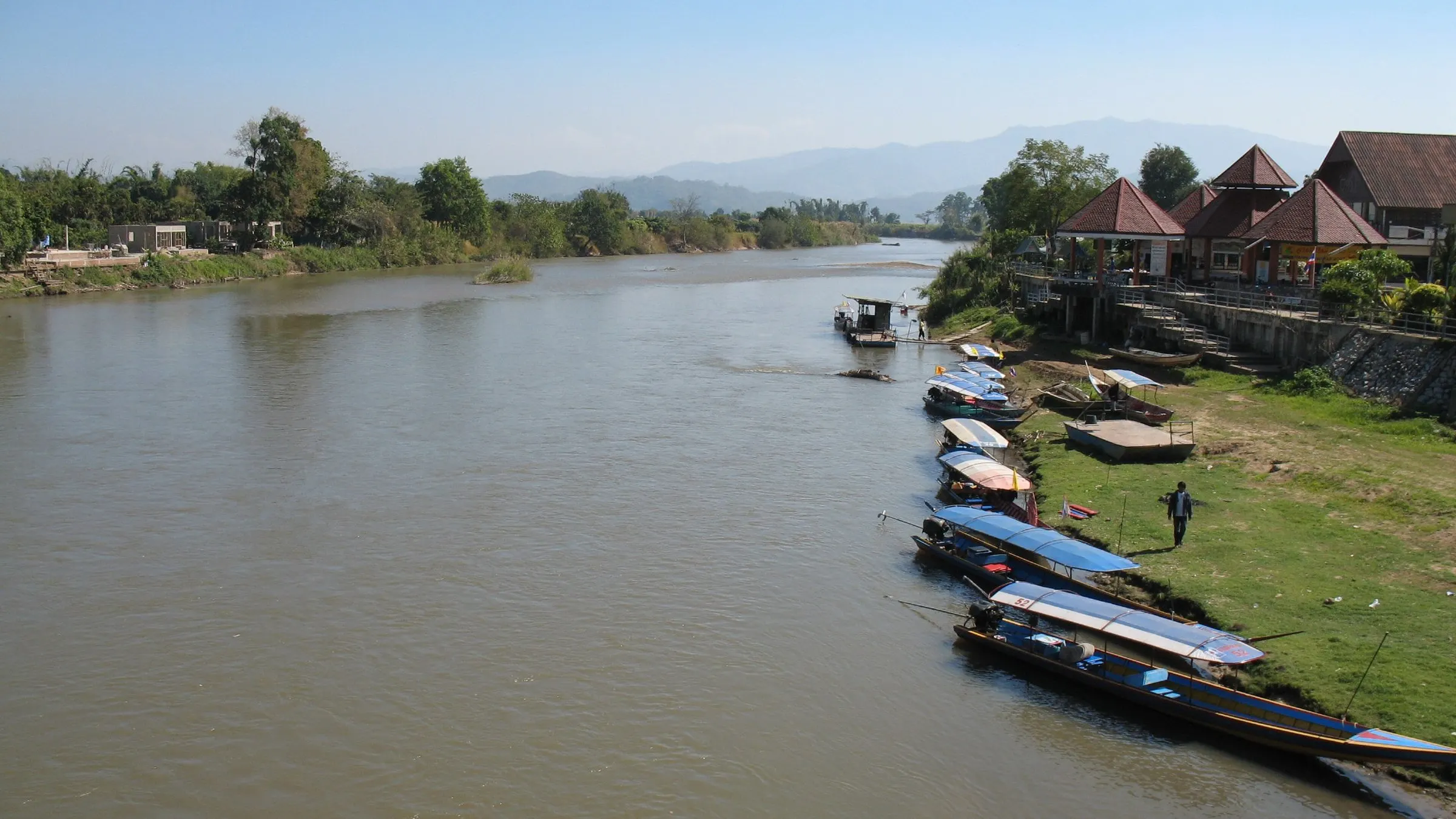
Rest of World reports that contamination has reached Thailand through rivers that rise in Shan State 4. Thailand’s Pollution Control Department said in March 2026 that arsenic exceeds standards in parts of the Kok, Sai and Mekong rivers, while its Public Health Ministry said residents tested had arsenic levels within accepted limits 15. “I think companies are consistently using Myanmar as a sacrifice zone,” said Ben Hardman of EarthRights International 4.
Where things stand
The KIO says it is tightening rules 1617. In January 2026 its spokesperson, Colonel Naw Bu, said new mining sites and companies were not yet allowed, though sources on the ground said existing companies were still clearing new land 16. In August 2026 it issued a 14-point framework for Chinese miners around Pangwa requiring land restoration and the prevention of toxic runoff, and banning abuse and wage theft 17. Villagers in Jeitlwal and Sheezaw reported that mining representatives offered payments for letters of support 17.
In May 2026 the military launched offensives aimed partly at retaking the rare-earth belt, Reuters reported 18. Washington has heard pitches too: Reuters reported in July 2025 that the Trump administration had received proposals to access Myanmar’s rare earths, including working directly with the KIA, though nothing had been decided 19. Myanmar’s heavy rare earths are almost all still sent to China for processing 1.
Why it matters
Reuters reports that nearly half of the world’s heavy rare earth supply comes from Kachin mines, and nearly all of it is processed in China 81. Control of Pangwa therefore affects supply chains for magnets used in electric vehicles and wind turbines 28. Researchers say the costs fall on mine workers and downstream communities in Myanmar and Thailand 515. The SOC ACE authors say governments and companies seeking to reduce dependence on China “should not assume that diversification automatically produces more ethical or resilient sourcing” 5.
The documents
-
Global Witness: Fuelling the future, poisoning the presentMay 2024. Satellite, trade and water-sampling investigation of Kachin mining.Open (Global Witness: Fuelling the future, poisoning the present)
-
SOC ACE Research Paper 48: Contested Rare Earth FrontiersOctober 2026. KIO/KIA takeover, pp.21-22; harms, pp.25-26; China's border pressure, pp.29-30.Read (SOC ACE Research Paper 48: Contested Rare Earth Frontiers)
-
ISP-Myanmar: Political & Conflict Economy Tracker No. 3November 2025. Chinese customs figures for January-September 2025.Open (ISP-Myanmar: Political & Conflict Economy Tracker No. 3)
-
Shan Human Rights Foundation: forced labour at Shan rare earth minesMay 2026. Survivor testimony; allegations unverified.Open (Shan Human Rights Foundation: forced labour at Shan rare earth mines)
The KIO told Global Witness in 2024 that it had “strict rules” for rare earth companies, saying “in order not to harm the environment, KIO have regulated strict rules” 2. In January 2026 KIO spokesperson Colonel Naw Bu said: “We have negotiated and reached agreements with companies to reduce harm to the ecosystem” 16. In August 2026 he acknowledged possible enforcement gaps and urged residents to report violations 17. Responding to the military’s 2026 offensive, KIA spokesperson Naw Bu told Reuters: “We will welcome them with the barrels of our guns.” 18
China’s foreign ministry told Reuters in March 2025 it was not aware of the specifics of the situation in the mining belt and that China would “actively promote peace talks and provide all possible support and assistance for the peace process in northern Myanmar” 6. In July 2025 a spokesperson said an early ceasefire and peace talks between the military and the KIA “are in the common interests of China and Myanmar as well as their people” 8. Asked about mines in Shan State, the ministry said Chinese firms abroad must “abide by local laws and regulations and actively fulfill their social responsibilities” 11.
The junta’s spokesperson’s office told Reuters in July 2025 that “China may have been exerted pressure and offered incentives to the KIA” 8. The military did not respond to Reuters’ requests for comment in March and June 2025 611. At a cabinet meeting on 28 October 2026, Min Aung Hlaing complained that traders using unauthorised border routes were paying armed groups fighting his forces, Asia Times reported 1.
The UWSA did not respond to Reuters’ requests for comment 11. The SHRF report does not include responses from the companies, the UWSA or the junta 12. The Tengchong Rare Earth Association told SOC ACE researchers that all mining companies followed environmental regulations; the researchers said they found no evidence of this in practice 5. Global Witness said state-owned REGCC told it it would form a team to investigate, and JL Mag denied sourcing heavy rare earths from Myanmar 2.
How we reported this
This investigation is a review of public records and published research: Global Witness’s 2024 investigation, an October 2026 SOC ACE research paper by the University of Manchester, SOAS and the Kachinland Research Centre, ISP-Myanmar’s customs analysis, a Shan Human Rights Foundation testimony report, Thai official statements reported by The Straits Times, and reporting by Reuters, Radio Free Asia, Burma News International, Yale Environment 360, Rest of World and Asia Times. Export figures are Chinese customs data as reported by those organisations and are attributed; they cover different product categories and periods and are not directly comparable. Allegations of forced labour and of a Chinese ultimatum are attributed and unverified. We could not open reporting by The Irrawaddy, Frontier Myanmar or Foreign Policy, so we excluded claims that rested only on them, including an exact date for the capture of Pangwa, a reported landslide toll of about 50, September 2026 import figures and a UWSA denial we could see only in a search summary. We did not visit the mining areas.
Sources and references
- ArticleAsia Times, “Myanmar’s rare earth pitch to US risks China’s wrath”, 11 November 2026. Link
- ReportGlobal Witness, “Fuelling the future, poisoning the present: Myanmar’s rare earth boom”, 23 May 2024. Link
- ReportGlobal Witness, “New investigation reveals the alarming expansion of heavy rare earth mining in Myanmar”, 23 May 2024. Link
- ArticleRest of World (originally Grist; Pulitzer Center), “The hidden cost of Myanmar’s rare earth mines”, 23 July 2026. Link
- ReportSOC ACE, University of Birmingham (Meehan, Dan Seng Lawn, Xu Peng, Goodhand), “Contested Rare Earth Frontiers in the Myanmar-China Borderlands (SOC ACE Research Paper 48)”, October 2026. Link
- ArticleReuters (via Yahoo News), “Myanmar rebels disrupt China rare earth trade, sparking regional scramble”, 28 March 2025. Link
- ArticleRadio Free Asia, “Myanmar’s Kachin rebels stop rare earth exports to China”, 14 November 2024. Link
- ArticleReuters (via The Kathmandu Post), “Why China’s dispute with Myanmar rebels threatens global supply of heavy rare earths”, 8 July 2025. Link
- ReportISP-Myanmar, “Myanmar Exported USD 620M Worth of Rare Earths to China in 2025 (Political & Conflict Economy Tracker No. 3)”, 27 November 2025. Link
- ReportShanghai Metals Market (SMM), “China’s Rare Earth ore Imports Show Mixed Trends in H1 2026 [SMM Analysis]”, 22 June 2026. Link
- ArticleReuters (via Profit/Pakistan Today), “China-backed militia secures control of new rare earth mines in Myanmar”, 12 June 2025. Link
- ReportShan Human Rights Foundation, “Chinese rare earth mines in eastern Shan State using trafficked Burmese scammers as slave labour”, 18 May 2026. Link
- ArticleBurma News International / Karen Information Center, “Myanmar citizens reportedly trafficked, enslaved at Shan-China border”, 20 May 2026. Link
- ArticleYale Environment 360, “Myanmar rare earth mining (feature)”, 20 November 2025. Link
- ArticleThe Straits Times/ANN (via The Star), “Toxic tide: Myanmar’s rare earth mining surge hurting livelihoods along Thailand’s Kok River”, 12 April 2026. Link
- ArticleBurma News International / Kachin News Group, “KIO to prioritise environmental safeguards in rare earth mining”, 28 January 2026. Link
- ArticleBurma News International / Myitkyina Journal, “KIO Imposes 14-Point Environmental and Labor Rules on Chinese Rare-Earth Miners”, 26 August 2026. Link
- ArticleThe Nation/ANN, citing Reuters, “Myanmar junta pushes to retake rare-earth belt near China border”, 26 May 2026. Link
- ArticleReuters (via The Daily Star), “Trump team hears pitches on access to Myanmar’s rare earths”, 29 July 2025. Link
Sources and references are provided for transparency and further reading. Allegations and claims are attributed to their respective sources. Triple Frontiers distinguishes reported allegations from independently established facts.
Corrections and updates
The Frontier Brief
The week’s essential international reporting and new investigations, every Friday.