After Assad: what happened to Syria’s Captagon trade
Western governments accused Bashar al-Assad's relatives and associates of running an amphetamine trade worth billions of dollars. Since his fall, Syria says it has shut the factories and seized hundreds of millions of pills. The UN says supply has tightened, but trafficking continues, and the Assad cousin tried in Damascus was acquitted of drug charges.
Key findings
- Estimates of the Assad-era Captagon trade range from $3bn-5bn a year (Germany) to about $10bn (New Lines); Britain cited experts’ estimate of up to $57bn. Disputed
- The US, UK and EU sanctioned Assad cousins Samer Kamal and Wassim al-Assad and others over the trade; the US kept 11 Captagon designations after lifting wider Syria sanctions in 2025. Alleged
- Syria says it seized 697 million pills and closed 17 production facilities between December 2024 and June 2026; UNODC verified at least 177 million tablets seized regionally to late 2025. Alleged
- UNODC found no verified evidence that production moved to Africa; New Lines says it is spreading to fragile states such as Sudan and Yemen. Disputed
- Wassim al-Assad was sentenced to death in August 2026 for murders classed as war crimes, but acquitted of drug trafficking. He can appeal. Confirmed
Confirmedbacked by documents or on-record sourcesAllegedclaimed by sources, not provenDisputedcontested by the parties involved
On 8 December 2024, the day Bashar al-Assad’s government fell, Ahmad al-Sharaa, then leader of the rebel group Hayat Tahrir al-Sham (HTS), said Syria had become “the largest Captagon factory in the world” 1. Within days, fighters and reporters were walking through sites where the amphetamine pills had been made or stored: a former snack-chip factory in Douma, outside Damascus, a car-trading company in Latakia and the Mazzeh air base in the capital 12.
Triple Frontiers reviewed US, British and EU sanctions, research by the UN Office on Drugs and Crime (UNODC) and the New Lines Institute, official seizure announcements from six countries and a trial monitor’s record of a Damascus judgment to establish what has happened to the trade since.
How big was the trade?
No one has measured it directly, and estimates vary widely. When Britain and the US imposed coordinated sanctions in March 2023, the British government said 80% of the world’s Captagon was produced in Syria and cited independent experts’ estimate that the trade “could be worth up to $57 billion” 3. The US Treasury described it as “a billion-dollar illicit enterprise” 4. Germany’s foreign ministry put its annual value at $3 billion to $5 billion 5. Caroline Rose, who directs the New Lines Institute’s Captagon project, told the Associated Press in December 2024 that the global trade was worth about $10 billion a year and the Assad family’s annual profit about $2.4 billion 1.
UNODC says that between January 2019 and November 2025, 80% of Captagon seizures reported across the region named Syria as the country of origin 6. A New Lines briefing in May 2024 found that seizures had peaked in 2021 and that smuggling was moving from sea to land routes 7.
Who was sanctioned
Sanctions are administrative decisions by governments, not criminal verdicts. The people named below have not been convicted of the allegations made in their designations, except where stated.
On 28 March 2023 the US Treasury, acting with Britain, designated people it accused of supporting the Assad government and the Captagon trade 4. They included two of Bashar al-Assad’s cousins: Samer Kamal al-Assad, whom it accused of overseeing Captagon factories in Latakia in coordination with the army’s Fourth Division and associates of Hizballah, and Wassim Badi al-Assad, whom it described as a figure in regional drug smuggling 4. The Treasury said 84 million pills made at a factory owned by Samer, worth an estimated $1.2 billion, had been seized at the Italian port of Salerno in 2020 4. It also named Khalid Qaddour, a businessman it tied to Maher al-Assad, the president’s brother; Imad Abu Zureik, a militia leader; and two Lebanese men, Hassan Muhammad Daqqou, known as “The King of Captagon”, and Noah Zaitar, for alleged support of Hizballah 4. Britain sanctioned 11 people the same day, among them both cousins, Daqqou and Zaiter 3.
The EU followed on 24 April 2023, listing 25 people and eight entities 85. The reasons given for 12 of those people refer to Captagon, and the EU also listed the army’s Fourth Armoured Division, which it said was led by Maher al-Assad and profited from the war economy, “especially the trafficking in Captagon” 8. Each entry states that the trade “has become a regime-led business model, enriching the inner circle of the regime and forming its lifeline” 8.
Washington added names in 2024, including Taher al-Kayali, whose company it said had bought the cargo ship Noka, intercepted by Greece in 2018, and the Lebanon-based Khaldoun Hamieh, whom it accused of controlling Captagon laboratories in Sayyida Zainab 910. When the US ended its wider Syria sanctions programme on 30 June 2025, it kept sanctions on “captagon traffickers” and redesignated 11 individuals for Captagon-related activity, among them Samer Kamal al-Assad, Wassim al-Assad and Khalid Qaddour 11.
What the new authorities found
At a warehouse outside Damascus in December 2024, Agence France-Presse reporters found pills packed into household voltage stabilisers for export 2. “After we entered and did a sweep, and we found that this is a factory for Maher al-Assad and his partner Amer Khiti,” a fighter told them 2. That claim was not independently verified 2. At the Mazzeh air base, AFP found a bonfire of pills 2. The original owner of the Douma factory told the AP: “They came at night and lit the drugs on fire but couldn’t burn everything.” 1
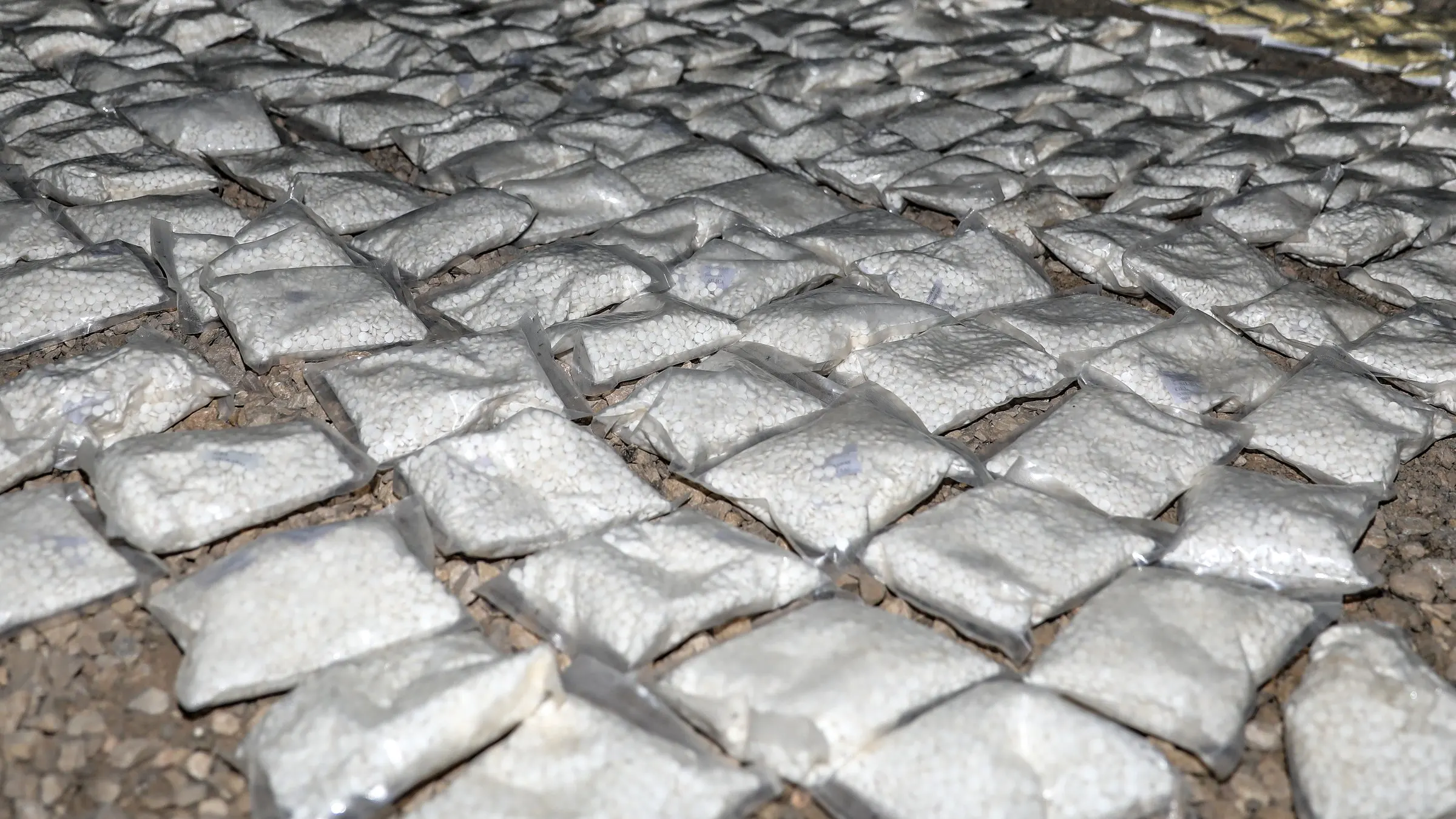
The new government announced in June 2025 that “all production facilities” had been shut down, although raids continued after that 12. Syrian authorities told UNODC they had dismantled 15 industrial-scale laboratories and 13 smaller storage facilities by late 2025 136; the World Drug Report in June 2026 gave updated figures of 16 laboratories and 15 storage sites 14. According to official figures published by the state news agency SANA, the authorities seized 697 million Captagon pills between 8 December 2024 and 26 June 2026, dismantled 90 trafficking networks and closed 17 production facilities and 20 warehouses in 1,550 operations 1516.
Those totals have not been independently audited. UNODC could verify a minimum of 177 million tablets, about 30 tonnes, intercepted across the Arab region from December 2024 to late 2025, and said the true figure was “likely to be significantly higher” 6. Syria alone reported seizing more than 500 million tablets in that period 6.
How it unfolded
-
Beirut court jails Hassan Daqqou for seven years.
-
Key moment. US and UK sanction Assad cousins and others over Captagon.
-
EU lists 25 people and eight entities, including the Fourth Armoured Division.
-
US adds Khaldoun Hamieh and others.
-
Key moment. Assad government falls; Captagon sites uncovered.
-
Lebanese army seizes about 50 million pills in the Bekaa.
-
Wassim al-Assad arrested near the Lebanese border.
-
US ends Syria sanctions programme but keeps Captagon designations.
-
Lebanese army seizes about 64 million pills at Bouday.
-
Key moment. UNODC: large-scale manufacturing in Syria disrupted.
-
Dubai and Kuwait seize more than 14 million pills.
-
Key moment. Wassim al-Assad sentenced to death; acquitted of drug charges.
-
Syria says it seized 697 million pills up to June 2026.
Seizures across the region
Jordan reports more frequent smuggling attempts with smaller consignments 6. Its armed forces said they thwarted 536 infiltration and smuggling attempts in 2025, seizing 18,938,266 pills of various drugs and shooting down 89 drones, and foiled 156 attempts in the first quarter of 2026, seizing 9,202,872 Captagon pills 17. On 3 May 2026 Jordan’s air force struck sites inside Syria in what its army called a “deterrence operation”; reports cited by Arab News described it as Jordan’s fifth strike in Syria since December 2024 18.
In Lebanon, the army seized about 50 million pills at a facility in Al Yammouna, in the Bekaa valley, on 8 January 2025 19. On 17 September 2025 it seized about 64 million pills and 79 barrels of chemicals at Bouday, near Baalbek, calling it “one of the largest drug quantities ever recorded on Lebanese soil” 2012. Lebanon reported seizing 78 million tablets between December 2024 and November 2025, more than in 2023 and 2024 combined 6.
Iraq’s interior ministry announced on 16 March 2025 that it had seized about 1.1 tonnes of Captagon in a lorry that entered from Syria through Turkey, after information from Saudi Arabia’s drug enforcement agency 21. Syria counts 28 joint operations with Iraq, 13 with Jordan, nine with Turkey and five with Saudi Arabia up to June 2026 15. In April 2026 a joint Syrian-Iraqi operation seized about one million pills and led to four arrests, according to SANA 22.
Gulf countries remain the main market, according to UNODC 13. Saudi authorities seized 11,108,998 amphetamine pills hidden in a food shipment at Dammam port in February 2025 and arrested two men 23. In January 2026 customs officers found 4,793,000 pills in bags declared as charcoal at Jeddah port, and the intended recipient was arrested 24. In February 2026 Dubai Police, working with Kuwaiti counterparts, seized 14,062,500 Captagon pills weighing 2,250kg, hidden in sacks of corn in five containers, and arrested three men 2526.
Has production moved?
UNODC’s December 2025 brief said manufacturing seen in the past outside Syria was “likely continuing in the Middle East”, particularly in neighbouring countries, and that some small-scale manufacturing might still occur inside Syria 136. Despite speculation that production had moved to Africa, it found “no verified evidence” of Captagon manufacturing there 6.
Karam Shaar of the New Lines Institute reached a different conclusion in October 2025, writing that Captagon production “over the past four years has been spreading well beyond its traditional zone” and was increasingly shifting towards fragile states such as Sudan and Yemen 27. He cited Yemeni seizures rising from 400,000 pills in 2024 to 5.4 million in the first nine months of 2025 27. “Border enforcement can disrupt shipments, but it cannot dismantle the ecosystem behind it,” Benjamin Feve, an analyst at Karam Shaar Advisory, told Arab News in May 2026 18.
Both UNODC and New Lines report that supply has tightened. UNODC found signs of shortages in several destination markets, higher prices in some Gulf states and in Syria’s neighbours, and lower purity 6. In Lebanon, the price of a tablet rose from $2-3 to $5-7 14. Ms Rose told Arab News that “the reduction in supply has increased the profitability of Captagon, with pills now priced higher” 18. UNODC says traffickers are turning to methamphetamine 14. Monica Juma, its executive director, said in June 2026: “The lesson is clear: when one door closes, organized crime looks to another to open.” 28
In court
In Lebanon, a Beirut court sentenced Hassan Daqqou in December 2022 to seven years’ hard labour for manufacturing Captagon and smuggling it abroad, and sentenced 25 others in absentia 29. According to court documents seen by AFP, he denied any role in drug trafficking and said he had worked with the Syrian military 29.
In Syria, security forces arrested Wassim al-Assad near the Lebanese border on 21 June 2025 30. His trial before the Fourth Criminal Court in Damascus opened on 24 June 2026 31. On 18 August 2026 the court sentenced him to death for multiple murders, which it classed as crimes against humanity and war crimes, and for other offences including torture 3233. It acquitted him of drug trafficking and smuggling for lack of sufficient evidence, finding that no narcotics had been seized and that a photograph of him with a known trafficker was not legal proof 3233. The court said the drug charge could be reopened if new evidence emerged, and the judgment can be appealed to the Court of Cassation 3233.
The previous week a Syrian court had sentenced Bashar al-Assad to death in absentia, and Maher al-Assad was among six former officials also sentenced in absentia; AFP reported those rulings in connection with atrocities during the civil war 33.
Where things stand
Syria’s government now describes itself as an “active partner” against the drug trade 16, and its neighbours continue to report seizures 1722. The US still sanctions those it accuses of running the trade under Assad 11. But Wassim al-Assad, one of the two cousins at the centre of the 2023 sanctions, was acquitted of the drug charges when he was tried 433.
Why it matters
Western governments described Captagon as a financial lifeline for Mr Assad’s government 38. Since December 2024 Syria has turned from a sanctions target into a partner in joint operations with Iraq, Jordan, Turkey and Saudi Arabia 15. Yet UNODC’s data point to stockpiles, new routes and a shift to methamphetamine 614, which suggests the problem has changed shape rather than ended.
The documents
-
UK government: sanctions on the Captagon trade28 March 2023. Eleven designations and the $57bn estimate.Open (UK government: sanctions on the Captagon trade)
-
US Treasury: Syrian and Lebanese Captagon designations28 March 2023. Samer Kamal and Wassim Badi al-Assad, Daqqou, Zaitar and others.Open (US Treasury: Syrian and Lebanese Captagon designations)
-
EU Council Implementing Regulation 2023/84424 April 2023. Listing reasons for 25 people and eight entities.Read (EU Council Implementing Regulation 2023/844)
-
US Treasury: termination of Syria sanctions30 June 2025. Annex 4 lists 11 Captagon-related redesignations.Open (US Treasury: termination of Syria sanctions)
-
UNODC research brief on synthetic drugs in Arab countriesDecember 2025. Seven pages: lab closures, seizures, relocation, prices.Read (UNODC research brief on synthetic drugs in Arab countries)
-
UNODC World Drug Report 2026: special points of interestJune 2026. Captagon and methamphetamine on page 16.Read (UNODC World Drug Report 2026: special points of interest)
-
New Lines Institute: Captagon production proliferationOctober 2025. Evidence that production is spreading.Open (New Lines Institute: Captagon production proliferation)
-
SJAC: the judgment in the Wasim al-Assad trialUnofficial summary of the 18 August 2026 ruling, including the drug acquittal.Read (SJAC: the judgment in the Wasim al-Assad trial)
The Assad government denied producing or marketing Captagon; after the EU listings its foreign ministry said “The European Union is repeating its lies” and called the sanctions “unilateral and illegitimate” 34. Hezbollah’s then leader, Hassan Nasrallah, said in May 2023: “These are baseless lies. For us Captagon and other types of drugs are religiously prohibited.” 35 Hassan Daqqou denied involvement in drug trafficking, according to court documents seen by AFP 29. Wassim al-Assad was acquitted of the drug charges; the trial monitor’s summary of the judgment records no statement from him or his court-appointed lawyer 32. Triple Frontiers found no published response from Samer Kamal al-Assad, Maher al-Assad, Khalid Qaddour or Amer Khiti to the allegations in the sanctions designations. Triple Frontiers did not contact those named directly; their positions are taken from published statements and court records.
How we reported this
This investigation is a review of public records: US, UK and EU sanctions documents, UNODC research, New Lines Institute reports, official seizure announcements and an independent trial monitor’s summary of the Damascus judgment. Estimates of the trade’s value are attributed to their authors and are not audited figures. Seizure totals are official claims; where UNODC verified a lower minimum, both figures are given. Sanctions designations are allegations, not findings of guilt. We excluded claims we could not trace to a source we opened, including some 2026 seizure tallies, reports of a Captagon factory in Kuwait, a reported 630% rise in Syrian seizures and conflicting reports that Wassim al-Assad was convicted on drug charges.
Sources and references
- ArticleAssociated Press (via KTLA), “What has Assad’s fall revealed about the Captagon drug trade in Syria? (Sally Abou Aljoud, AP)”. Link
- ArticleAl-Monitor / AFP, “Syria’s rebel victors expose ousted government’s drug trade”, 12 December 2024. Link
- Official documentUK Foreign, Commonwealth & Development Office, “Tackling the illicit drug trade fuelling Assad’s war machine”, 28 March 2023. Link
- Official documentUS Department of the Treasury, “Treasury Sanctions Syrian Regime and Lebanese Actors Involved in Illicit Drug Production and Trafficking”, 28 March 2023. Link
- Official documentGerman Federal Foreign Office, “New EU package of sanctions against Syria targets drug trafficking and the most serious human rights violations”, 26 April 2023. Link
- ReportUNODC / Naif Arab University for Security Sciences, “The Evolution of the Synthetic Drug Market in the Arab Countries post-December 2024 (research brief)”, 22 December 2025. Link
- ReportNew Lines Institute (Caroline Rose, Karam Shaar), “From 2015-2023: The Captagon Trade’s Trends, Trajectory, and Policy Implications”, 30 May 2024. Link
- Official documentCouncil of the European Union (Official Journal L 109I), “Council Implementing Regulation (EU) 2023/844 of 24 April 2023 implementing Regulation (EU) No 36/2012 concerning restrictive measures in view of the situation in Syria”, 24 April 2023. Link
- Official documentUS Department of the Treasury, “Treasury Sanctions Financial Facilitators and Illicit Drug Traffickers Supporting the Syrian Regime”, 26 March 2024. Link
- Official documentUS Department of the Treasury, “Treasury Targets Hizballah Finance Network and Syrian Captagon Trafficking”, 16 October 2024. Link
- Official documentUS Department of the Treasury, “Treasury Implements President’s Termination of Syria Sanctions”, 30 June 2025. Link
- ArticleThe National, “Lebanon takes down 64 million Captagon pills in one of biggest drugs busts yet”, 17 September 2025. Link
- ReportUNODC, “Illicit ‘captagon’ manufacturing disrupted following regime change in Syria, says new UNODC research brief”, 22 December 2025. Link
- ReportUNODC, “World Drug Report 2026: Special Points of Interest”, 26 June 2026. Link
- ArticleArab News, “Syria seizes nearly 700m captagon pills since Assad regime fell”, 16 September 2026. Link
- ArticleThe National, “Syrian authorities foil plots to smuggle 700,000 Captagon pills from Lebanon”, 24 July 2026. Link
- Official documentPetra (Jordan News Agency), “JAF foiling hundreds of smuggling, infiltration attempts along borders”, 7 May 2026. Link
- ArticleArab News, “How Jordan, Syria are closing in on multibillion-dollar Captagon network”, 21 May 2026. Link
- Official documentLebanese Army, “Raids on Drug Manufacturing and Storage Facility in Al Yammouna – Bekaa”, 8 January 2025. Link
- Official documentLebanese Army, “Lebanese Army statement on Bouday-Baalbek drug seizure”, 17 September 2025. Link
- ArticleThe National, “Iraq confiscates 1.1 tonnes of Captagon pills shipped from Syria”, 16 March 2025. Link
- Official documentSANA (Syrian Arab News Agency), “Joint Syrian-Iraqi operations seize 1 million Captagon pills”, 8 April 2026. Link
- ArticleArab News, “Saudi counter-narcotics authority seizes 11 million amphetamine pills in Dammam”, 5 February 2025. Link
- Official documentZakat, Tax and Customs Authority (Saudi Arabia), “ZATCA foils attempt to smuggle 4.7 million Captagon pills through Jeddah Islamic Port”, 9 January 2026. Link
- ArticleThe National, “Dubai Police seizes more than 14 million Captagon pills in operation with Kuwaiti counterparts”, 13 February 2026. Link
- ArticleGulf News, “Over 14 million Captagon pills seized in joint UAE-Kuwait operation”, 13 February 2026. Link
- ReportNew Lines Institute (Karam Shaar), “Captagon Production Proliferation in the Middle East: Transformations, Challenges and Policy Responses”, 29 October 2025. Link
- ReportUNODC, “Launch of the 2026 World Drug Report (remarks by Monica Juma)”, 26 June 2026. Link
- ArticleGulf News / AFP, “Lebanon’s ‘Captagon King’ sentenced to 7 years in jail”, 9 December 2022. Link
- ArticleRudaw, “Syrian security forces detain Wassim al-Assad”, 21 June 2025. Link
- ArticleAl-Monitor, “Syria opens trial of Wassim al-Assad, cousin of ousted president: What we know”, 24 June 2026. Link
- Court documentSyria Justice and Accountability Centre, “Inside the Trial of Wasim al-Assad #6: The judgment must go down”, 3 September 2026. Link
- ArticleJusticeInfo.net / AFP, “Syria sentences detained Assad cousin to death”, 18 August 2026. Link
- ArticleVoice of America / Associated Press, “Syria condemns EU sanctions over amphetamine business”, 25 April 2023. Link
- ArticleVoice of America / Associated Press, “Hezbollah leader denies reports linking group to Syria drug dealer”, 12 May 2023. Link
Sources and references are provided for transparency and further reading. Allegations and claims are attributed to their respective sources. Triple Frontiers distinguishes reported allegations from independently established facts.
Corrections and updates
The Frontier Brief
The week’s essential international reporting and new investigations, every Friday.